think we’re still telling ourselves too small a story about what’s happening with AI.
Right now, almost every conversation is about AI agents. People are excited about tools that can answer emails, summarize meetings, write reports, handle customer support, and take care of all the digital tasks that usually drain time and attention. And to be fair, that excitement makes sense. These tools are useful. They save effort. They make work feel lighter. For a lot of people, they already feel like a real shift.
But I keep coming back to the same thought: this is only part of the story, and maybe not even the biggest part.
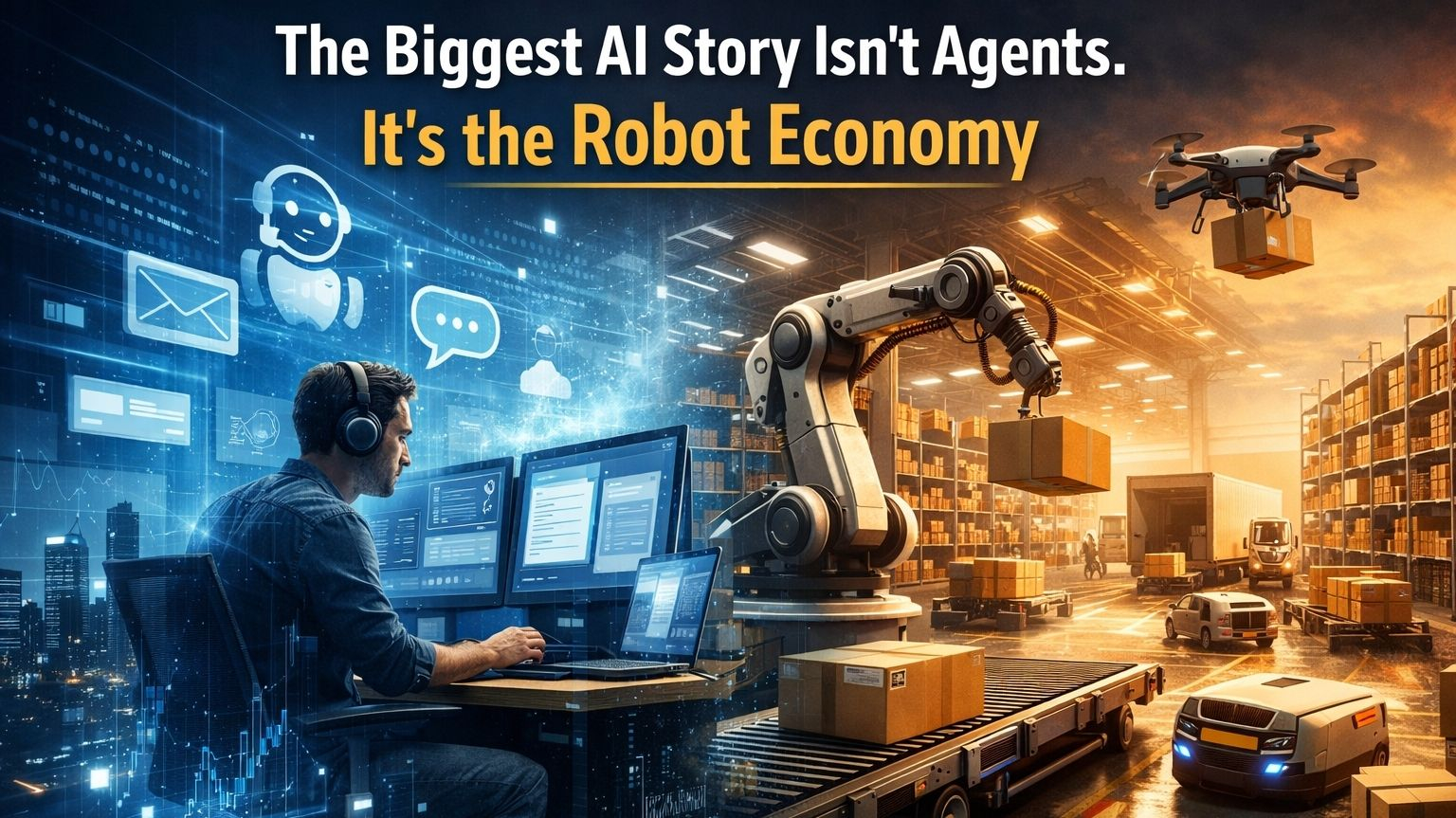
AI agents mostly live inside screens. They work with information. They read, write, organize, recommend, and respond. That matters, especially in a world where so much of our work has become digital. But the economy itself is not purely digital. It still runs on things that have to be physically made, moved, stored, packed, sorted, delivered, and repaired. It runs through warehouses, supply chains, trucks, factories, stores, and fulfillment centers. It runs through the physical world.
That’s why I think the idea of a “Robot Economy” is much bigger than the current obsession with AI agents.
A software agent can help a retailer predict demand. It can answer a customer asking where their order is. It can summarize operations data for a manager. But it cannot, on its own, pick an item off a shelf, move it through a warehouse, pack it, and get it out the door faster. It cannot reduce the physical friction that makes commerce expensive and messy. And that friction is where a huge amount of economic value is won or lost.
That’s what makes this next phase so important.
When intelligence starts moving beyond software and into physical systems, the impact becomes much deeper. We’re no longer just talking about making office work more efficient. We’re talking about changing how real work gets done in the real world. We’re talking about fulfillment, logistics, manufacturing, delivery, storage, and industrial operations becoming more automated, more precise, and more scalable.
To me, that’s a much bigger shift than another digital assistant sitting in a browser tab.
That’s also why companies like Fabric feel important. Not just because they use AI, but because they sit at the point where software meets physical execution. That is a different category of value. Software alone can advise. Physical automation can act. And once systems can act in the real world, they start changing cost structures, labor needs, service speeds, margins, and customer expectations. That is when technology stops being a nice productivity layer and starts becoming infrastructure.
I think a lot of people miss this because digital tools are easier to notice. You can see an AI agent write an email in seconds and immediately feel impressed. Physical-world automation is harder to package into a flashy demo. It is slower, messier, and less visible to most people. But that doesn’t make it less important. In many ways, it makes it more important. The technologies that reshape economies are often not the ones that feel the most magical in the moment. They are the ones that quietly change the systems underneath everyday life.
Another reason I think the robot economy matters more is because it creates stronger moats. Software features get copied quickly. One company launches a new AI workflow, and soon several others offer something similar. The advantage doesn’t always last. But physical automation is much harder to replicate. It depends on hardware, infrastructure, deployment, integration, maintenance, logistics, and operational trust. It is not just about writing code. It is about making systems work reliably in the real world, under pressure, at scale.
That kind of capability is harder to build, but it is also harder to replace.
And the value it creates is more fundamental. Saving someone a few hours a week on digital admin is useful. But reducing fulfillment time, lowering warehouse costs, improving inventory movement, and making delivery faster can reshape an entire business. One improves workflows. The other changes economics.
That difference matters.
I also think this conversation is bigger than tech hype. AI agents mostly affect digital and white-collar work. The robot economy reaches further. It touches logistics, retail, manufacturing, food systems, healthcare supply chains, and infrastructure. It affects the parts of the economy that people rely on every day, even if they rarely see them. That makes it more than a software story. It becomes a story about how societies produce, move, and deliver value.
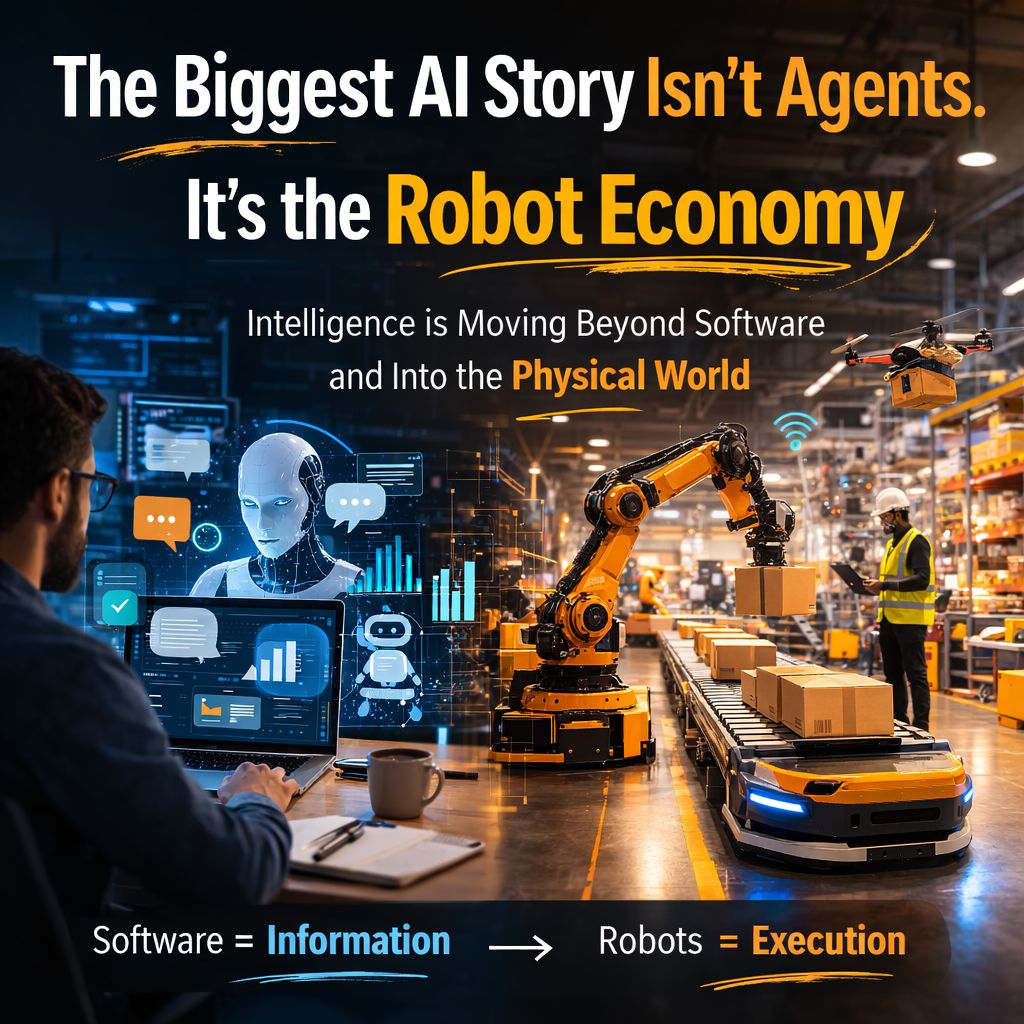
For me, the clearest way to put it is this: AI agents automate information, but the robot economy automates execution.
That’s why I believe the robot economy is the larger narrative. AI agents are important, but they are still mainly working in the layer of words, decisions, and digital tasks. The robot economy moves into the layer where goods are handled, orders are fulfilled, and the physical economy actually runs. One makes work easier. The other changes how the system itself operates.
And in the long run, I think that second shift will matter more.