
last weekend trying to explain blockchain to my uncle. He runs a small construction company. Buys materials, pays workers, bids on contracts. Normal stuff. He asked me why anyone would put business records on a public ledger where competitors could see everything.
I didn't have a good answer.
Most blockchain projects treat data like an afterthought. The focus stays on moving tokens around. Who sent what to whom. How many coins changed hands. That works fine for trading but falls apart when real businesses try to use the technology.
This is where @MidnightNetwork caught my attention a few months back. Someone mentioned it in a developer group I follow. They described a system that separates transaction verification from data exposure. I read their technical papers and came away with a different view of what blockchain could become.
The core problem with existing chains is visibility. Bitcoin and Ethereum show every transaction to everyone. That is by design. It builds trust through transparency. But transparency kills privacy. You cannot run a business or manage personal identity when every move you make gets recorded forever for public viewing.
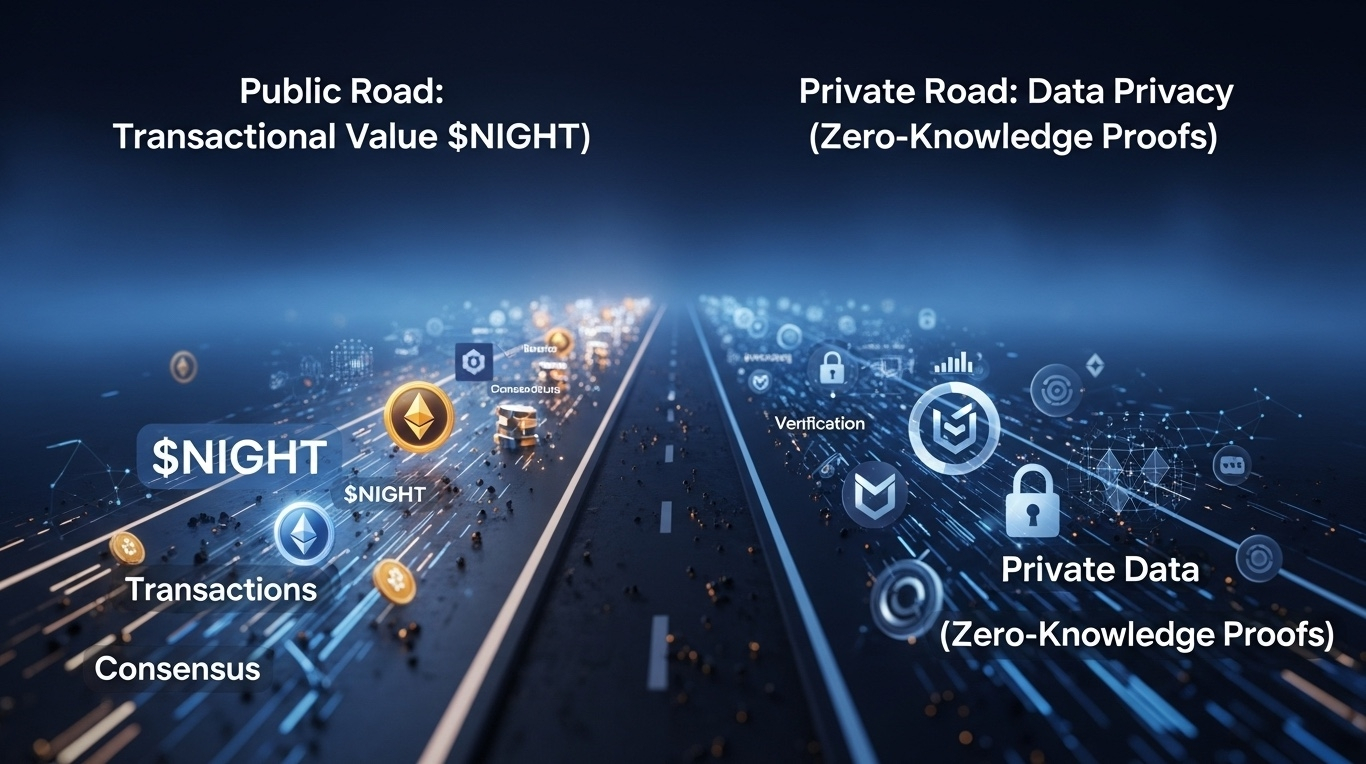
Midnight Network builds two roads instead of one. The public road handles token movement and network consensus. $NIGHT moves along this road. Transactions settle, nodes agree on the state of things, and the ledger stays visible to anyone who wants to look.
The second road handles actual data. Personal information, business records, identity credentials. This road uses cryptography to let the network verify facts without seeing the raw information. The verification happens. The data stays hidden.
I worked in banking compliance for seven years. We spent millions verifying customer identities, monitoring transactions, filing reports. Every piece of customer data we touched became a liability. Breach risk, audit requirements, storage costs. If a customer wanted privacy, we could not serve them. Regulations demanded we see everything.
Midnight Network's architecture offers a way out of this trap. A bank can verify that a customer's income meets loan requirements without ever seeing pay stubs or tax returns. A regulator can verify that transactions stay within legal limits without monitoring every purchase. The proof arrives. The underlying numbers never leave the customer's control.
The $NIGHT token makes this economy work. Verifying zero-knowledge proofs takes computing power. Nodes that perform this work earn tokens. Users who need verification spend tokens. Simple supply and demand sets the price for privacy.
I talked to a healthcare administrator last week about this. She manages patient records for a clinic network. Current law requires strict privacy protections but the tools available force tradeoffs. Secure systems are hard for patients to use. Easy systems leak data constantly. She told me about patients who avoid care entirely because they fear insurance companies or employers seeing their records.
With Midnight Network's selective disclosure model, a patient could prove they need a specific treatment without revealing their full medical history. The clinic verifies the necessity. The insurer confirms coverage. No unnecessary data changes hands. The patient maintains control.
The #night community forums discuss use cases beyond finance. Supply chain verification where suppliers prove origin without revealing proprietary sources. Voting systems where ballots count without linking votes to identities. Professional license where credentials verify without exposing personal details.
Each uses case shares the same style. Verification happens. Data stays private.
I spent years assuming privacy and transparency could not coexist on blockchain. One required sacrificing the other. Midnight Network convinced me otherwise by building both into the same system at the protocol level. @MidnightNetwork separates data from transactional value so users don't have to choose between participation and exposure. @MidnightNetwork #night $NIGHT
