
I needed to pace myself down to know what I actually think about Fabric Protocol.
A serious look at how verified identity and accountability may become the real foundation of large scale autonomous robotics.
The robotics and artificial intelligence sector inside crypto has become extremely crowded. New projects appear almost every week. Most promise a future machine economy powered by intelligent agents autonomous systems and decentralized infrastructure. The language is ambitious and the narratives are often impressive. Yet deeper analysis often reveals a common pattern. Many projects attach a token to an abstract concept and leave the rest of the development story undefined.
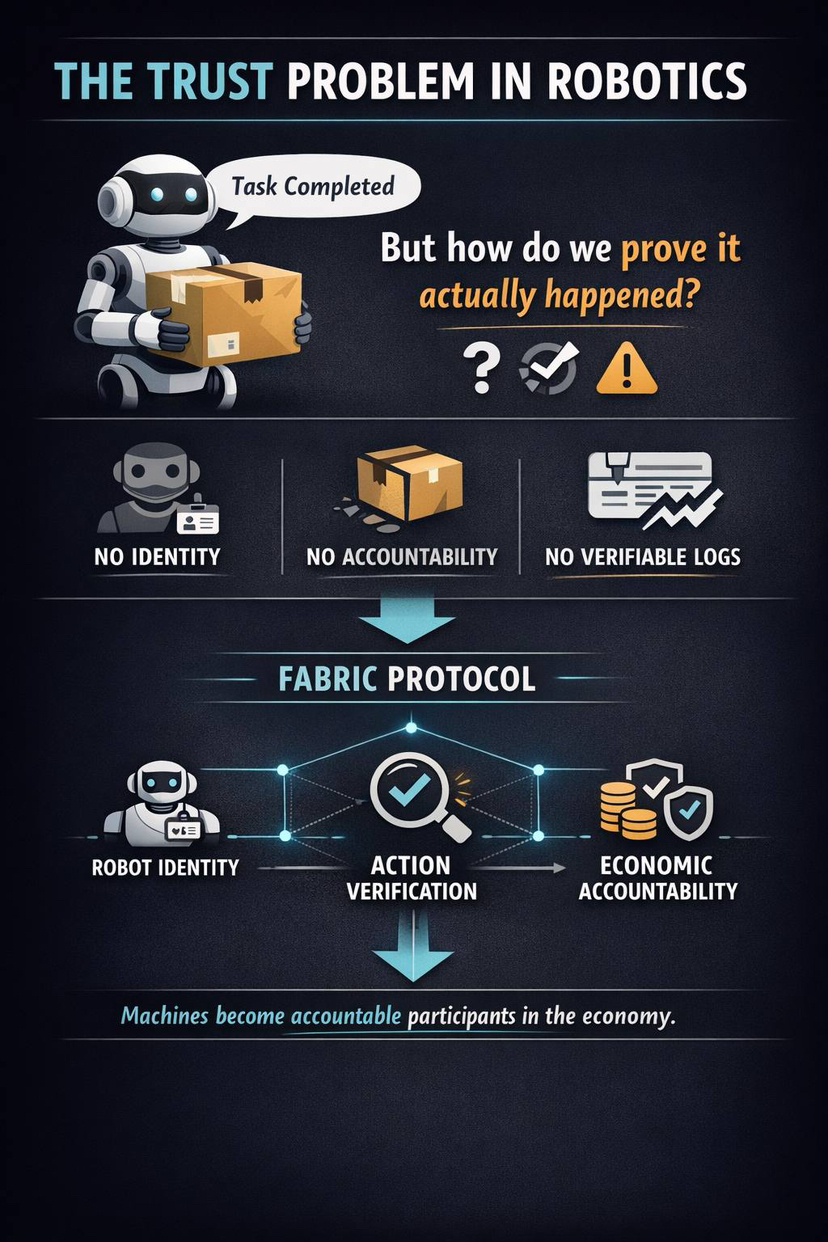
Within this environment Fabric Protocol connected to Fabric Foundation presents a noticeably different perspective. Instead of focusing on the usual race toward smarter robots Fabric concentrates on a structural challenge that receives far less attention. The issue is trust.
As autonomous machines begin moving beyond controlled industrial environments into cities hospitals warehouses and homes a new class of problems appears. These machines are no longer theoretical tools inside laboratories. Their actions now interact directly with the physical world. When a failure occurs the consequences can include lost goods damaged property or safety risks. At that moment a fundamental question emerges. Who is responsible.
Technology
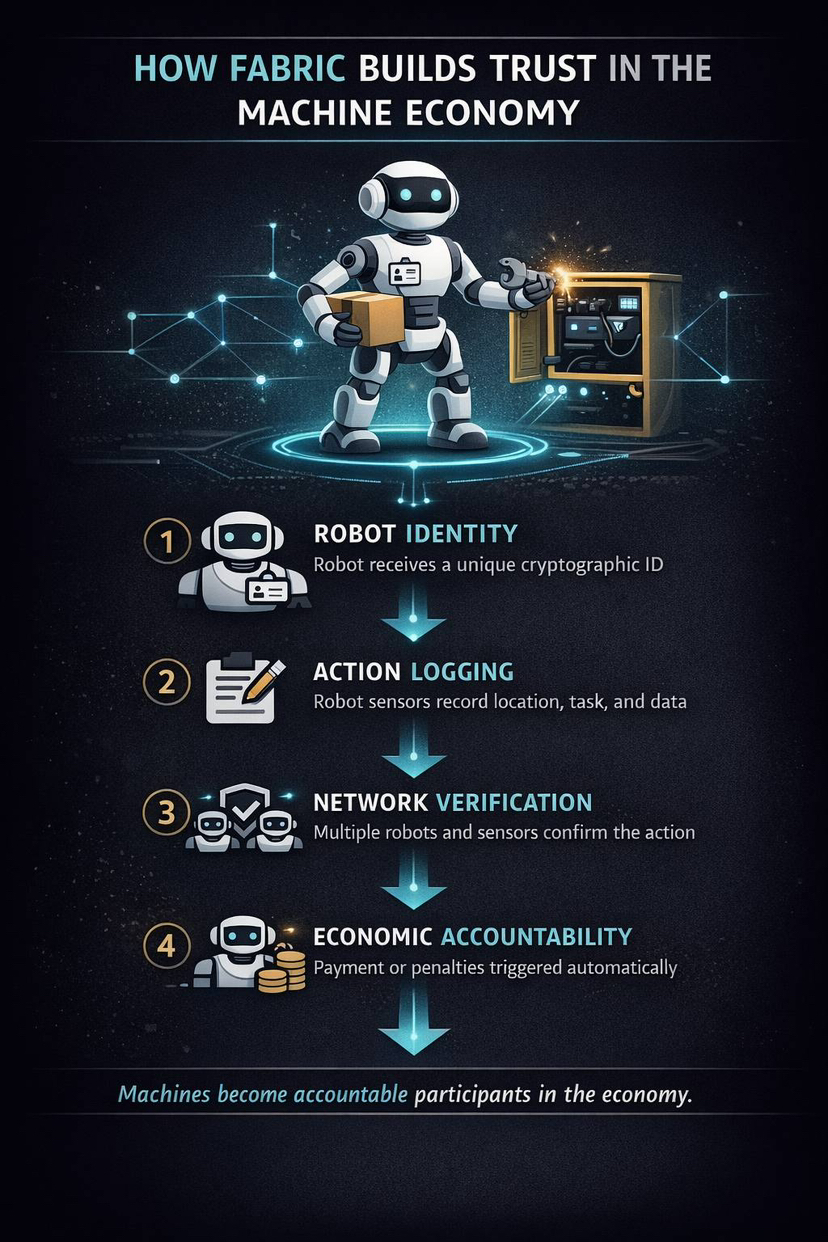
Fabric approaches this challenge by introducing a digital identity framework for machines. In the Fabric network each robot is assigned a verifiable identity. This identity links the machine to ownership operational history and environmental context. Instead of existing as anonymous hardware controlled behind corporate infrastructure each robot becomes a traceable participant inside a shared network.
The network records machine activity and verifies whether actions actually occurred. Sensor data can be secured through trusted hardware environments. Multiple robots and sensors can confirm shared events in a process similar to witness validation. Privacy preserving proof systems allow verification of outcomes without exposing sensitive operational data.
This design creates a structural shift in how machine actions are interpreted. Rather than relying on a robot claiming that a task was completed the network provides verifiable confirmation that the action occurred in reality.
Utility
Once machine activity becomes verifiable a new economic structure becomes possible. Robots can operate within a framework of accountability rather than pure trust. Operators may stake collateral behind the robots they deploy. Successful operations strengthen reputation and generate rewards. Failures or dishonest behavior can lead to economic penalties through the loss of collateral.
In practical terms this transforms robots from simple tools into accountable economic actors within the network. Their operational reliability becomes measurable. Reputation accumulates through performance history. Over time reliable machines gain economic value while unreliable ones face financial consequences.
This approach introduces a governance layer that mirrors how responsibility functions within human systems. Identity enables ownership. Ownership enables accountability. Accountability enables economic interaction.
Advantage
The strategic strength of Fabric lies in its focus on infrastructure rather than surface level innovation. Many robotics projects emphasize intelligence improvements or advanced automation features. Fabric examines the foundational layer beneath those capabilities.
Large scale robotic ecosystems require more than technical intelligence. They require coordination between machines operators companies and economic systems. Without shared identity frameworks and verification standards collaboration becomes difficult. Each organization must operate inside closed systems with limited interoperability.
Fabric proposes a trust layer that could unify these environments. If machines from different organizations can verify actions through a common network the barriers to cooperation decrease significantly. Logistics robotics urban delivery systems industrial automation and service robotics could potentially interact within a shared accountability structure.
Future Outlook
The long term potential of this model depends heavily on execution. Verifying real world events is technically complex. Sensors can be compromised environments vary widely and economic incentives may introduce new vulnerabilities. A trust layer for machines must demonstrate reliability under real operating conditions before it can support large scale adoption.
However the conceptual direction addresses a structural gap that the robotics economy will eventually confront. As millions of autonomous machines begin performing real world tasks across industries the absence of standardized identity and accountability frameworks could create operational fragmentation.
Fabric positions itself to explore that missing layer.
Analytical Summary
Fabric Protocol represents a thoughtful shift in how the intersection of robotics artificial intelligence and blockchain infrastructure may evolve. Instead of pursuing the crowded narrative of increasingly intelligent machines the project examines the underlying requirement for trust verification and responsibility.
The importance of this perspective becomes clearer as robotics moves from controlled environments into everyday economic activity. Intelligence alone does not guarantee safe or reliable automation. Systems that operate at scale require mechanisms that define ownership track actions and enforce accountability.
Fabric attempts to build that foundation. Whether the model succeeds will depend on practical deployment and the resilience of its verification systems. Yet the direction itself highlights an important insight for the broader industry.
The future machine economy may depend less on how intelligent robots become and more on how responsibly they can operate within a trusted network of identity verification and economic accountability.
@Fabric Foundation #ROBO $ROBO
