

The proposal didn’t look like it would cause any controversy.
* Standard treasury reallocation.
* Stablecoin reserves → LST strategy → expected to boost APY.
The kind of governance vote that usually passes without discussion.
This time something was off.
The proposal wasn’t written by a delegate.
It was generated by an agent.
The on-chain treasury analytics looked good.
The yield simulation across three L2s seemed solid.
The liquidity depth modeling appeared thorough.
Risk scoring was built in.
The formatting was clean.
The numbers looked strong.
The tone was confident.
The DAO frontend showed it like any proposal.
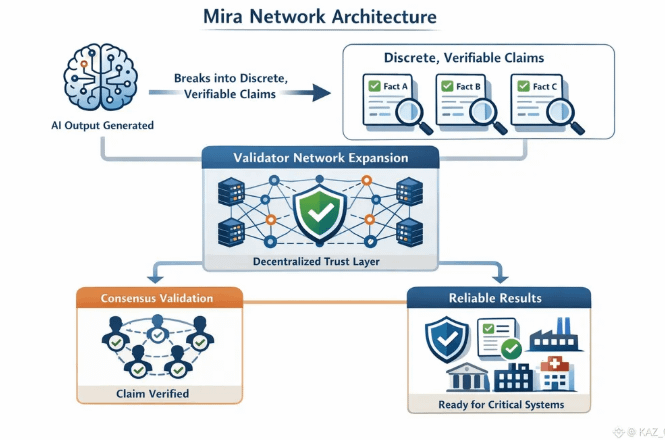
Behind the scenes the AI output had already been checked by Mira Network’s verification layer.
The verification process started before the Snapshot page even finished loading.
* The paragraph was split.
* Financial projections were isolated.
* Risk assumptions were extracted.
* Cross-chain liquidity claims were separated into verification units.
Each fragment was given an ID.
Evidence hashes were attached.
They were sent to Mira’s decentralized validator network.
The validation process was open.
Fragment 1 said, "Projected 6.8% APY across aggregated LST positions.”
Validators quickly agreed on its weight.
Two confirmations were made.
One validator abstained.
A supermajority was reached.
A certificate candidate was forming.
Fragment 2 said, "Liquidity depth sufficient for $4.2M rotation without slippage exceeding 0.5%.”
This one took longer.
Validators double-checked the DEX depth.
One validator flagged pool data.
The weight was paused below the threshold.
Fragment 3 said, "Risk profile remains within DAO mandate.”
This one was split further internally.
The mandate clause was interpreted.
Historical volatility was compared.
Stress-test modeling was done.
A partial quorum was reached across sub-claims.
And here’s what most people wouldn’t notice:
The governance interface already showed "AI-Verified.”
It had a badge.
It looked clean.
It looked confident.
Mira’s validator network was still in the middle of the round.
The status was incomplete.
The export mode was set to sealed
The DAO smart contract doesn’t read paragraphs.
It reads certificates.
Fragment 1 was sealed first.
Fragment 2 was still waiting.
Fragment 3 was still being debated across distributed validators.
Delegates were already voting.
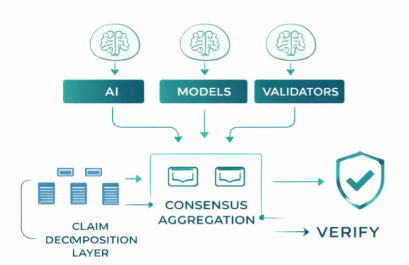
Because in Web3, governance latency and verification latency are not the same.
Votes accumulate while claims are still forming.
This is where Mira becomes more than a safety layer.
It becomes a coordination layer between AI and DAO logic.
When Fragment 2 finally reached quorum the slippage assumption was locked in cryptographically.
A certificate was attached.
Downstream the execution contract updated its risk flag.
Fragment 3 took the longest.
Validators disagreed on mandate interpretation.
Not maliciously.
Not adversarially.
Decentralized judgment.
The weight oscillated.
Then it crossed the threshold.
The certificate was sealed.
The status was complete.
Then did the governance execution script move from "conditional" to "authorized.”
Treasury funds were bridged.
LST positions were opened.
On-chain transaction hashes were confirmed.
No drama.
No exploit.
Here’s what mattered:
The DAO didn’t trust the AI model.
It trusted Mira’s certificate.
That shift is subtle.
It changes everything in Web3.
Because once DAOs begin requiring verification certificates for AI-generated proposals…
Once treasury contracts read validator quorum weight of model confidence scores…
Once cross-chain strategies depend on cryptographic proof of reasoning…
Mira Network stops being middleware.
It becomes governance infrastructure.
Not a UI feature.
Not an oracle.
A protocol-level trust anchor for coordination.
In a future where DAOs rely on AI agents to draft, simulate and execute capital strategies the difference, between "AI suggested". Mira-certified" will define which proposals move millions.
Which never execute.
That’s not about reducing risk.
That’s about protocol legitimacy.
Mira Network doesn’t make AI smarter.
It makes AI governable.
In Web3 governability is power.
