

There is a quiet tension running through the current wave of artificial intelligence development. On the surface, models keep getting smarter, faster, and more convincing. But underneath that progress sits an uncomfortable reality: these systems are built on probabilities, not certainty. They can generate remarkably coherent answers while still being wrong in subtle or obvious ways. The industry often treats this as a temporary limitation, something that better training data or larger models will eventually resolve. Yet there are growing signs that uncertainty may not disappear so easily.
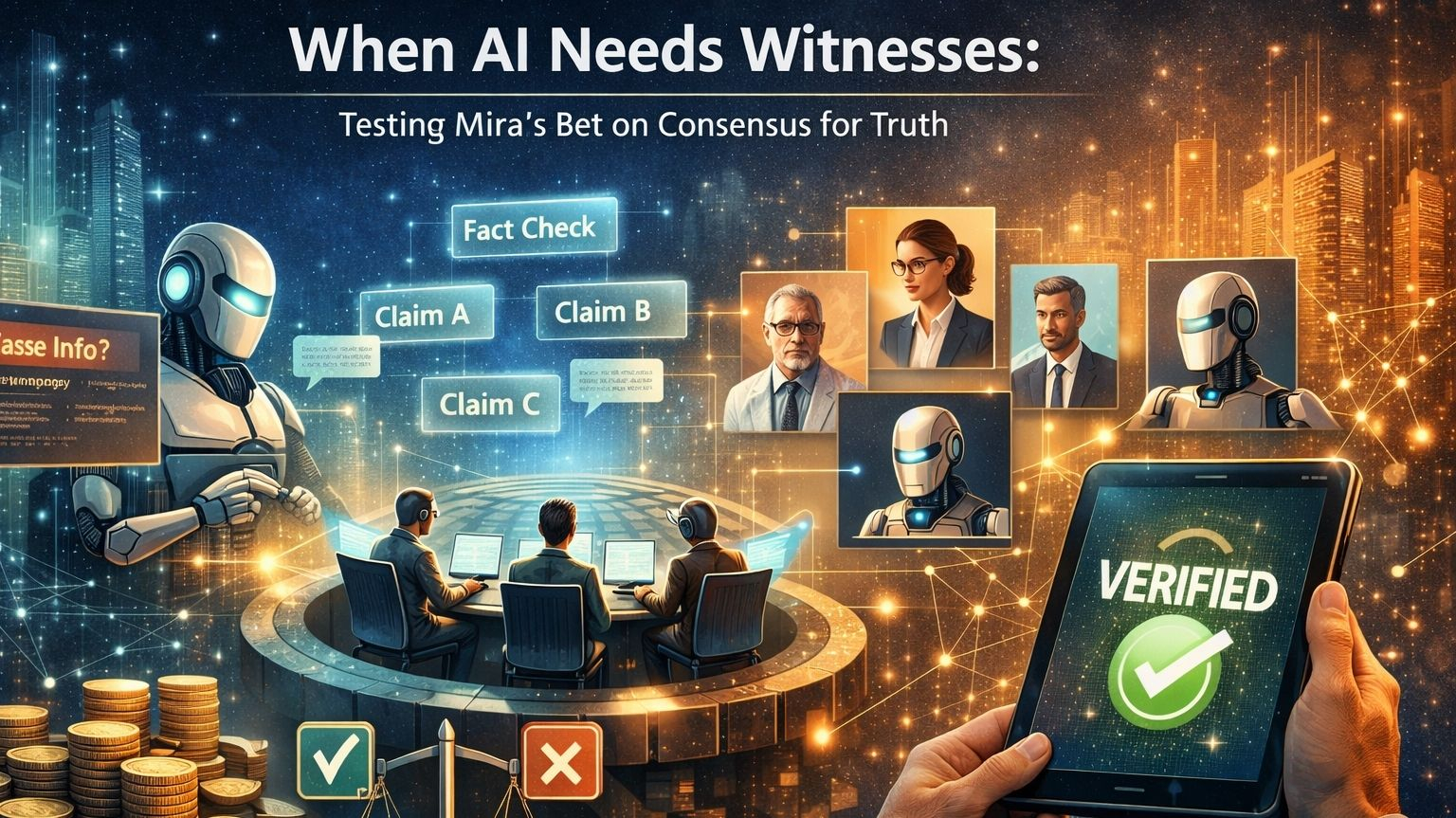
Mira seems to start from that possibility. Instead of trying to make AI perfectly reliable, it treats unreliability as something that needs to be managed. The project’s central idea is not to change how models generate answers but to create a system around those answers that evaluates them after the fact. In simple terms, the model produces a response, the response is broken into smaller claims, and those claims are checked by other participants in a distributed verification process. If enough validators confirm the claims, the output receives something like a receipt showing it has been reviewed.
The logic feels practical. If one system might make a mistake, perhaps multiple independent evaluators can catch it. The system does not claim to eliminate uncertainty. Instead, it attempts to organize uncertainty into something that appears more structured and accountable.
But that approach quietly shifts the meaning of verification. The system is not directly proving that a statement is true. It is demonstrating that several participants agree that the statement is likely correct. Most of the time those two things may overlap, but they are not identical. Agreement has always carried a certain psychological weight. When multiple sources say the same thing, confidence increases. Yet history repeatedly shows that shared assumptions can travel through groups without being challenged.
Mira attempts to reduce that risk by spreading verification across different models and validators. The hope is that diversity of evaluators will produce independent judgments. If one system overlooks an error, another might detect it. In theory this creates a network where mistakes become harder to pass through unnoticed.
The difficulty is that independence among AI systems is often more fragile than it appears. Many models are trained on overlapping datasets. Many inherit similar design philosophies. Even when they are developed by different organizations, they often learn from similar pools of information and from each other’s outputs. If those systems share blind spots, their agreement might simply reflect those shared limitations.
In that situation, consensus would still emerge, but it might represent alignment of assumptions rather than confirmation of truth.
To make the system function economically, Mira also introduces incentives. Validators participate in the verification process and are rewarded when their assessments align with correct outcomes. The structure is meant to encourage honest participation while discouraging careless or malicious behavior.
Economic incentives can be powerful, but they also shape behavior in ways that are not always obvious at the beginning. Participants tend to learn what the system rewards and adjust their actions accordingly. If quick agreement becomes the most efficient path to earning rewards, verification could gradually become more about matching expected outcomes than carefully evaluating claims. Dissent, even when justified, might start to look like unnecessary risk.
This kind of drift is not unusual in distributed systems. Early participants behave independently, exploring the boundaries of the network. Over time, patterns form. Strategies converge. What begins as open evaluation can slowly become a coordination game where the safest move is simply to align with the majority.
The structure of claim verification also introduces subtle pressure on how information is produced. Mira breaks complex AI responses into smaller factual units so they can be evaluated individually. This makes technical sense. Short, clear claims are easier to test than long explanations filled with context and interpretation.
Yet the process may gradually favor information that fits neatly into that format. Statements that can be clearly labeled true or false move smoothly through the verification pipeline. Ideas that require nuance, ambiguity, or interpretation become harder to evaluate.
Infrastructure tends to influence behavior over time. Once verification systems are in place, the systems generating information adapt to those verification rules. AI models might begin producing outputs that are easier to verify rather than outputs that are most useful or complete. Complexity could quietly shrink in favor of clarity that fits the system’s checking process.
There is also a longer-term question about how decentralized the verification network can realistically remain. Early in a project’s life, participation is often wide and experimental. But as the network grows and economic incentives become more meaningful, certain actors may gain advantages. Running verification nodes requires resources, infrastructure, and capital. Over time those requirements can push participation toward operators who can manage the system at scale.
If that happens, verification could slowly concentrate among a smaller group of participants. The network would still appear decentralized on paper, but much of the actual decision-making might be happening within a narrow circle of validators. This kind of quiet consolidation has appeared in many blockchain systems once they moved beyond their early experimental phase.
None of this necessarily undermines the usefulness of what Mira is attempting. The problem it addresses is increasingly real. AI systems are beginning to influence research summaries, financial analysis, logistics planning, and automated decision tools. In environments where automated outputs shape real actions, the ability to trace how information was evaluated becomes valuable.
A verification receipt attached to an AI response could serve as a kind of accountability layer. Users would not just see an answer; they would see that the answer had been reviewed by independent participants. Even if the system does not guarantee perfect accuracy, it might create a stronger sense of traceability around automated knowledge.
The deeper question is whether this structure truly reduces uncertainty or simply repackages it in a way that feels easier to trust. If the network remains diverse, if validators retain genuine independence, and if incentives continue to reward careful disagreement when necessary, the system could become a meaningful part of how AI outputs are trusted.
But if incentives gradually encourage conformity, if validators begin sharing the same assumptions, or if verification power becomes concentrated among a small group of operators, the meaning of those receipts could shift. They would still show that a network reached consensus, but the consensus might not always reflect careful evaluation.
These kinds of dynamics rarely reveal themselves immediately. Systems often look stable when conditions are calm and incentives are aligned. The real character of infrastructure tends to appear when pressure increases—when information becomes controversial, when economic rewards grow large, or when participants face incentives to influence outcomes.
Mira’s idea can be understood as a strategic bet on how trust in AI will evolve. It assumes that distributed verification can stabilize systems that are inherently uncertain. That assumption may turn out to be correct, especially if the network manages to preserve independence and diversity among its validators.
But the answer will probably not be determined by the elegance of the concept. It will emerge gradually through the behavior of the system under stress. If the network continues to produce thoughtful verification when disagreement becomes difficult, its receipts could carry real meaning.
If it does not, the receipts may still exist. They will simply record that consensus happened, leaving open the quieter question of what that consensus actually represents.