If you’ve been following the DePIN and Decentralized Compute space, you’ve probably noticed something interesting: we’re moving past the wild west phase of just renting hardware and into a more sophisticated, modular stack.
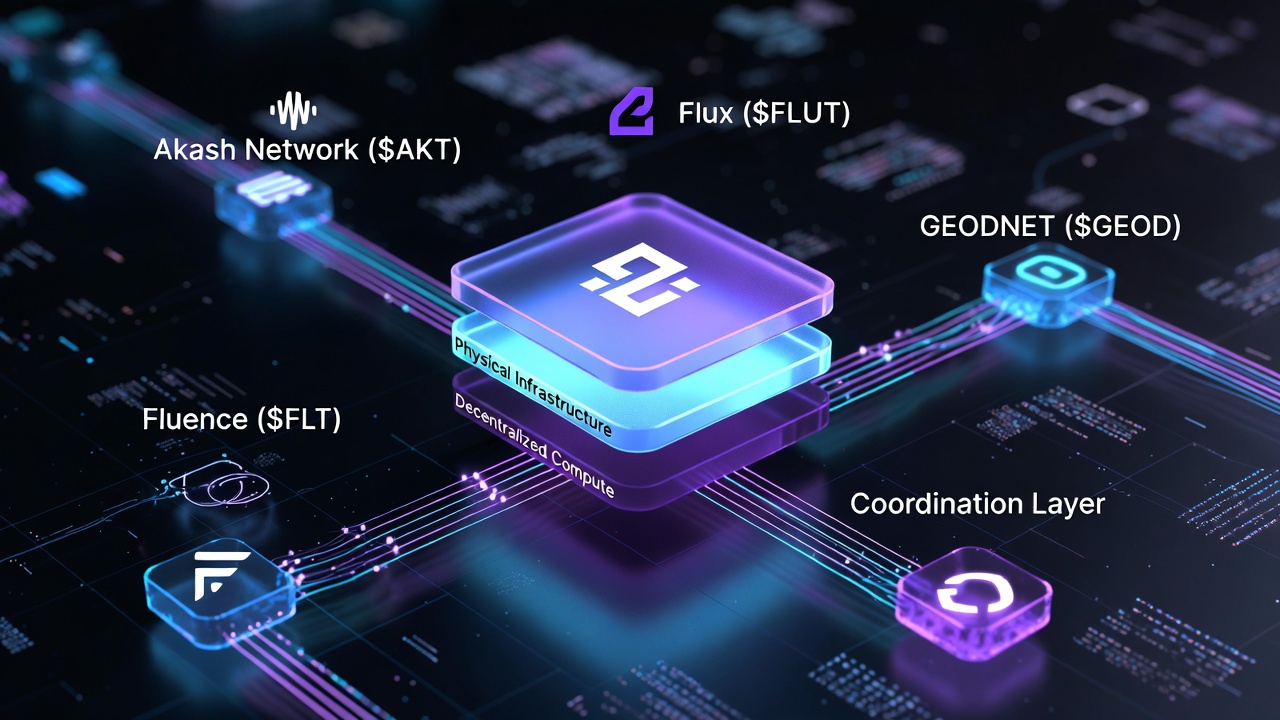
Looking at Akash ($AKT), Flux ($FLUX), GEODNET ($GEOD), and Fluence ($FLT), a clear hierarchy is starting to form. Here’s what I’m seeing from the digital trenches:
🧱 The Muscle vs. The Senses
First, let’s talk about the heavy hitters. Akash and Flux are the muscle of the decentralized cloud. They are the marketplaces where you go to rent raw machines or containers. If you need a fleet of GPUs to train a massive AI model, these are your go-to providers. They map directly onto the DevOps workflows developers already know from AWS.
Then you have GEODNET, which is essentially the senses of the stack. It’s not trying to be a general-purpose computer; it’s a specialized sensor network providing high-precision location data. It’s a perfect example of how DePIN can capture real-world data that centralized providers often overlook.
🧠 Fluence ($FLT): The Logical Brain
This is where Fluence stands out. While AKT and FLUX sell you the machine, Fluence sells you the execution. Fluence sits higher up the stack as a decentralized serverless platform. Instead of managing a virtual machine, you deploy composable functions (WASM). Think of it as the "logical router" of the decentralized world.
Why this matters for the AI Narrative:
In the emerging AI infra stack, hardware is only half the battle. We need an orchestration layer, a place where AI agents, inference endpoints, and data pipelines can be wired together without a single point of failure. Fluence is positioning itself as that agent backplane.
🎯 The Cloudless Mission
Fluence’s mission isn't just to be another compute coin. It’s about building a cloudless future.
The goal is to turn compute into a neutral, verifiable resource that isn't locked into any single provider.
While Fluence is currently at a much smaller scale and earlier stage than the AKT or FLUX giants, its architecture is built for the Modular DePIN trend. It allows developers to wire together services that might internally pull from various hardware providers, making the entire ecosystem more usable.
📉 The Bottom Line
We are witnessing the unbundling of the cloud. Akash and Flux provide the raw infra, GEODNET provides the specialized data, and Fluence provides the serverless glue to turn it all into a functional, verifiable application backend.
It’s a bold bet on a future where AI and agents don’t live on a corporate server, but in an open, composable mesh. 🌐