
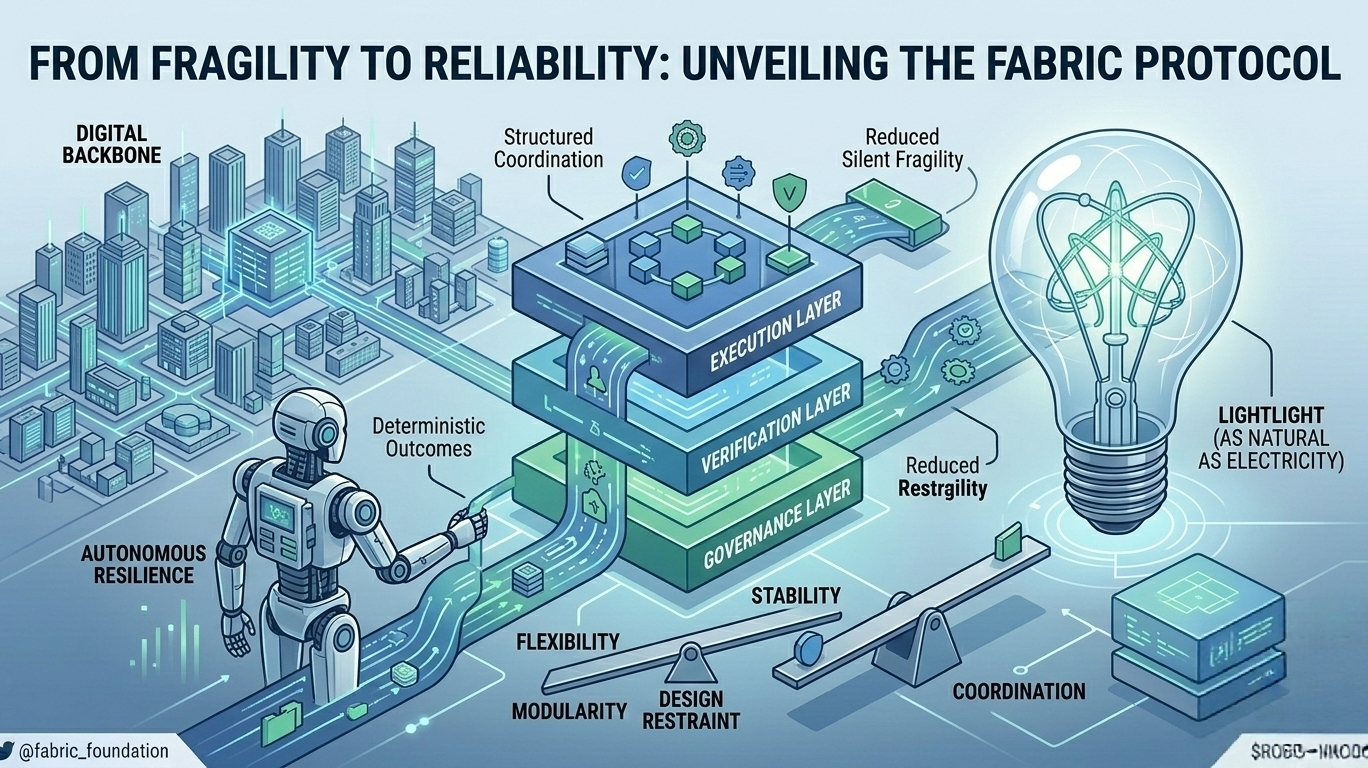
When I first started looking closely at Fabric Foundation, what stood out wasn’t branding or velocity. It was restraint. The idea that really clicked for me was that in a world increasingly shaped by autonomous agents, APIs, and machine to machine transactions, the core problem isn’t speed. It’s verification. Not just proving that something happened, but proving it happened correctly, consistently, and in a way other systems can depend on.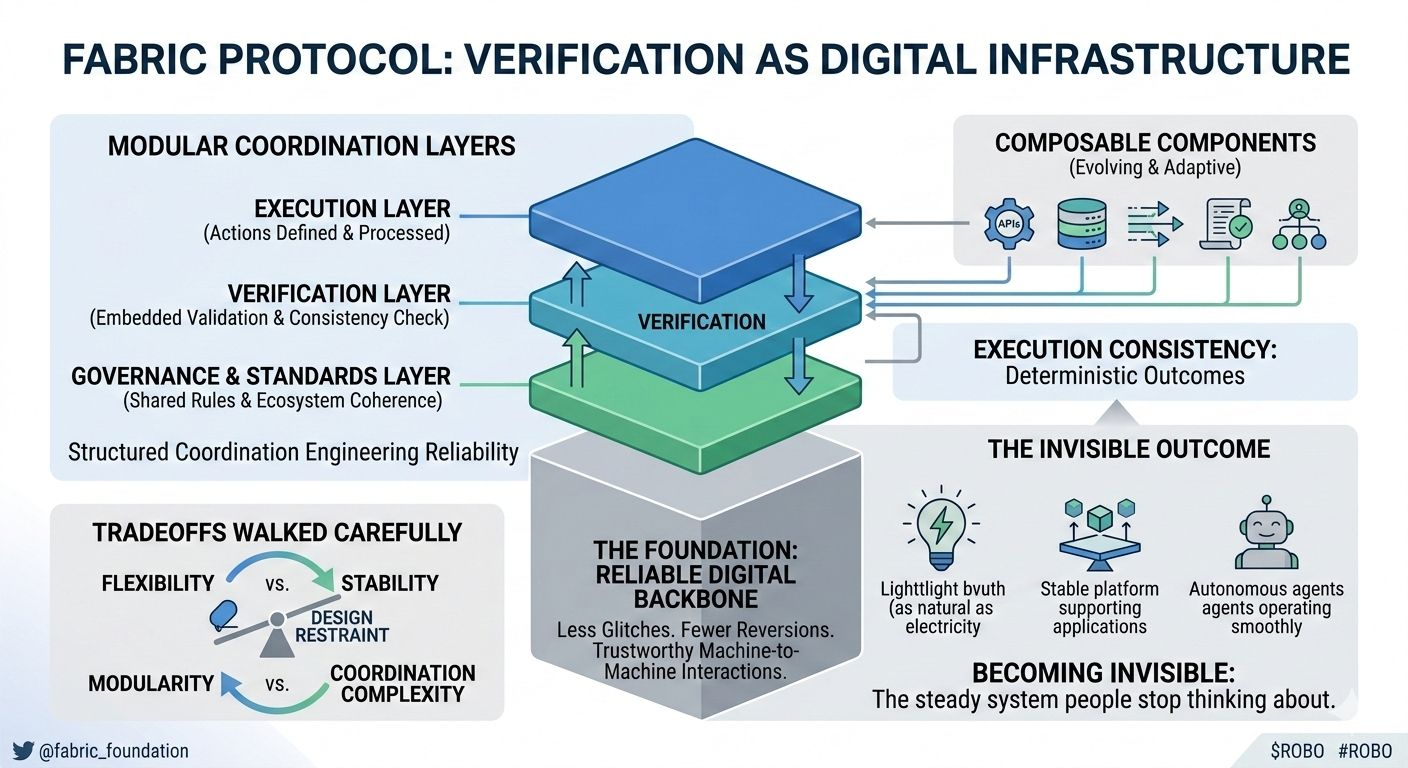
Fabric Protocol approaches this through modular coordination. Instead of treating execution as a monolithic black box, it structures responsibilities into composable layers. Verification isn’t an afterthought bolted on at the edge; it’s embedded into how actions are defined and validated. That modularity matters. It means components can evolve without destabilizing the whole. It means builders aren’t forced into brittle architectures where one failure cascades across everything.
Stepping back, I began to see how this design philosophy speaks directly to a machine driven economy. Machines don’t tolerate ambiguity well. They require deterministic outcomes, predictable interfaces, and clearly defined rules of engagement. Fabric Foundation’s emphasis on execution consistency ensuring that what is declared is exactly what is processed feels less like a feature and more like a prerequisite for serious adoption.
Another principle that struck me was structured coordination. Many ecosystems rely on loose alignment and hope that incentives smooth out rough edges. Fabric Protocol seems to assume the opposite: coordination must be engineered. Clear boundaries. Defined interactions. Composability without chaos. For developers, that translates into fewer edge case failures. For applications, it reduces the silent fragility that often appears only under scale.
If Fabric succeeds, most users won’t notice it. They won’t know which layer verified their machine-triggered payment or authenticated a data exchange between two autonomous systems. They’ll just experience fewer glitches. Fewer inexplicable reversions. Fewer moments where “the chain” becomes the bottleneck instead of the backbone.
That doesn’t mean the path is simple. Modularity increases coordination complexity. Governance must remain disciplined to prevent fragmentation. Ecosystem coherence requires shared standards, not just shared incentives. There is always a tradeoff between flexibility and stability, and Fabric Foundation walks that line carefully.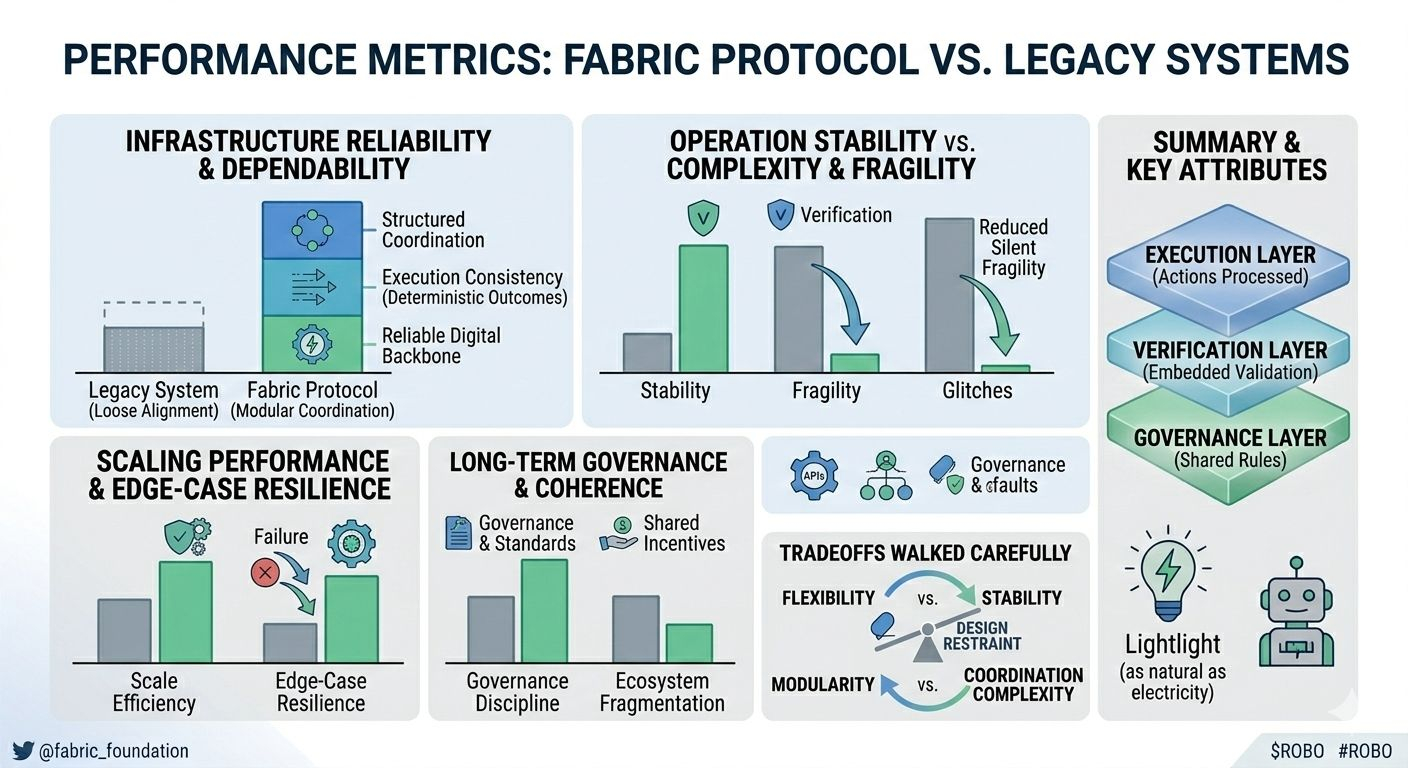
But maybe that’s the point. In a machine driven economy, reliability isn’t glamorous. It’s essential. The radical idea isn’t to be the loudest protocol in the room. It’s to be the one systems quietly depend on.
If one day the verification layer of our digital infrastructure feels as invisible as electricity always there, rarely discussed that might signal that Fabric Protocol did its job. And that might be the most human strategy of all: build something steady enough that people can stop thinking about it.