

Bitcoin Likely Found Bottom Near $60K, Says Michael Saylor
#Bitcoin could have already established a local bottom near $60,000, according to Michael Saylor.

Speaking at a Mizuho investor event, he emphasized that market bottoms typically form when forced sellers are exhausted rather than when confidence returns.
In particular, Saylor attributed the recent downturn to liquidations among over-leveraged miners and weaker market participants, which intensified selling pressure.
Looking ahead, Saylor also downplayed concerns around quantum computing. He described the risk as distant and manageable, noting that Bitcoin’s open-source structure would allow timely upgrades if threats begin to materialize.
$285M Drift Protocol Hack Triggers Legal Probe
In a separate development, the U.S. law firm Gibbs Mura has opened a class action inquiry following the April 1 breach of Drift Protocol.
The exploit is estimated to have caused losses of approximately $280–$285 million. Investigators are now also examining potential claims involving Circle Internet Financial, after more than $230 million in USDC was reportedly routed through its cross-chain infrastructure without being frozen.
Blockchain analytics firm Elliptic has further linked the attack to a suspected North Korean threat actor group.
Following the incident, Drift’s total value locked (TVL) fell sharply from about $550 million to below $250 million, while its native token declined by more than 40%. In addition, over 20 DeFi protocols have reported indirect exposure to the broader fallout.
JPYC Stablecoin Gains Traction, Polygon Dominates Volume
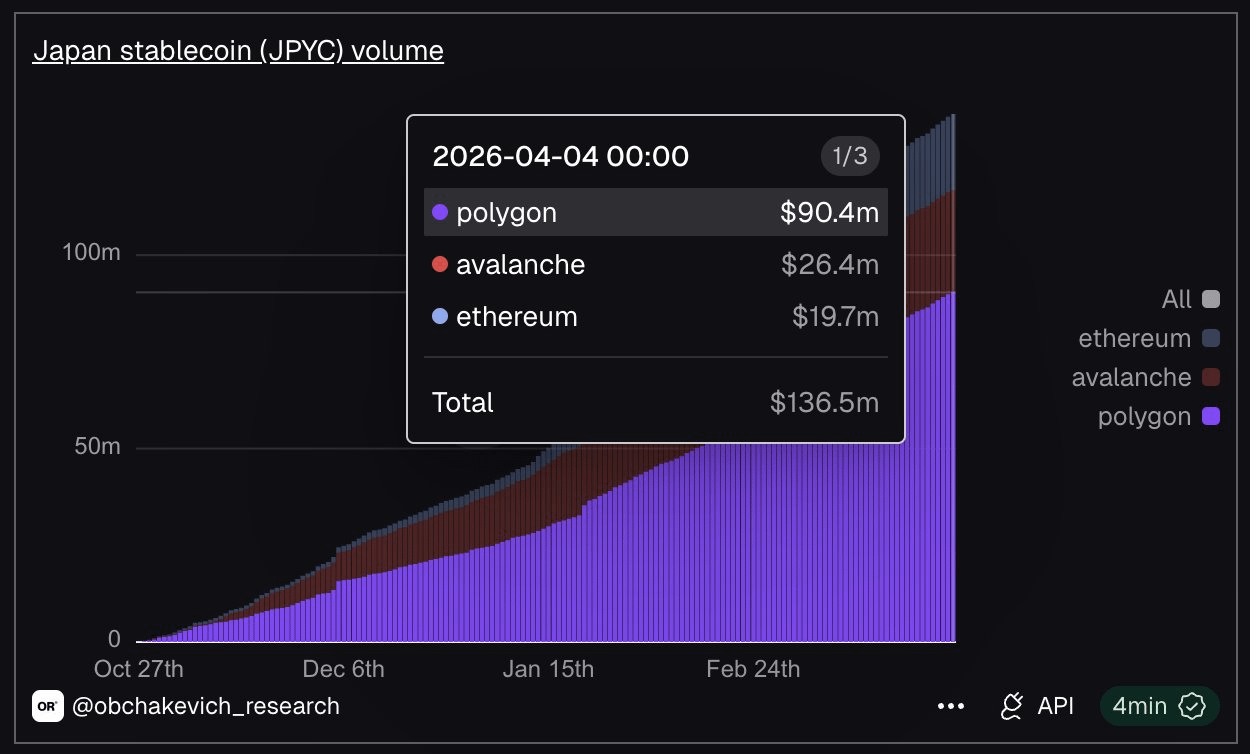
Meanwhile, Japan’s yen-backed stablecoin JPYC is gaining traction, signaling growing demand for localized digital currencies.
The token, issued by JPYC Inc. in October 2025, has generated $137 million in trading volume over the past six months. During this period, Polygon dominates usage, accounting for 66% of activity ($90.4 million), while Avalanche and Ethereum follow.
Polygon co-founder Sandeep Nailwal highlighted the milestone in a recent X post.
U.S. Treasury Pushes for Clear Crypto Rules
On the policy front, U.S. Treasury Secretary Scott Bessent is pressing Congress to advance a comprehensive crypto framework, referred to as the Clarity Act.
In an op-ed for The Wall Street Journal, he warned that regulatory uncertainty is driving crypto firms offshore.
Specifically, he pointed to jurisdictions like Abu Dhabi and Singapore as more attractive alternatives due to clearer frameworks, cautioning that the U.S. risks losing both innovation and capital without decisive policy action.
Exodus Movement Expands Crypto Holdings in Q1
Elsewhere, Exodus Movement, a U.S.-listed self-custody cryptocurrency company, reported steady growth in its crypto holdings for Q1 2026.
By the end of March, the company held 628 BTC, reflecting a net addition of 18 BTC.
At the same time, its Ethereum holdings increased to 1,857 ETH, while Solana holdings reached 17,541 SOL. During the period, the firm added 17 ETH and 1,847 SOL, thereby signaling steady accumulation across major assets.