
Over the last five years in crypto, I’ve seen a lot of projects come and go. Many of them promise huge things, but when you look closely it’s hard to understand what real problem they are trying to solve. Some ideas sound impressive at first, but once the hype fades, there isn’t much substance behind them.
When I first came across the work being done by the Fabric Foundation, I approached it with the same skepticism I’ve developed over time. In this industry you learn pretty quickly that bold narratives are everywhere. What matters is whether the project is asking the right question.
In this case, the question caught my attention.
What happens when robots become part of the economy?
It sounds like something out of a science fiction movie at first, but when you take a step back and look at the world today, the direction is actually clear. Robots are already working in warehouses, factories, ports, and logistics centers. AI systems are controlling machines, analyzing environments, and making decisions that affect real-world operations.
But here’s the thing most people don’t notice. Almost all of these machines operate inside closed systems.
A warehouse robot from one company doesn’t communicate with machines owned by another company. Delivery robots operate on their own software stacks. Industrial robots are tied to proprietary infrastructure controlled by the manufacturer or operator. Every environment is isolated.
From a business standpoint that made sense for a long time. Companies built systems for their own efficiency, not for cooperation with competitors.
But if automation keeps expanding, that structure eventually starts to look inefficient.
Imagine a world where millions of machines are performing tasks across cities, supply chains, and industries. If every system remains isolated, coordination becomes messy very quickly. Robots might be doing similar tasks in the same area but still unable to interact or share verified information.
That’s where Fabric’s idea starts to make sense.
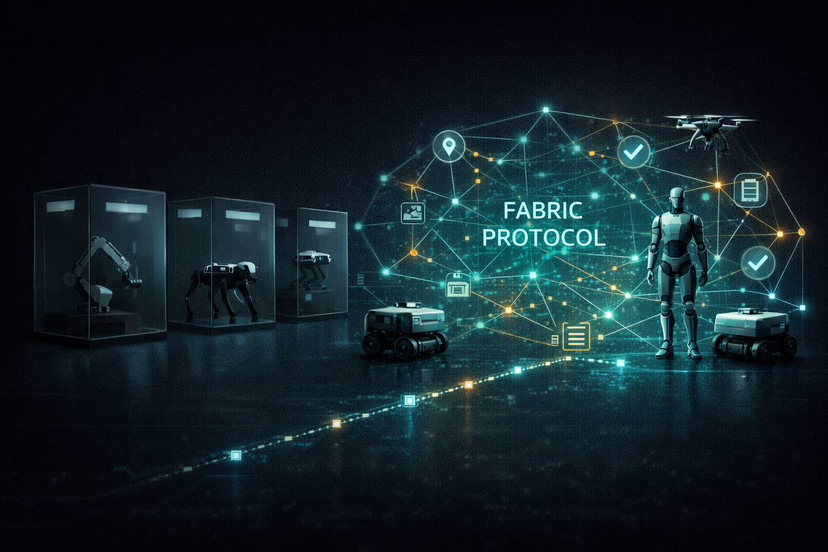
Instead of robots working only inside private networks, they could connect to a shared coordination layer. A robot would have an identity, it could prove what work it completed, and it could receive payment for that work in a transparent system.
In other words, machines wouldn’t just be tools anymore. They would be participants in a network where work, data, and payments move between different operators.
From my perspective, the most interesting part of the concept is the trust problem.
If a robot claims it delivered a package or inspected a building, how does another system know that actually happened? In centralized environments that’s easy because the same company controls everything. But once machines from different operators interact, trust becomes much harder.
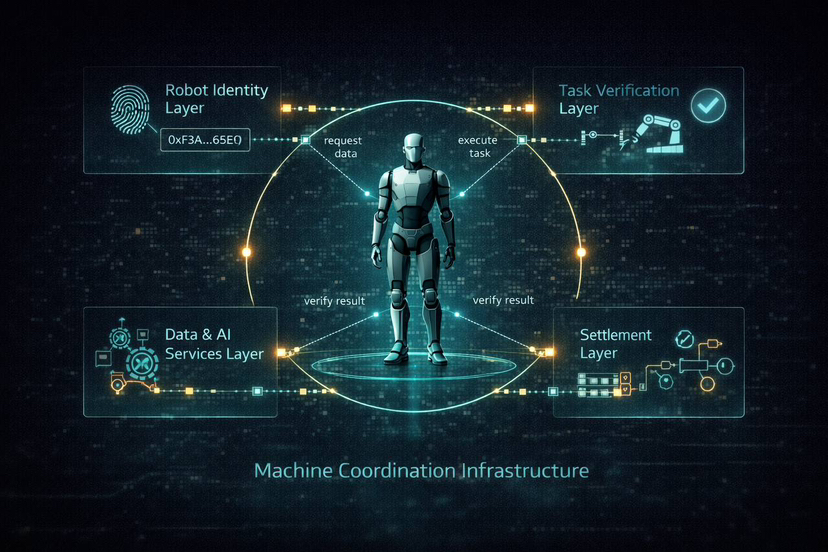
Fabric is trying to solve this by creating a shared infrastructure where machine activity can be recorded and verified. Every robot connected to the network receives a cryptographic identity. That identity allows the machine to authenticate itself and build a history of the work it has done.
Over time that history becomes a kind of reputation system.
When a robot completes a task, it doesn’t just report it. The network looks at evidence generated by the machine. Sensor data, operational logs, location signals, and other inputs help confirm that the job actually happened.
Once the task is verified, the record is stored permanently and the operator receives payment through the network.
The economic layer of the system runs through a token called ROBO. This token acts as the payment and coordination mechanism inside the network. Operators who deploy machines can earn rewards when their robots complete verified work, and participants can also use the token for staking and governance.
One detail I found particularly important is how the system handles accountability. Anyone who has spent time in crypto understands that open networks attract both honest participants and bad actors. If there is an opportunity to exploit the system, someone will eventually try it.
Fabric tries to reduce that risk by requiring robot operators to stake value before participating. This stake acts like collateral. If an operator behaves dishonestly or if their machine repeatedly fails to perform tasks properly, part of that stake can be lost.
That mechanism creates a simple economic rule. If you want access to the network and the rewards it offers, you must take responsibility for how your machines behave.
It’s a practical way of combining technology and incentives. Instead of relying purely on trust or purely on automation, the system uses financial consequences to encourage honest behavior.
Of course, the concept still faces real challenges. Verifying physical activity is much harder than verifying digital transactions. Sensors can fail, environments change, and machines don’t always behave perfectly in unpredictable conditions.
This means building a reliable system for verifying robotic work will take time. It won’t be solved overnight, and it will probably require years of testing and adjustments before something like this becomes truly reliable.
But the direction itself is interesting.
Automation is moving fast. Robotics hardware is getting better, and AI systems are improving every year. We’re already seeing autonomous machines handle tasks that were once considered impossible to automate.
If that trend continues, robots will eventually perform a large share of real-world work.
And if machines are generating economic value at scale, they will need infrastructure that allows them to coordinate, verify tasks, and exchange payments across different operators.
That’s the broader vision Fabric is exploring.
It’s not just about launching another blockchain protocol. It’s about experimenting with how a future machine economy might function. Instead of isolated robotic fleets controlled by separate companies, there could be networks where machines interact more openly and efficiently.
From my point of view after years in this space, the projects worth watching are usually the ones asking unusual questions. Not every experiment succeeds, but the ideas themselves can push the industry forward.
Fabric falls into that category for me.
It forces us to think about something most people haven’t considered yet. If robots eventually become part of everyday economic activity, the systems that organize their cooperation will matter a lot more than we realize today.