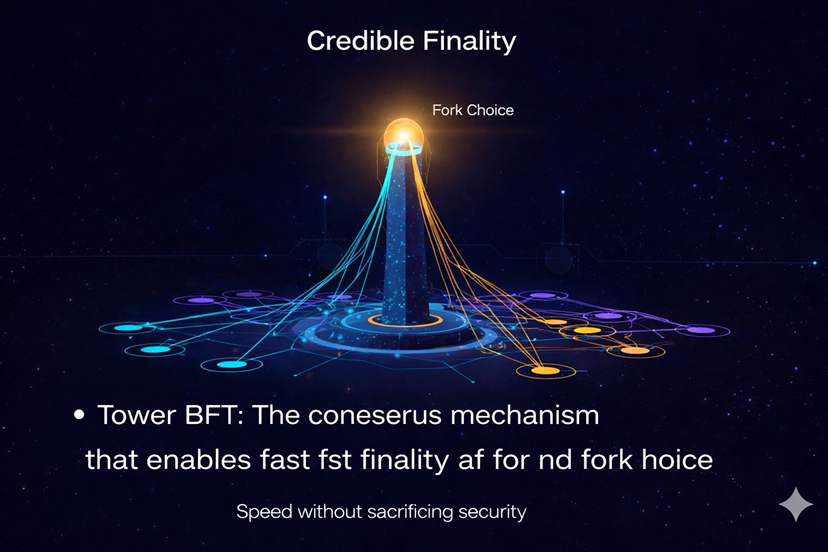
When I study Fogo’s architecture, Tower BFT is where real finality becomes visible.
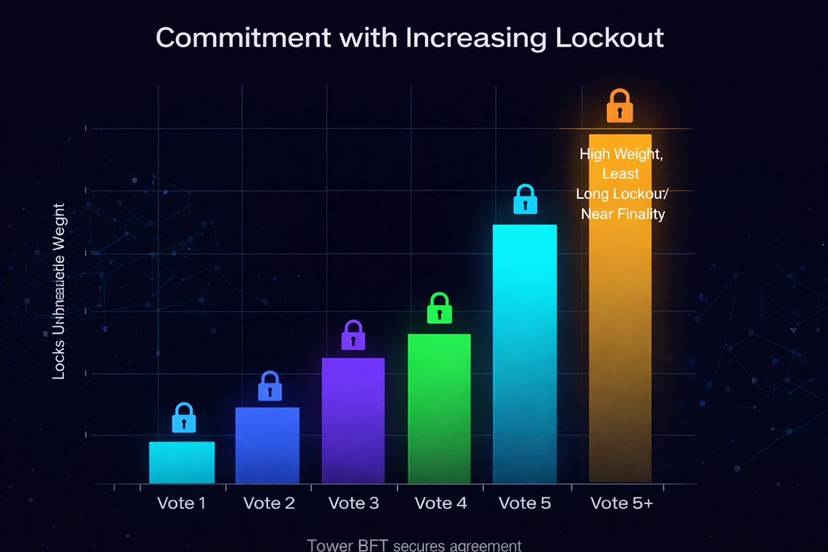
It’s not just voting it’s commitment with increasing lockouts. Every vote builds economic weight behind a fork. The longer validators support a chain, the harder it becomes to switch.
That’s how Fogo achieves fast confirmation and credible finality.
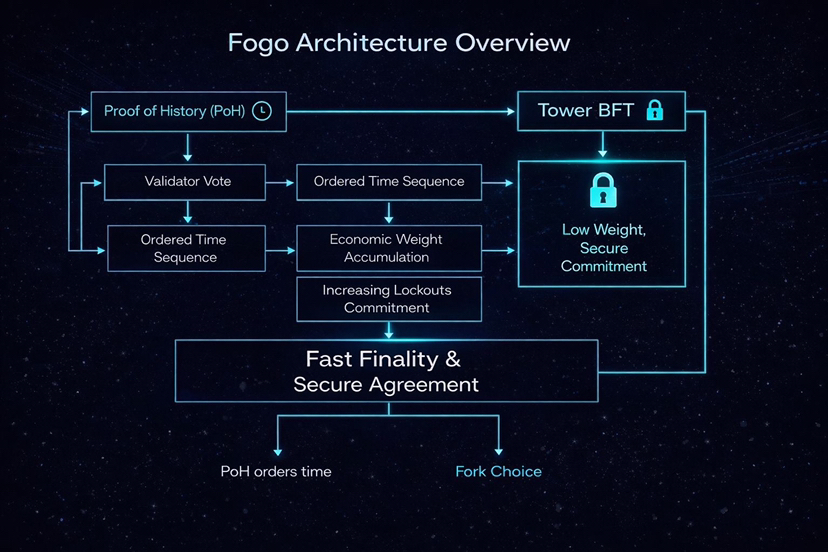
PoH orders time.
Tower BFT secures agreement.
Speed without sacrificing security that’s the design I respect most.
In a world where blockchains compete on speed charts and TPS numbers, very few conversations focus on what truly matters: credible finality. Not the illusion of speed. Not vanity metrics. But the moment when a transaction moves from “probably confirmed” to “economically irreversible.”
That’s where Fogo stands apart.
Let’s break this down from a structural lens not hype, not speculation, not marketing but architecture.
The Illusion of Fast Chains
Many networks advertise “instant confirmation.” But instant confirmation without economic commitment is simply optimistic messaging. If validators can switch forks with minimal cost, then confirmation is soft. And soft finality doesn’t scale trust.
Real decentralization demands friction.
Real consensus demands consequence.
Fogo understands that.
Proof of History: Time as Infrastructure
Before consensus even begins, time must be ordered. This is where Proof of History (PoH) becomes foundational.
PoH isn’t consensus — it’s coordination. It provides a cryptographic clock that sequences events before validators vote on them. That sequencing reduces communication overhead and allows validators to focus on what they should be doing: validating and committing.
Think of PoH as the rhythm section of an orchestra.
It keeps tempo.
It keeps order.
It reduces chaos.
But tempo alone doesn’t guarantee harmony.
Tower BFT: Commitment Over Convenience
Now we reach the real innovation layer — Tower BFT.
Unlike traditional voting mechanisms where validators can pivot with relative ease, Tower BFT introduces increasing lockouts. Each vote isn’t just an expression of preference — it’s an escalating commitment.
Here’s what makes this powerful:
Each vote extends the lockout period.
Switching forks becomes progressively expensive.
Validators accumulate economic weight behind a specific chain.
The result?
Confidence compounds.
With every block, validators are signaling more than agreement — they’re signaling skin in the game. And when enough economic weight accumulates, the chain doesn’t just look finalized — it becomes economically impractical to reverse.
That’s the difference between technical confirmation and credible finality.
Why Lockouts Matter
Let’s zoom out.
Consensus without lockouts is flexible.
Consensus with lockouts is accountable.
In Fogo’s model, validators don’t just validate — they commit capital, reputation, and opportunity cost over time. If they attempt to revert, they’re not just disagreeing — they’re breaking accumulated commitment.
This creates a feedback loop:
Time passes → Votes stack → Lockouts increase → Fork switching becomes irrational → Finality strengthens.
This is economic gravity at work.
And gravity builds trust.
Speed Without Compromise
Here’s the part that deserves respect: Fogo doesn’t trade security for performance.
The pairing of PoH and Tower BFT means:
Blocks are ordered efficiently.
Votes are structured predictably.
Finality emerges rapidly.
Security strengthens over time.
Most systems optimize one dimension:
Speed or security.
Fogo aligns both.
And that alignment isn’t accidental — it’s architectural.
The Psychological Layer of Finality
Let’s go deeper.
Finality isn’t just technical — it’s psychological.
Users need to feel safe.
Developers need to trust settlement.
Institutions need deterministic guarantees.
When validators are economically locked into their votes, the system signals strength. It communicates durability. It creates confidence beyond code — confidence rooted in incentive design.
This is game theory in motion.
And well-designed incentives outlast marketing cycles.
Economic Weight as Reputation
In Tower BFT, economic weight accumulates behind a fork like reputation accrues behind a brand.
The longer validators support a chain:
The more credibility it gains.
The more switching costs rise.
The more the system stabilizes.
This creates layered finality:
Soft confirmation (early votes)
Strengthened commitment (increasing lockouts)
Economic finality (fork switching becomes irrational)
It’s not instant.
It’s intentional.
And intentional systems endure.
Why This Matters for Builders
If you’re building on Fogo, you’re not just choosing throughput — you’re choosing finality guarantees.
That matters for:
DeFi protocols
NFT marketplaces
On-chain gaming
Institutional settlement layers
Cross-chain bridges
Fast confirmation without credible finality increases risk exposure. But when finality becomes economically visible, risk compresses.
And compressed risk unlocks capital efficiency.
That’s where ecosystems scale.
Architecture > Hype
The crypto space often rewards noise. But architecture always wins long-term.
When I study Fogo’s design, I don’t see a chain chasing metrics. I see a system aligning time, incentives, and validator behavior into a cohesive structure.
PoH reduces coordination complexity.
Tower BFT enforces economic discipline.
Together, they produce fast, credible finality.
That’s not marketing — that’s mechanism design.
The Respect Factor
What earns my respect isn’t speed alone.
It’s the refusal to sacrifice security for optics.
It’s the understanding that consensus is not just about agreement — it’s about commitment over time.
And it’s the discipline to design incentives where switching costs grow naturally, not artificially.
That’s maturity.
That’s systems thinking.
That’s Fogo.
The Bigger Vision
As blockchain infrastructure evolves, we’re moving from experimentation to reliability. From “can it work?” to “can institutions trust it?”
Finality will define that transition.
And in Fogo’s architecture, finality isn’t an afterthought — it’s engineered.
Tower BFT is where finality becomes visible.
Where economics reinforces agreement.
Where validators don’t just vote — they commit.
In a space obsessed with speed, I choose structure.
In a market chasing narratives, I choose architecture.
In systems balancing performance and safety, I choose design integrity.
Speed without sacrificing security — that’s the standard.
And that’s why Fogo stands out.