
There is a specific kind of frustration that only shows up when you are trying to ship something real. Not a demo. Not a quick clip. A real product where normal users click buttons without thinking.
I remember sitting with a friend while we tested a simple flow mint then claim then trade. Nothing complicated. And yet the biggest discussion was not about the UI, the artwork, or even the smart contract logic.
It was about fees.
Not because fees were high. But because fees were uncertain.
That uncertainty does something quietly destructive. It turns your product into a negotiation. Users do not feel like they are using an app. They feel like they are stepping into a market that can change the rules mid click.
Vanar fee targeting is trying to delete that experience.
Not by pretending fees do not exist. But by treating fees like something a product should control.
Core idea
Most chains behave like this. Fees are whatever the network feels like right now.
Vanar is pushing a different model. Fees should behave like product pricing. Predictable. Stable. Explainable.
Instead of letting VANRY price swings turn into user pain, Vanar targets a USD cost, then adjusts how much VANRY is paid so the user facing cost stays stable. This model is described in Vanar documentation as fixed fees based on the USD value of VANRY, with frequent updates.
That update cadence matters. It is the difference between stable most of the time and stable enough to design around.
Why this becomes UX freedom
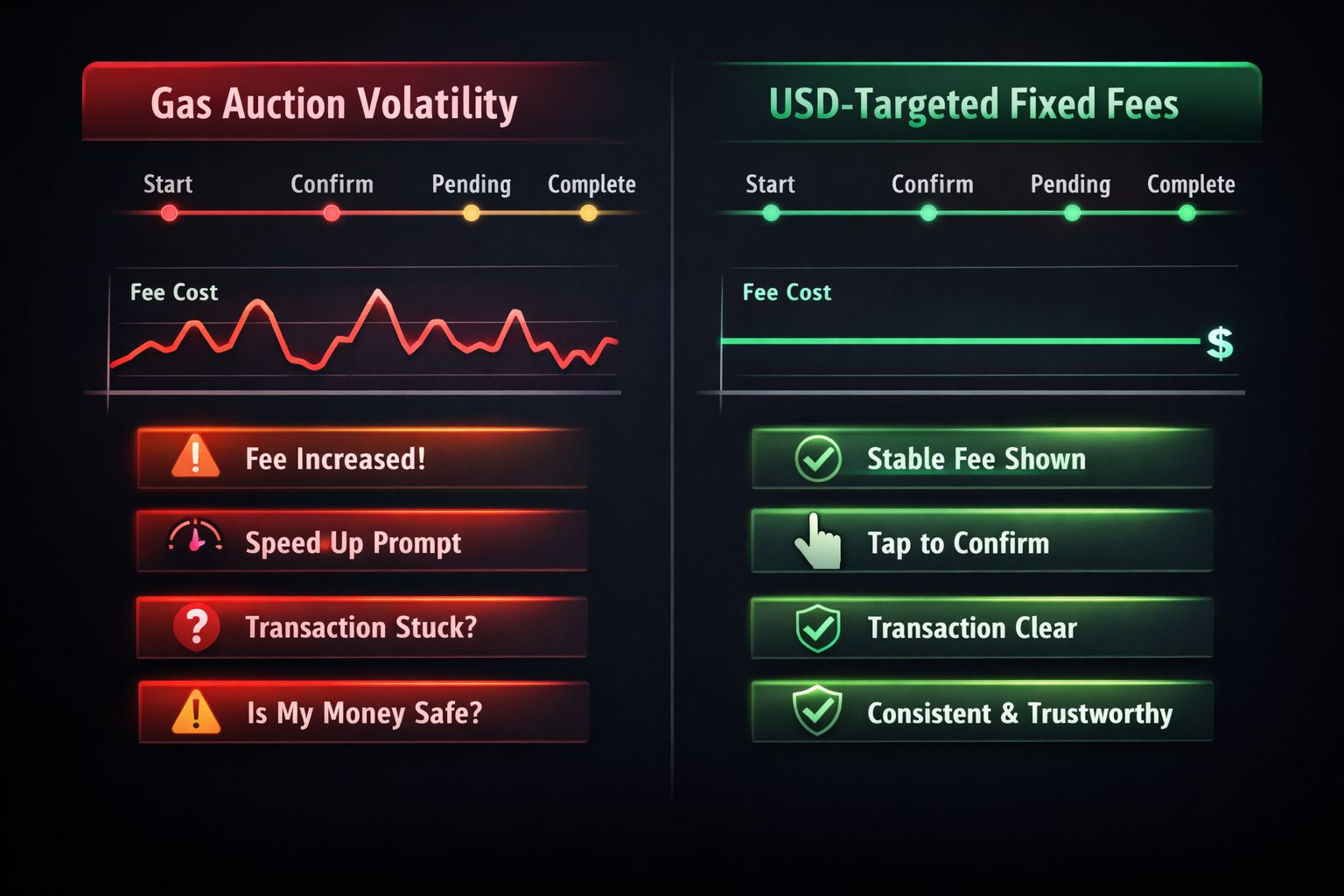
Users do not abandon crypto apps because they hate crypto. They abandon them because the experience feels unstable and stressful.
Gas auctions create stress in small repeated ways.
1. The fee changes seconds after the estimate
2. The user sees prompts like speed up
3. The user is unsure if the transaction failed or is just stuck
4. The user worries their money is gone
That anxiety is the opposite of mainstream UX.
When a user knows the same action costs basically the same every time, the app becomes trustworthy. Not because it is centralized. Because it is consistent.
That consistency is what gives builders freedom. You can design flows like tap to claim reward or tap to mint without adding extra screens to explain gas, congestion, and fee strategy.
Architecture choice that makes it viable
The obvious pushback is simple. If fees are tiny and stable, will people spam the chain
Vanar answer is tiering. Pricing tiers map to transaction size and gas used. Common light actions stay in a low tier. Heavy transactions move into higher tiers. This is documented as a way to keep normal actions cheap while making abuse expensive.
The whitepaper also discusses the logic of discouraging attacks by pricing large consumption higher, rather than letting the network punish everyone through sudden spikes.
My interpretation is that tiering is Vanar pressure valve. Other chains often outsource protection to fee spikes that hurt ordinary users. Vanar tries to push cost onto the actor consuming outsized resources.
The hidden engine behind it
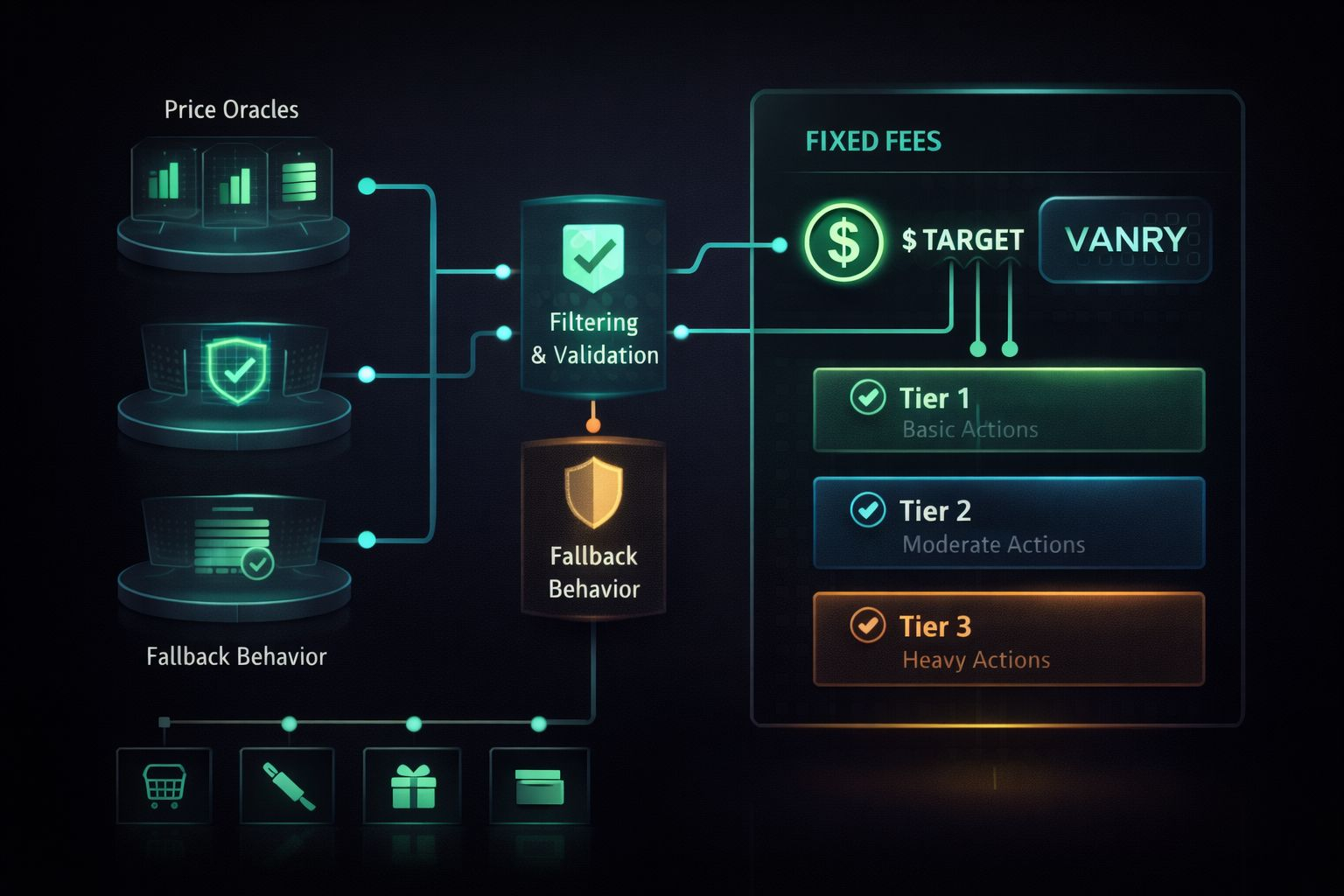
Any USD targeted fee system lives or dies on price input quality and how it handles bad data.
Vanar documentation describes validating VANRY price using multiple sources, applying filtering and thresholds, and using fallback behavior when data is unavailable or suspicious.
This matters because trust shifts.
In gas auctions, users trust a market. In fee targeting, users trust a control system. That control system must perform during volatility, outages, and manipulation attempts.
Token utility and economics
It is easy to say VANRY is gas. In this model, VANRY becomes something more specific. It is the settlement fuel behind a UX promise.
If fees are predictable and small, the value story leans away from high fee extraction per transaction and toward high frequency volume and habit. The question becomes whether Vanar can drive enough repeated consumer actions that small fees aggregate into durable demand.
Vanar also frames VANRY around staking and network security. That matters because low user fees alone do not pay for security. There must be a broader incentive design.
Ecosystem role
Fee targeting matters most in consumer apps, especially games.
DeFi users can tolerate complexity because money apps are expected to be complex. Gamers do not want finance homework.
In a game, on chain actions are background operations.
1. equip item
2. craft
3. upgrade
4. trade
5. claim
6. tip
7. unlock
These actions must feel instant, cheap, and predictable. If each tap risks a fee shift, the flow breaks.
Vanar messaging around gaming and consumer onboarding aligns with that reality. The fee model matches the world they want to serve. Their performance and responsiveness targets are also part of making interactions feel normal.
Data points that matter without pretending numbers equal adoption
I do not treat stats as hype. I treat them as a pulse check.
Vanar explorer displays cumulative counts for blocks, transactions, and addresses, which indicates sustained block production and throughput over time.
Market trackers list circulating and max supply figures and current trading activity, which is more useful as a liquidity and attention proxy than as a price narrative.
None of this proves mass daily active users. But it suggests the chain is not a ghost.
Recent progress signals I consider meaningful
I do not only look for big partnership headlines. I look for steady improvements that strengthen the exact promise being made.
For Vanar, meaningful progress signals include clearer documentation around fee tiers and fee management, explicit mechanics for frequent updates and fallback behavior, and ecosystem tooling that supports smoother onboarding flows.
If the thesis is UX freedom, then docs and tooling are not supporting material. They are part of the product.
The tradeoff that will matter long term
Any system that relies on an actively managed pricing mechanism must eventually answer governance questions.
1. who controls the update pipeline
2. how oversight works
3. what the path is toward stronger neutrality and resilience
Vanar published model includes foundation involvement in key operational framing. That can be practical early. Long term, credibility grows as single point trust is reduced.
A clear conclusion
Vanar is not trying to win a cheapest chain contest. It is trying to win something harder.
A chain where the user never feels like they are bargaining with the network.
If Vanar can keep USD targeted fees credible under stress, not only in calm markets, then it unlocks a specific kind of product design freedom.
Apps can show prices confidently. Brands can sponsor usage predictably. Games can run micro interactions without breaking flow. Onboarding can feel like Web2.
If that happens, VANRY stops feeling like a speculative token and starts behaving like infrastructure demand. The quiet fuel behind millions of tiny actions that are smooth enough people stop noticing they are on chain.
