
Crypto is full of “utility tokens,” but there’s an uncomfortable truth most people avoid:
In many networks, the token is optional to what users actually want.
You can speculate without using the product.
You can use the product without caring about the token.That disconnect weakens long-term demand.Vanar is trying to solve this at the model level, not the marketing level.From Gas Token to Access Token.In most blockchains, tokens exist mainly to pay gas.Gas demand rises only when activity spikes — and users usually want to hold as little of it as possible. The token becomes a toll booth, not a value driver.
Vanar flips this logic.
With its Neutron and Kayon layers, basic operations remain predictable and inexpensive. But advanced intelligence features — deeper indexing, higher query volumes, reasoning workflows, and enterprise-grade intelligence — require $VANRY.
In this design, VANRY isn’t just fuel.
It’s an access credential to the most valuable parts of the stack.
A Paid Intelligence Stack, Not a One-Time Fee
Vanar isn’t building something you use once.
Its core products are repetitive by nature:
Asking questions.Indexing data.Running reasoning cycles.Refreshing memory.Executing automated workflows.Operating agents continuously.This makes subscription logic natural, not forced.
Instead of “pay once and forget,” usage becomes recurring, just like cloud services. The more useful the intelligence layer becomes, the more consistent the demand for VANRY becomes — independent of market hype.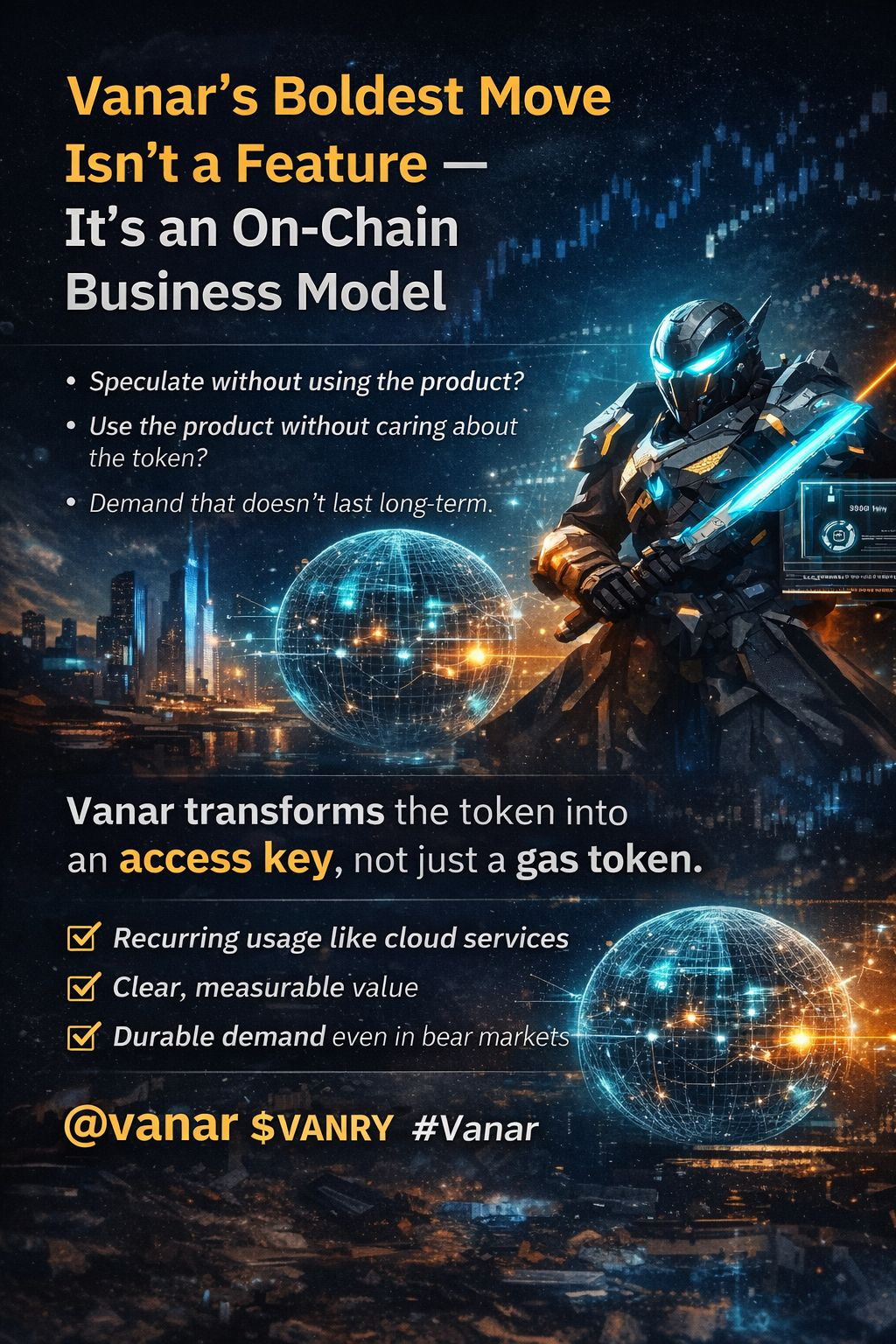
Why Subscription Logic Fits Vanar Better Than Most Chains
Subscriptions work when:
Usage is measurable
Value compounds over time
Costs are predictable
Vanar’s architecture allows this.
Memory objects, query counts, reasoning cycles, and automation workflows are quantifiable — far easier to meter than abstract “ecosystem growth.”
This begins to resemble a cloud platform model, where users pay for:
Queries.Compute.Intelligence depth.Operational scale
When usage is measurable, pricing becomes controllable.
Teams can budget.
Businesses can approve spend.
Builders can price products sustainably.
That’s rare in crypto.
Earned Demand vs Emotional Demand
Most tokens rely on excitement.
 Service tokens rely on necessity.
If a developer builds a product dependent on Vanar’s intelligence layer, VANRY becomes an operating cost, not an investment thesis — similar to API credits or cloud compute.
That kind of demand is quieter, slower… but far more durable.
Even in bear markets, companies still pay for infrastructure that keeps running.
Discipline Comes With the Model
A subscription model forces accountability.
You can’t survive on narratives when users pay monthly.
The product must:
Work reliably
Improve continuously
Offer clear pricing
Provide support and documentation
This pushes Vanar from “we have tech” to “we have a business loop.”
That’s maturity
The Risk: Charging Before Value Is Felt
There is a danger.
If subscriptions are introduced before users feel real value, it backfires. Crypto users already hate being nickel-and-dimed.
The clean path is:
A generous free tier
Paid access only for scale, depth, and enterprise needs
Clear value before cost
People pay willingly when results are obvious:
faster decisions, cleaner audits, fewer errors, saved time.
Why This Matters Over the Next 18 Months
Most L1s depend on a single driver: trading activity.
When trading slows, everything slows.
Vanar introduces a second driver: service usage.
Consumer tools.
Business intelligence.
Builder infrastructure.
Multiple products → multiple reasons to hold and use $VANRY.
That diversification makes the network harder to dismiss as a fad.
Final Thought
Vanar isn’t just positioning itself as an AI chain or a fast chain.
It’s attempting something rarer:
Commodifying intelligence itself and making it purchasable, measurable, and repeatable — on-chain.If successful, $VANRY stops being a token of hope and becomes a token of work.That path is harder.
It demands real product discipline.
But if Vanar executes well, it could be one of the few crypto models where real usage turns into a recursive, earned economic system — not hype-driven demand.
@Vanar @Cas Abbé @生财王者 @Sniper-007 @CatizenAI @furan @Ragnar_bnb @User-Vivian89 @Binance Earn Official @BinanceOracle @Binance Labs @ageofdino @Addy177 @Mukesh-Verma17
