

When I spend time with Vanar, I don’t think about it as a blockchain I’m supposed to admire. I think about it as a system that is trying to disappear. That may sound counterintuitive in an industry that often rewards visibility and complexity, but for consumer-facing infrastructure, invisibility is usually the goal. The moment users are forced to understand what chain they’re on or why a transaction behaves a certain way, the system has already failed at its primary job.
What makes Vanar interesting to me is how consistently its design choices align with that idea. The team’s background in games, entertainment, and brand work shows up not in flashy features, but in restraint. Products like Virtua Metaverse and the VGN games network aren’t theoretical showcases. They are environments where users interact repeatedly, often casually, and with very little patience for friction. That kind of usage exposes weaknesses quickly. If onboarding is clumsy, people leave. If performance stutters, they disengage. If ownership feels abstract, it gets ignored. Building infrastructure that survives those conditions requires different priorities than building something meant to be studied.
Looking at how the system is structured, I see a deliberate effort to absorb complexity rather than surface it. The chain is doing work on behalf of the user instead of asking the user to meet it halfway. This is not about oversimplifying reality, but about placing responsibility where it belongs. Everyday users do not want control over every parameter; they want consistency. They want things to work the same way tomorrow as they did today. Vanar’s approach suggests an understanding that reliability and predictability are features in their own right.
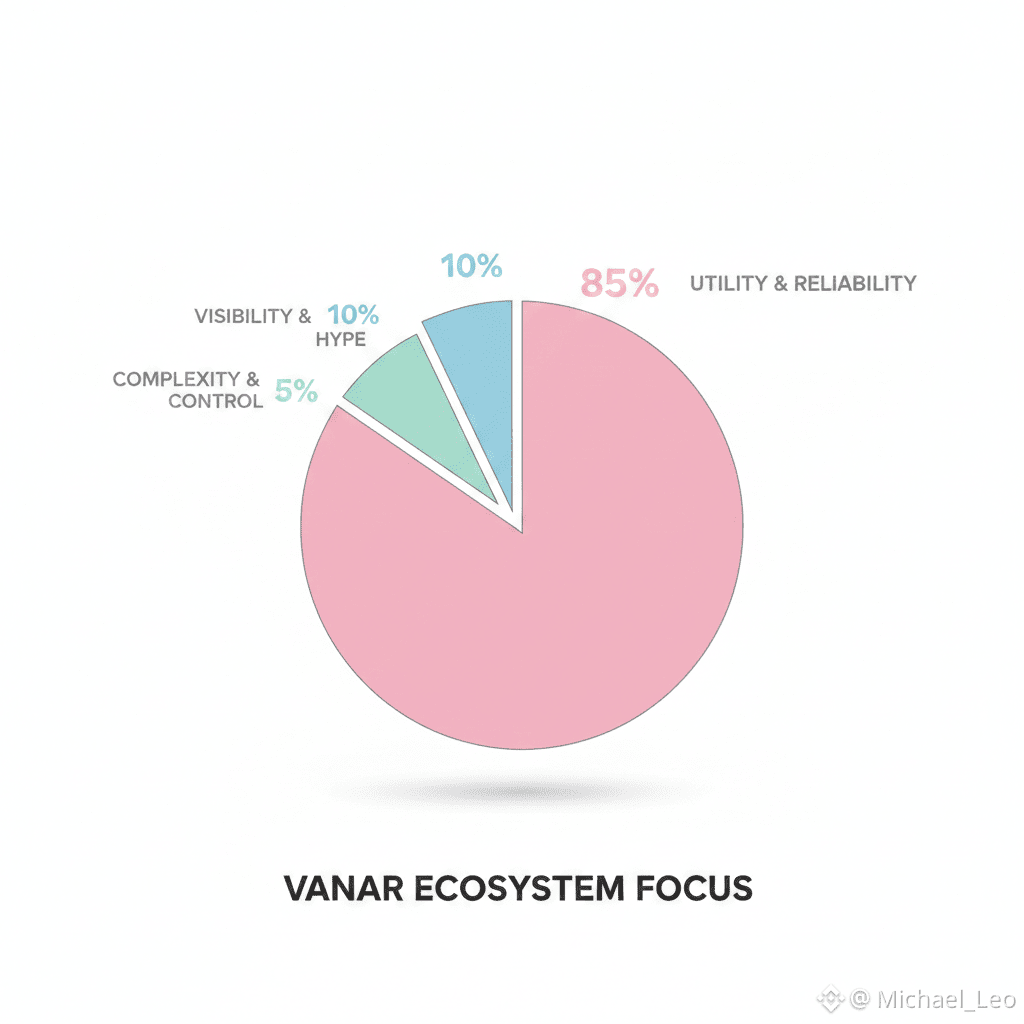 The breadth of verticals Vanar touches, from gaming to brand integrations to AI-related tooling, initially looks ambitious to the point of risk. But I’ve come to see this less as expansion and more as stress testing. Each vertical places different demands on the underlying system. Games punish latency. Brands punish instability. Persistent digital environments punish poor state management. If the infrastructure can hold up under those pressures, it earns its place quietly.
The VANRY token, in this context, feels utilitarian. Its purpose is tied to access, coordination, and ongoing use across the ecosystem rather than to attention. That choice limits excitement, but it strengthens alignment. Tokens that are boring in day-to-day operation are often the ones doing real work behind the scenes.
Stepping back, what Vanar signals to me is a future where consumer blockchain infrastructure succeeds by behaving more like background software than a destination. The systems that last will be the ones people stop thinking about, not because they are trivial, but because they are dependable.
