

Everyone keeps asking whether blockchain will actually replace traditional payment infrastructure, and honestly, most Layer 2s aren't even close. But Plasma is doing something different that's making institutions pay attention. It's positioning itself not as another crypto network, but as the settlement layer for how money actually moves globally. And the crazy part? It might actually work.
Let's get real about what's happening here.
What Settlement Layers Actually Do
Here's what most people miss about global payments: the actual movement of money between banks, countries, and institutions happens on settlement layers. SWIFT doesn't move money—it sends messages. Correspondent banks don't transfer value instantly—they update ledgers and settle later. The whole system is built on delayed settlement with multiple intermediaries taking cuts.
Plasma offers something radically different: instant cryptographic settlement where transactions are final in seconds, not days. When USDT moves on Plasma, it actually moves. No correspondent banks. No settlement windows. No wondering if the transaction will clear tomorrow.
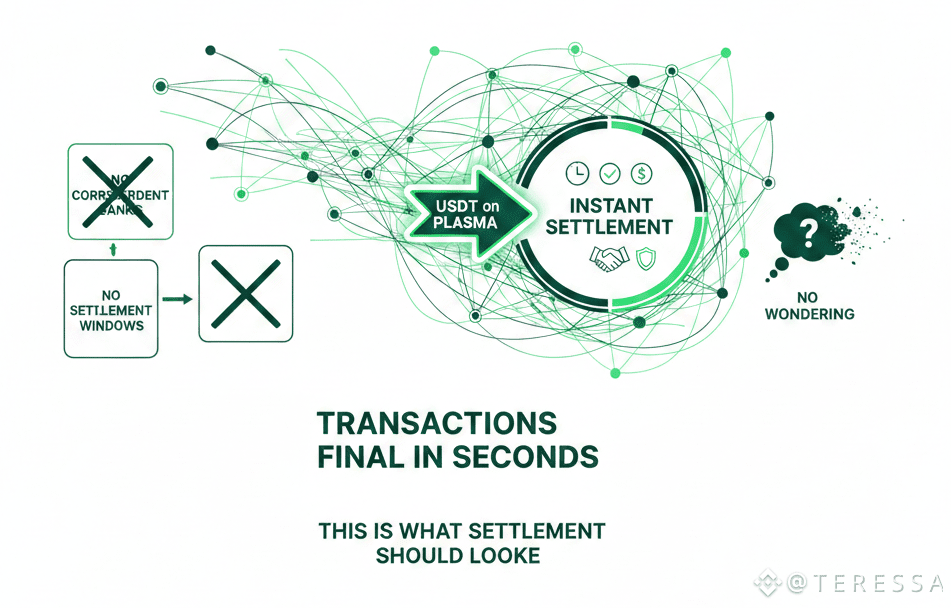
This is what settlement should look like if we'd had the technology from the start.
Why Institutions Are Actually Interested
Banks and financial institutions aren't interested in blockchain for ideology. They're interested because their current settlement infrastructure is expensive, slow, and increasingly inadequate for global digital commerce. Correspondent banking costs billions annually in fees. Settlement delays create counterparty risk. Cross-border payments take days when internet communication is instant.
Plasma's stablecoin-focused infrastructure speaks the language institutions understand. USDT and USDC settlement with cryptographic finality, transaction costs measured in pennies, and throughput that handles institutional volume. This isn't asking banks to reinvent money—it's offering better rails for moving the money they already use.
The Stablecoin Settlement Advantage
Let's talk about why stablecoins matter here. Traditional settlement requires currency conversion, exchange rate risk, and multiple intermediaries. Stablecoin settlement eliminates all of that. Dollar-to-dollar transfers happen identically whether you're sending across town or across continents.
Plasma processing billions in USDT and USDC daily creates a parallel settlement layer that's faster, cheaper, and more transparent than correspondent banking. Institutions can settle trades, clear invoices, and move treasury positions with immediate finality instead of T+2 or T+3 settlement cycles.
The cost savings alone justify institutional attention. The speed advantage makes new business models possible.
Real-World Use Cases Emerging
Everyone wants concrete examples. Here's what's actually happening: payment processors are using Plasma for cross-border settlement. Remittance companies are routing transfers through Plasma rails instead of correspondent banks. Trading firms are settling OTC deals with instant stablecoin transfers. Corporate treasuries are testing Plasma for supplier payments.
These aren't experiments—they're production implementations handling real volume. The settlement layer isn't theoretical. It's operational and proving its value with every transaction.
The Regulatory Path Forward
Here's where it gets interesting. Regulators globally are establishing frameworks for stablecoin settlement. Major jurisdictions are clarifying how blockchain-based settlement can comply with existing financial regulations. This regulatory maturation makes institutional adoption viable.
Plasma operating within these emerging regulatory frameworks positions it as legitimate settlement infrastructure rather than a regulatory workaround. Institutions need regulatory clarity to commit capital. That clarity is emerging, and Plasma is positioned to benefit.
Comparing to Traditional Settlement
Bottom line: SWIFT processes about 45 million messages daily. Settlement through correspondent banking costs $25-50 per wire transfer and takes days. Plasma processes stablecoin transfers for fractions of a cent with sub-second finality. The comparison isn't even close on performance or economics.
The question isn't whether Plasma's settlement is technically superior—it obviously is. The question is whether institutions will overcome inertia and legacy system integration challenges to adopt it. And increasingly, the answer appears to be yes.
What Global Money Settlement Requires
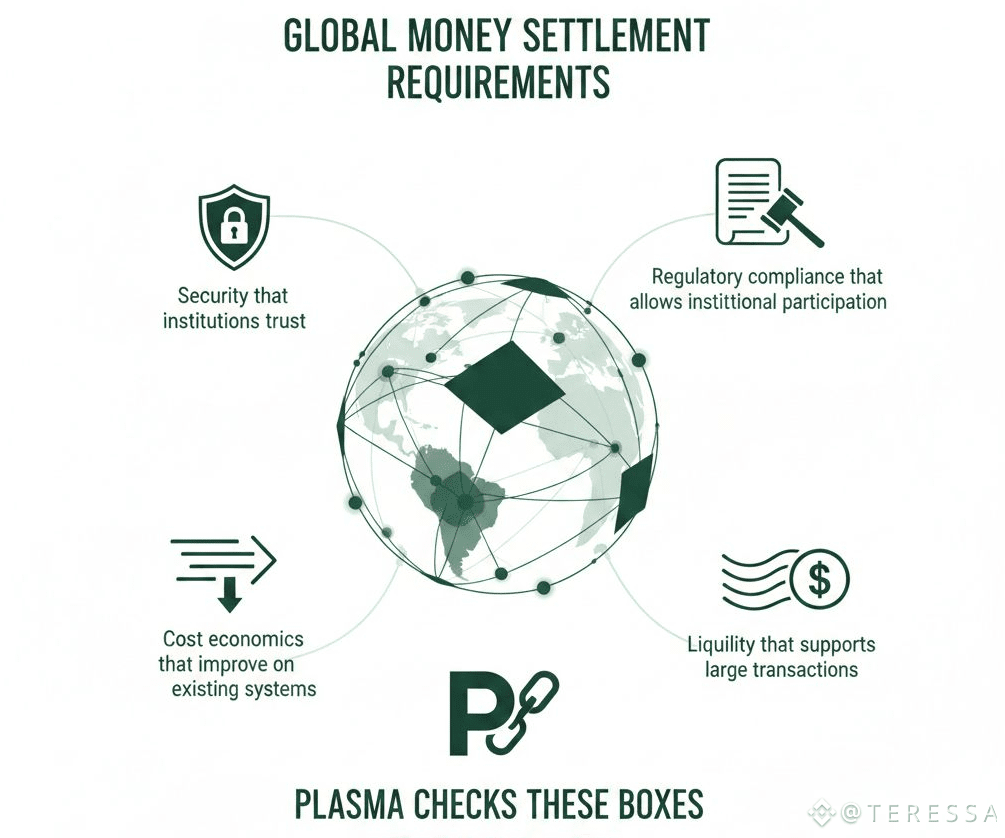
Let's be specific about what replacing traditional settlement requires: security that institutions trust, throughput that handles global volume, cost economics that improve on existing systems, regulatory compliance that allows institutional participation, and liquidity that supports large transactions.
Plasma checks these boxes in ways other blockchain networks don't. The security model is robust. The throughput is proven. The costs are dramatically lower. Regulatory frameworks are developing. And the liquidity—$1 billion and growing—supports institutional-scale settlement.
The Future of Money Movement
Everyone keeps debating whether blockchain will disrupt finance. Plasma suggests the disruption is already happening in settlement—the infrastructure layer most people never think about but that determines how efficiently money actually moves.
As more institutions test Plasma settlement and discover the cost and speed advantages, adoption compounds. Network effects in settlement infrastructure are powerful. The more participants using Plasma rails, the more valuable those rails become for everyone.
Is Plasma the new settlement layer for global money? Not yet universally, but the trajectory is clear. Institutions are testing it. Real volume is flowing. The economics favor adoption. And traditional settlement infrastructure isn't getting better while Plasma continuously improves.
The question isn't whether better settlement infrastructure will eventually win. It's how fast the transition happens. And based on current momentum, that transition is accelerating faster than most people realize. Global money needs modern settlement rails.
@Plasma is building them.

