

@Dusk is doing something very specific. #dusk is building a chain where real-world assets can settle privately, where institutions don’t have to choose between compliance and confidentiality. Zero-knowledge proofs, selective disclosure, regulated settlement — not narratives, but requirements
Real-world assets didn’t fail on crypto because of tokenization. They failed because blockchains were never designed to carry regulated value without breaking themselves.
Everyone talks about putting stocks, bonds, funds, and real estate onchain. Very few talk about what happens after you do that. Who is allowed to see what? Who is allowed to trade? What happens when compliance changes? How do you prove ownership without exposing identities? How do you settle value without turning the chain into a surveillance machine?
This is where most RWA narratives collapse.
Dusk Network exists precisely in that gap — not as a “tokenization chain,” but as regulated financial infrastructure built for onchain privacy.
Traditional finance works because rules are enforced selectively. Regulators see what they must see. Participants only see what they’re entitled to. Markets stay compliant without becoming transparent to everyone. Public blockchains inverted that model: everything is visible to everyone, all the time. That’s great for censorship resistance, but fatal for institutions.
Dusk flips the architecture without breaking decentralization.
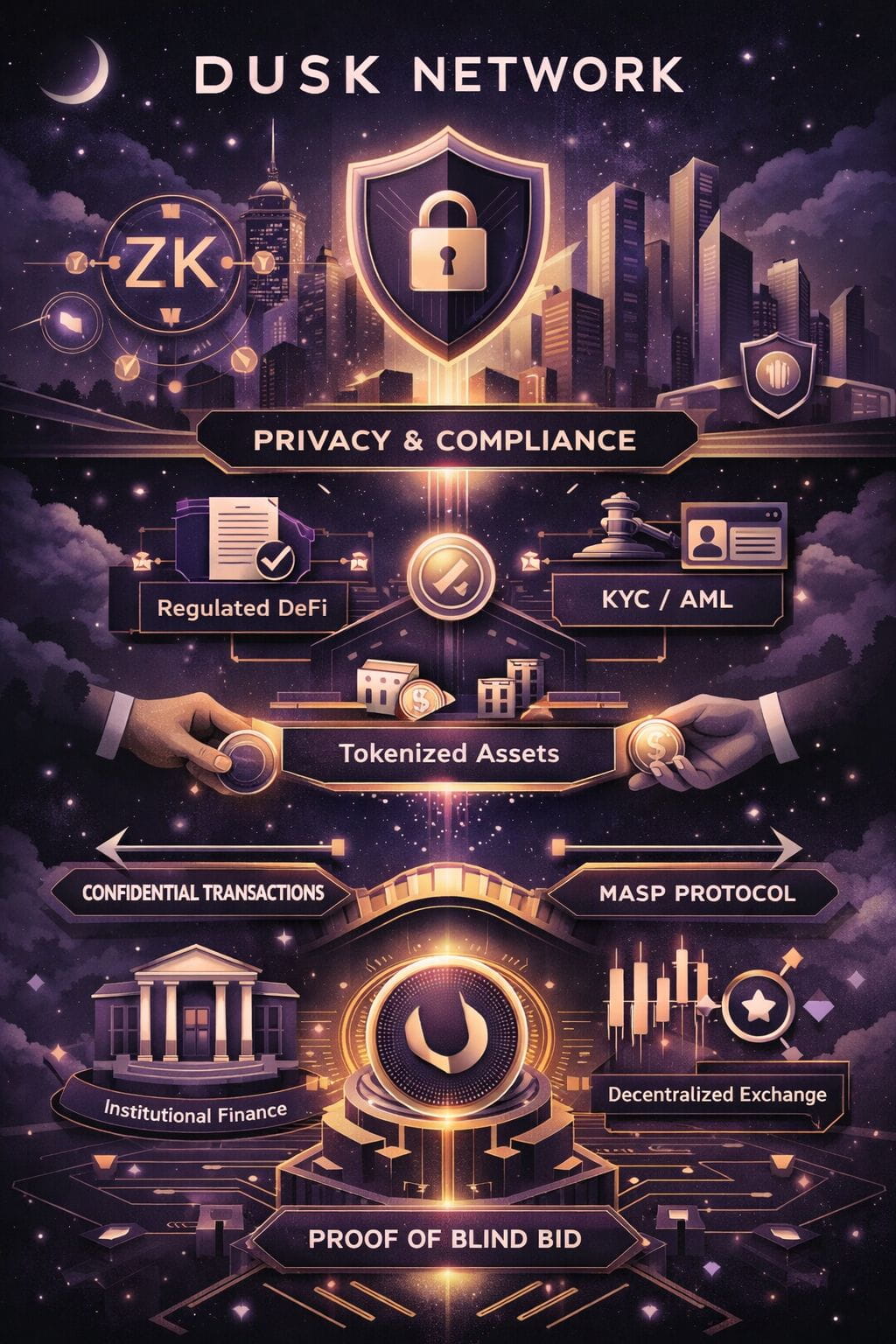
At its core, Dusk is built around zero-knowledge compliance. Not privacy as secrecy, but privacy as controlled disclosure. Transactions, ownership, and settlement can be validated without broadcasting sensitive data to the entire world. This is the missing primitive for real-world assets.
When a regulated asset moves on Dusk, the chain can verify that:
– the asset is real
– the participant is eligible
– the transfer follows jurisdictional rules
…without exposing identities, balances, or counterparties publicly.
That’s not cosmetic privacy. That’s structural.
This is why Dusk keeps showing up where others can’t. Equity issuance. Security tokens. Regulated secondary markets. These aren’t experiments — they require compliance guarantees by design. Dusk doesn’t bolt those guarantees on later. They are native.
Another thing most people miss: RWA isn’t about speed or fees. Institutions don’t care if a block settles in 400ms instead of 1 second. They care about finality, legal clarity, and auditability without leakage. Dusk optimizes for the things crypto usually ignores — and that’s exactly why it works for finance.
Dusk’s confidential smart contracts allow logic to execute without revealing the underlying data. That means dividend distribution, corporate actions, fund mechanics, and compliance checks can all happen onchain, without turning balance sheets into public artifacts. This is what allows real financial products to exist without compromise.
And importantly, Dusk doesn’t try to replace financial law. It encodes it.
Instead of asking regulators to “adapt,” Dusk builds rails that respect existing frameworks while removing intermediaries where they aren’t needed. Settlement becomes faster. Issuance becomes cheaper. Markets become global — but rules remain intact.
This is why Dusk doesn’t market itself loudly. It doesn’t need to. Its users aren’t chasing hype cycles. They’re issuing assets, settling value, and building markets that actually have to survive scrutiny.
Real-world assets won’t live on chains that treat compliance as an afterthought.
They won’t live on chains that confuse transparency with legitimacy.
They won’t live on chains that leak sensitive data by default.
They will live where privacy and regulation coexist.
That’s the category Dusk occupies — intentionally, deliberately, and with infrastructure that actually holds weight.
Not a promise.
Not a narrative.
A financial system that works when real money shows up.
