
There is a dirty little secret in the Web3 world that most projects don't want you to know. When you buy an NFT, or when a Real World Asset (RWA) is tokenized, or when a game item is "saved" on the blockchain, you assume that the item itself lives on the chain.
You are almost always wrong.
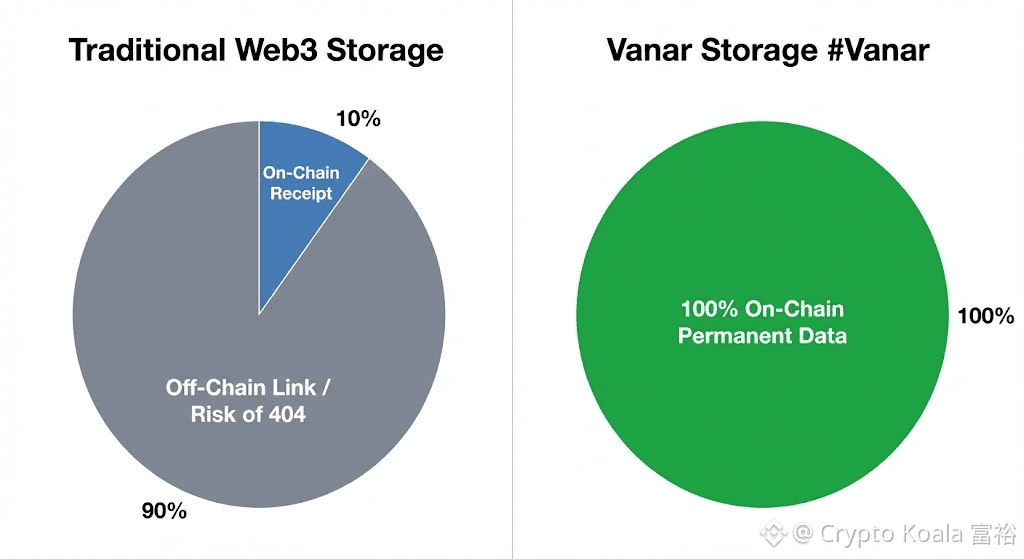
In 99% of cases, what lives on the blockchain is just a tiny text file containing a link. That link points to a server—maybe IPFS, but often just a centralized server like Amazon AWS or Google Cloud.
This creates a massive fragility problem. If the startup that sold you the NFT goes bankrupt and stops paying their server bill, the image disappears. If the link breaks, your valuable asset becomes a "404 Error." You still own the token, but it is now pointing to nothing. It’s like owning a deed to a house, but when you drive to the address, there is just a giant hole in the ground.
For Web3 to mature from selling JPEGs to handling serious Real World Assets (RWAs) like real estate deeds, legal contracts, and medical records, this reliance on external links must end.
This is why the "Neutron" engine built by @Vanar is such a critical breakthrough. It solves the problem of permanence through a revolutionary method of data compression.
The Magic of "Seeds": 500:1 Compression
Storing actual data (images, 3D models, documents) directly on a blockchain has always been prohibitively expensive. It clogs the network.
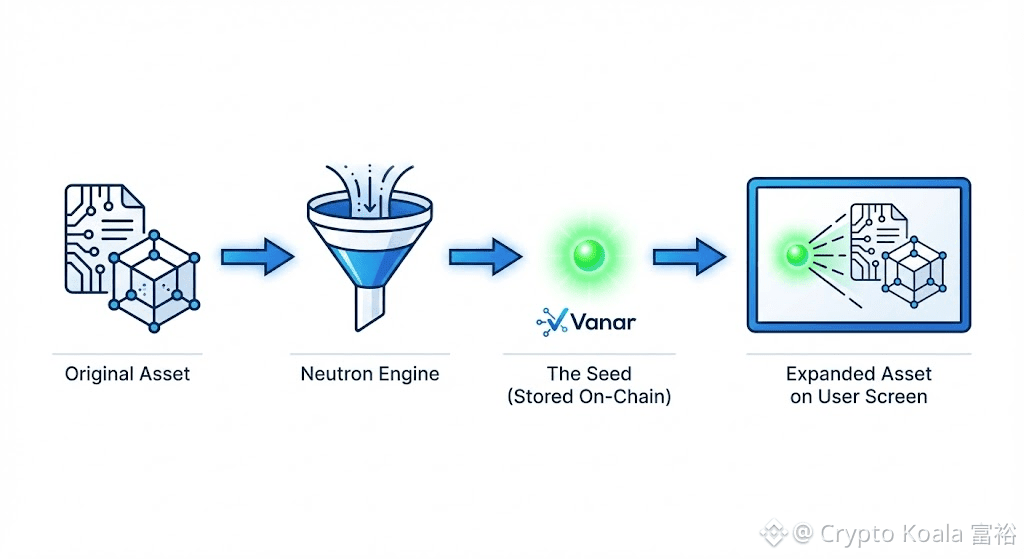
Vanar’s Neutron engine changes the physics of this equation using generative compression. Instead of trying to shove a massive file onto the chain, Neutron breaks the data down into its mathematical DNA, which we call a "Seed."
Think of it like a biological seed. An acorn is tiny, but it contains all the genetic instructions needed to build a massive oak tree. You don't need to store the whole tree; you just need to store the acorn and the instructions.
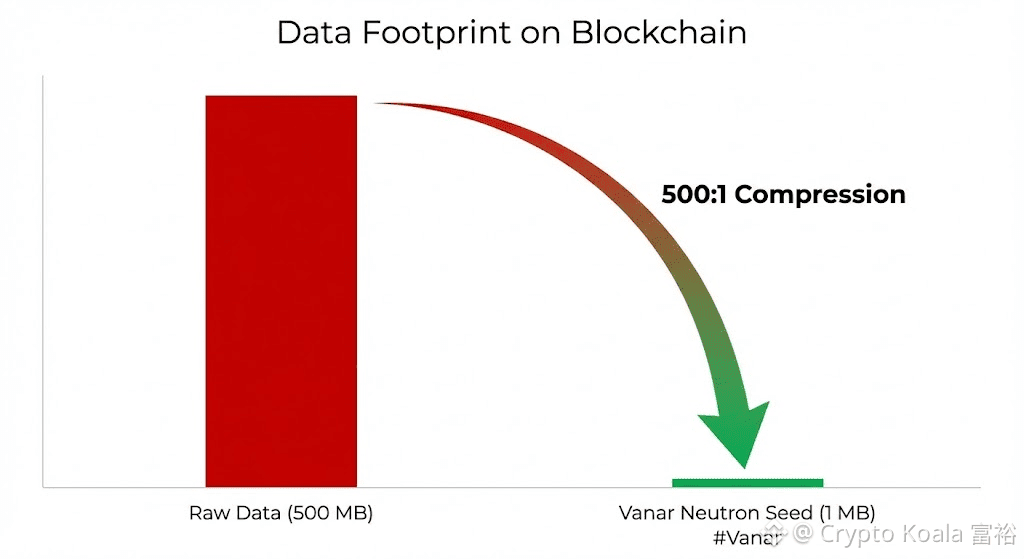
Neutron achieves a compression ratio of up to 500:1. This means a 500 MB file can be compressed down to just 1 MB of essential "Seed" data.
How Generative Reconstruction Works
When you access your asset on the Vanar chain, the network takes that tiny "Seed" and uses the Neutron engine to regenerate the original file in real-time on your device.
Because the instructions are mathematical and precise, the result is identical every single time. But the burden on the blockchain is 500 times lighter.
This allows Vanar to store the actual asset on-chain, not just a link to it.
Why This Matters for Real World Assets (RWA)
Let’s apply this to the trillion-dollar market of Real World Assets.
Imagine tokenizing a luxury apartment building. You need to store the architectural blueprints, the legal deed, and the inspection reports. You cannot risk these documents disappearing because a link broke.
With Neutron, the legal documents themselves are compressed and stored as immutable Seeds on the ledger. They are as permanent as the transaction itself. As long as the blockchain exists, the document exists. This creates a level of trust and security that traditional "link-based" blockchains simply cannot offer.
The Economic Efficiency
This technology also completely changes the economics of the network. On Ethereum, storing 1GB of data would cost millions of dollars. On Vanar, thanks to this compression, it becomes negligible.
This efficiency drives demand for the $VANRY token, not just for simple transfers, but as the payment currency for this high-tech storage. Every time a Seed is planted (stored) or reconstructed, the network generates economic activity.
Conclusion
The era of "broken links" and disappearing NFTs is coming to an end. We cannot build the future of finance and ownership on temporary infrastructure.
By solving the data storage problem with 500:1 compression, #Vanar is providing the only viable home for assets that need to last forever. Whether it’s a gaming sword or a house deed, if it’s on Vanar, it’s actually there.
