


That single problem is the doorway into what Dusk is trying to be.
Because in real finance, visibility is not automatically fair. A fully transparent ledger can leak positions, counterparties, settlement timing, inventory levels, and strategy. It can expose the exact shape of a market’s behavior in a way that rewards predation. At the same time, pure secrecy doesn’t work either, because institutions live inside audits, risk committees, regulatory obligations, and reporting requirements. Dusk exists in that tension. The entire design feels like an attempt to build a public settlement system where confidentiality is normal, but accountability still exists when the system needs it.
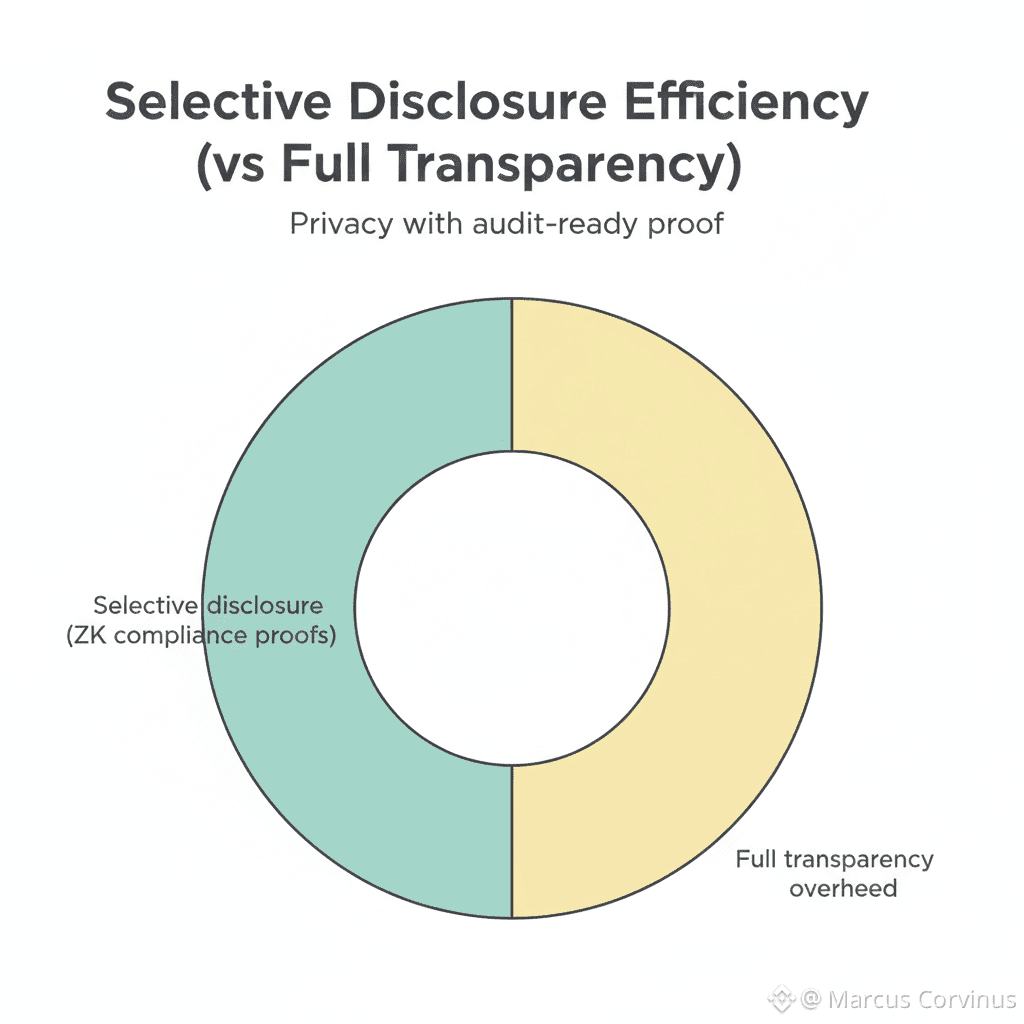
Their own positioning keeps repeating the same core idea in different words: a layer-1 blockchain built for financial applications, built around confidentiality, built around settlement finality, built around a privacy model that doesn’t collapse the moment regulated assets and compliance enter the room. They don’t describe privacy as an optional add-on. They describe it as a foundational property, because financial data is sensitive by nature.
The whitepaper frames this as building a scalable public infrastructure that can support direct settlement finality while maintaining strict data privacy. The website story leans into the idea that Dusk is for regulated and privacy-focused financial infrastructure, and that the chain is designed to support institutional-grade financial applications, compliant DeFi, and tokenized real-world assets with privacy and auditability built in by design. That is the premise. Everything else is an attempt to make that premise real.
When I dug into how they do it, the first thing that stood out is that Dusk doesn’t force one transaction personality on every use case. Instead, it supports multiple transaction models. This is subtle but important, because finance itself is not a single model. Some flows can be transparent. Some flows can be selectively disclosed. Some flows must remain confidential, otherwise participants simply won’t engage.
In the whitepaper, Dusk describes two core transaction models: Moonlight and Phoenix. Moonlight is the transparent, account-based model. Phoenix is a UTXO-based model designed to support both transparent and obfuscated transactions. That duality is not cosmetic. It’s the chain saying: we can support normal public flows, and we can support confidentiality where needed, without turning everything into a single rigid privacy tunnel.
Phoenix is not positioned as generic “private payments.” It’s described as a novel transactional model intended to bring confidentiality to transactions as well as smart contracts. The way they talk about Phoenix makes it feel structural, not optional. And then they build on it.
Tokens deployed on Dusk can build on top of Zedger, a hybrid privacy-preserving model based on Phoenix and developed specifically for security tokens. That sentence matters. It signals the real target: not only private transfers, but private instruments that still behave like real financial products.
Zedger is where Dusk stops feeling like privacy technology and starts feeling like market infrastructure. In the documentation and architecture descriptions, Zedger is presented as the asset framework that enables the Confidential Security Contract standard. This is about asset lifecycle, compliance-aware behavior, settlement logic, and enforceable constraints. Things like dividend distribution, voting mechanisms, capped transfers, redemption flows, and controlled account behavior are treated as expected features, not afterthoughts.
This is also where the privacy-plus-auditability idea becomes practical. The point is not that everything is hidden forever. The point is that confidentiality is preserved by default, while verification and accountability remain possible when required. Dusk keeps emphasizing that it is designed for financial markets, and financial markets don’t work without finality, predictable settlement, and enforceable rules.
That’s why their consensus design is central. They describe a Proof-of-Stake protocol called Succinct Attestation, designed to achieve settlement finality quickly and consistently. The framing is deliberate. This isn’t about flashy throughput numbers. It’s about behaving like settlement infrastructure rather than probabilistic experimentation.
Even before consensus, they focus on how information moves through the network. Kadcast appears as the peer-to-peer communication layer for broadcasting blocks, transactions, and consensus messages. It’s built around efficient routing and resilience to faults and churn. This kind of design choice rarely gets attention, but it matters if the system is expected to remain coherent under stress.
After understanding the architecture, I went straight to the code. That’s where narratives either hold up or fall apart.
The GitHub organization reflects the structure Dusk claims to have. There is a reference platform implementation and tooling. There is a full PLONK proving system in Rust, aligning with the privacy and zero-knowledge requirements of the protocol. There is Piecrust, a WASM virtual machine for smart contracts, signaling a serious approach to execution environments. Phoenix exists as its own module. There is node installation tooling. There are configuration surfaces for the EVM execution track.
It reads like a real stack being built: cryptography, execution, networking, operations, and developer tooling. Not a single monolithic repo pretending to do everything.
The next layer is how Dusk brings developers and markets into this system. This is where DuskEVM matters. DuskEVM is described as an EVM-compatible execution layer built on top of the Dusk settlement layer, with gas paid in DUSK and compatibility with familiar tooling. This is a pragmatic decision. Instead of forcing builders to learn an entirely new environment just to experiment, Dusk provides a familiar entry point while keeping the settlement and privacy logic underneath.
The documentation connects this execution layer to privacy tooling through components like Hedger, which facilitates zero-knowledge operations via precompiled contracts. The pattern is consistent: privacy primitives are meant to be usable, not exotic. If builders can’t work with them easily, they won’t be adopted.
Then there is the product direction. Dusk does not hide that it wants to go beyond infrastructure. They openly describe building a regulated asset trading platform, with an iterative rollout approach. The idea is to start with a narrow scope and expand over time. Alongside this, Dusk Trade exists publicly as a pre-launch interface focused on tokenized real-world assets, onboarding, and verification flows.
This matters because it shows intent. The chain is not only saying “you could build markets here.” It is actively shaping a path where markets actually exist.
Regulation is not avoided in this story. Dusk explicitly references working toward regulatory pathways such as a DLT-TSS exemption route with partners. That signals a willingness to engage with real-world constraints instead of pretending they don’t apply. For a privacy-focused financial chain, this is not optional. Institutions do not participate in systems that cannot explain their compliance posture.
The ecosystem references align with this direction. Oracles and messaging infrastructure. Issuance and market partners. Stablecoin integrations. Custody and settlement services. These are not flashy categories, but they are necessary if tokenized assets are going to move beyond theory.
When I think about benefits, I tie them directly to pain points.
Confidentiality reduces information leakage that harms market participants. Settlement finality reduces uncertainty and risk. Compliance-aware asset standards reduce legal and operational friction. Developer accessibility lowers the barrier to building real applications. A visible product pathway turns infrastructure into something users can actually touch.
Even the token footprint adds grounding. The ERC-20 contract you shared provides a public snapshot of supply, holders, and transfer activity. It doesn’t define the entire economy, but it anchors the system in something verifiable. Dusk’s own materials position the token as integral to network usage, especially within the execution environment.
Stepping back, Dusk feels like a project trying to define what privacy should look like when finance is taken seriously. Not total opacity. Not forced exposure. But a system where sensitive information is protected by default, settlement is credible, and regulated assets can exist without constant compromise.
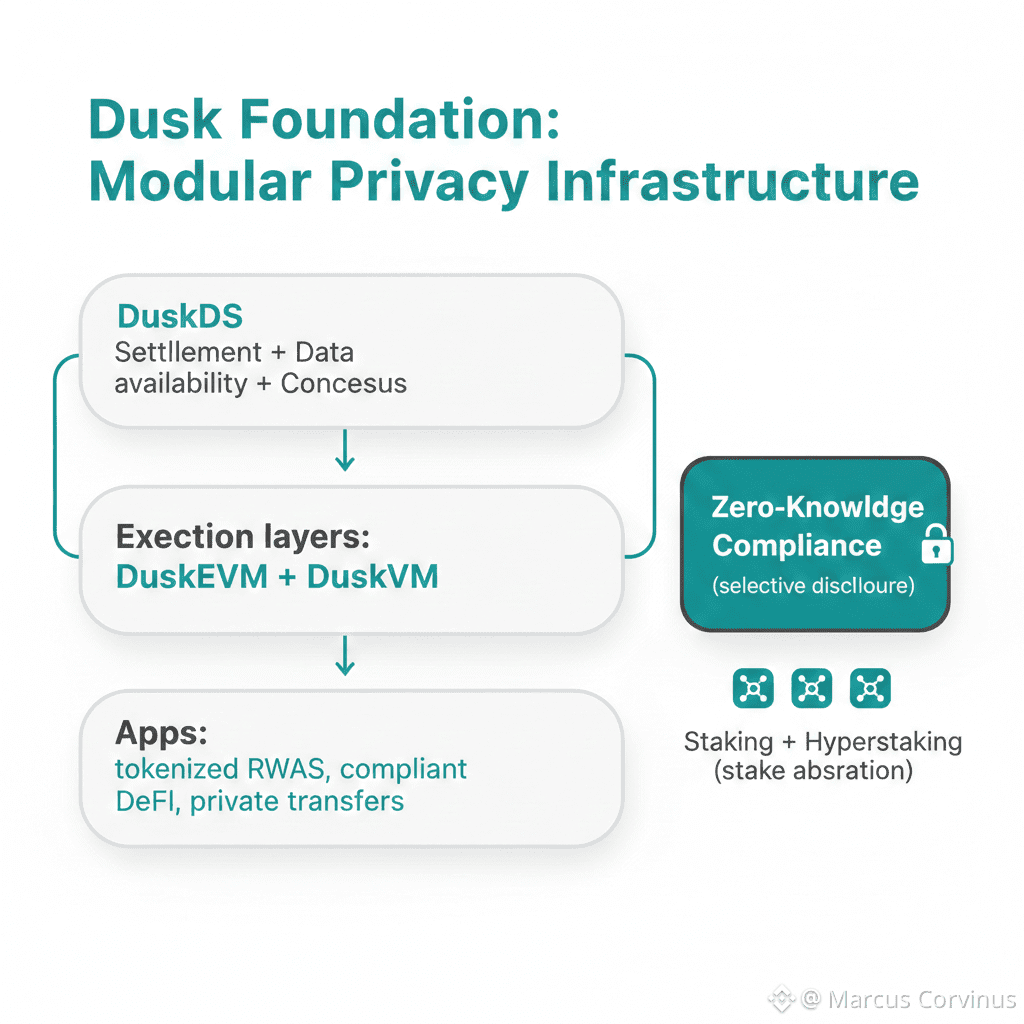
Phoenix gives the transactional foundation. Zedger and the Confidential Security Contract framework give assets structure. Succinct Attestation and Kadcast give the network settlement and resilience. DuskEVM gives developers a familiar execution surface. Dusk Trade gives the architecture a destination.
If this works, Dusk doesn’t become interesting because it is private. It becomes interesting because it allows financial activity to happen without broadcasting everything to the world, while still preserving the rules and accountability that markets rely on.
