


The hesitation does not happen on chain though.
It happens before anyone presses publish.
A creative change sits ready. The build passes. The interaction feels right in isolation. On Vanar, that's the last comfortable moment. Once the onchain experience state advances, the outcome isn't just live... it is witnessed. Someone has already seen it. Reacted to it. There's no quiet undo for that.
You feel it in the tiny calls teams start making. The build is green, but the button still doesn't get pressed.
Try it. Watch it. Roll it back if it doesn't land. That's the old muscle memory. Some changes don't behave like drafts on Vanar chain. They behave like commitments. Once an experience renders, the system moves on even if the creator is still thinking, and teams slow down in places they didn't before.
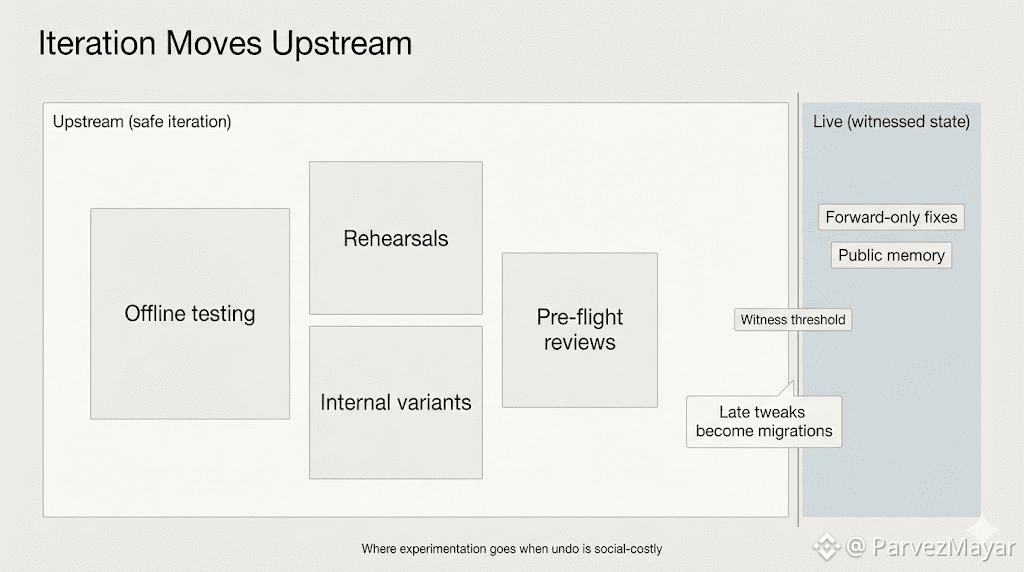
Ideas get tested earlier, away from users. Flows are rehearsed instead of tweaked. A creative decision that once would have shipped "just to see" now carries the weight of consequence. Not because it is dangerous, but because it's final in a way that matters socially, not just technically. You can feel it in the choices people stop making.
An interaction that could surprise gets trimmed.
A variant that might confuse gets shelved.
A moment that would've been playful gets replaced with something predictable.
Not because the system forbids it. Because the system won't pretend it did not happen.
Vanar doesn't shatter creative work, but it changes how close to the edge iteration is allowed to get. Experimentation migrates upstream. The live environment stops feeling like a sandbox and starts behaving more like a stage. Once you're on it, you don't want to be caught adjusting the set.
Everything works. States resolve. Users progress. From the outside, nothing looks constrained. Inside, the room for last-minute change narrows. Vanar's Creative adjustments start to feel like migrations instead of tweaks and people adapt without ever announcing that they have.
Rehearsals get longer. Arguments happen earlier. Fewer experiments make it through, and the ones that do get defended harder.
The system isn't instructing anyone to behave this way. The irreversibility is.
On Vanar, some outcomes can't be unseen once they are rendered. You don't get to quietly correct the moment after the fact. If something needs changing, it becomes a forward move actually, not a rewind, and that shifts how risk gets priced before anything is public.
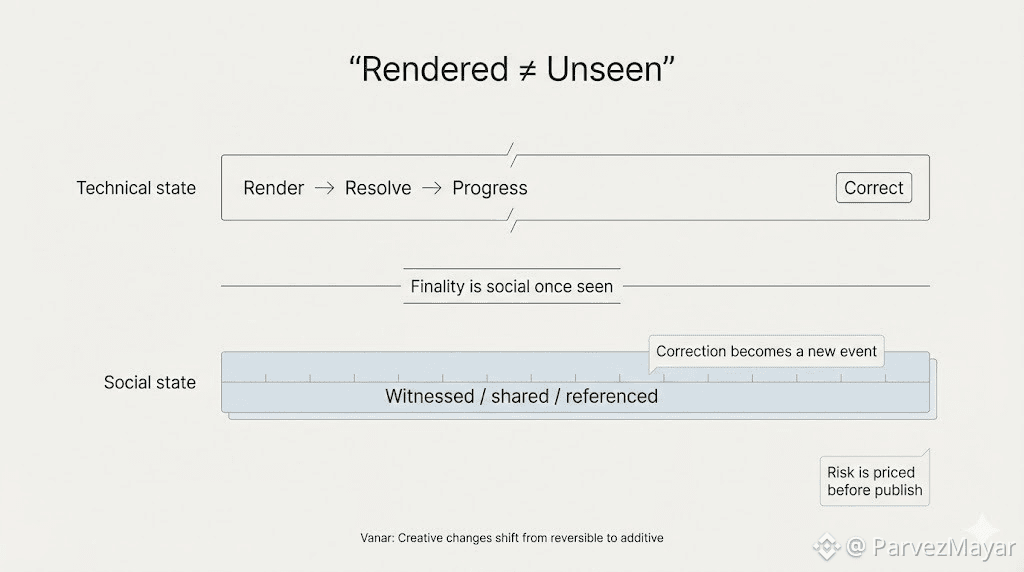
The pressure isn't about making mistakes.
It's about choosing which ones are worth carrying once they've already been seen.
Over time, that calculus tightens. Creative freedom doesn't disappear. It becomes deliberate. Less casual. Less forgiving.
And what finally ships tends to reflect that. Some ideas just don't get taken to the edge.
