
I thought verification would feel like a button.
Something you click when you’re nervous. Something you run after the fact, when you want reassurance. A separate mode. A separate ritual. The kind of thing you do because you don’t trust the system yet.
But the first time I went to “check” a blob on Walrus, the moment didn’t arrive with ceremony.
It just blended into the same quiet flow as everything else.
That’s what threw me.
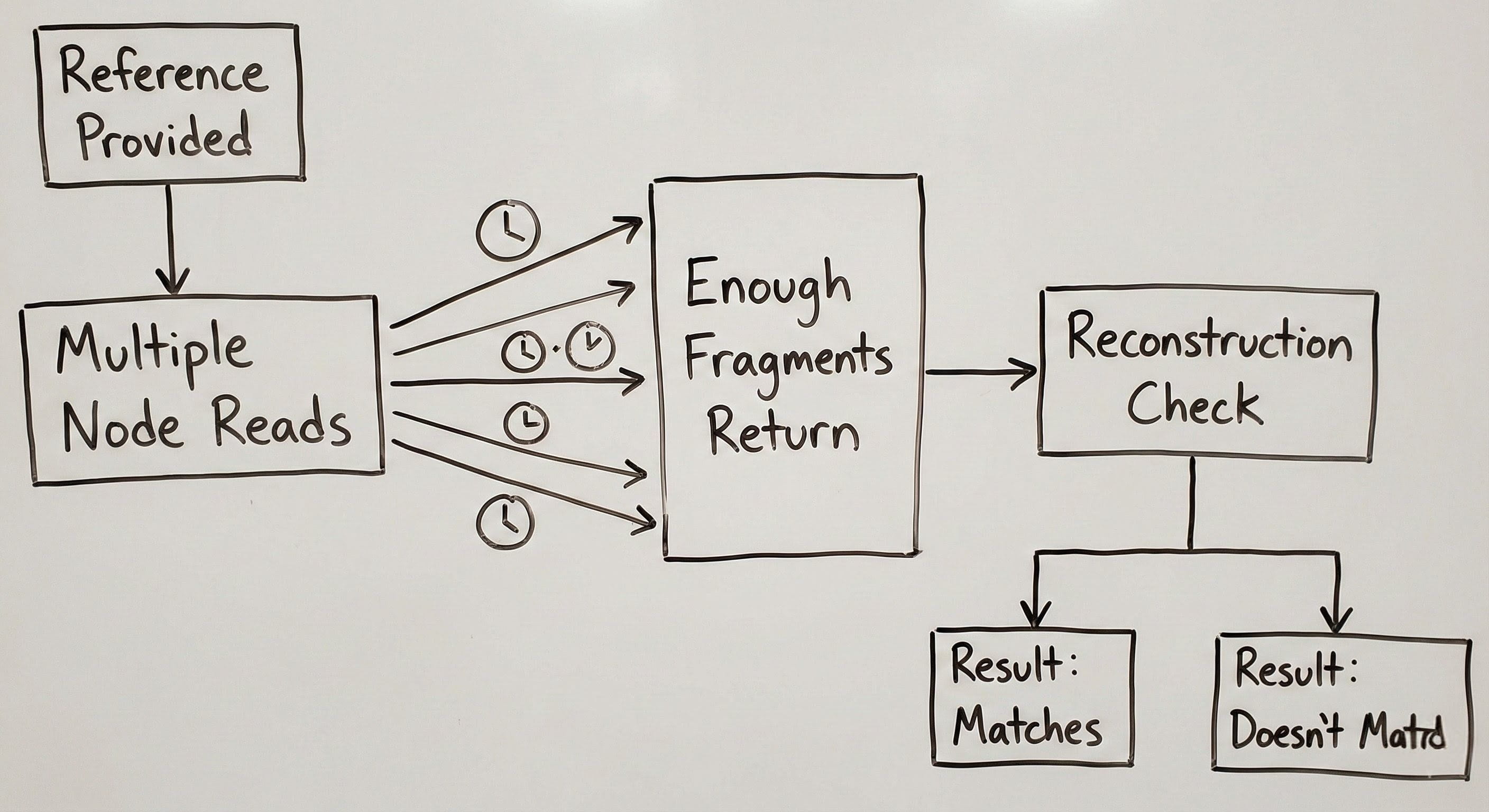
The file was “there” in the way modern interfaces love to say things are there. The reference resolved. The app moved on like the story was finished. But my instinct didn’t match the screen. I hesitated in that tiny window where humans start inventing narratives: maybe it’s cached, maybe it’s lucky, maybe it only worked because the network was in a good mood.
So I tried again.
Not because anything failed, because nothing proved itself.
On good days, availability feels like a vibe. A clean fetch. A fast response. A calm UI that doesn’t ask questions. It’s easy to mistake that for reliability. It’s easy to treat “worked once” as “will work when it matters.”
Then a read comes back just a little uneven.
Not slow enough to escalate. Not broken enough to blame. Just late enough to make you aware of time. And time is where trust gets expensive, because time is where you either retry and create a mess, or wait and feel passive, or do the worst option assume.
Walrus doesn’t punish you for assuming.
It just doesn’t reward it either.
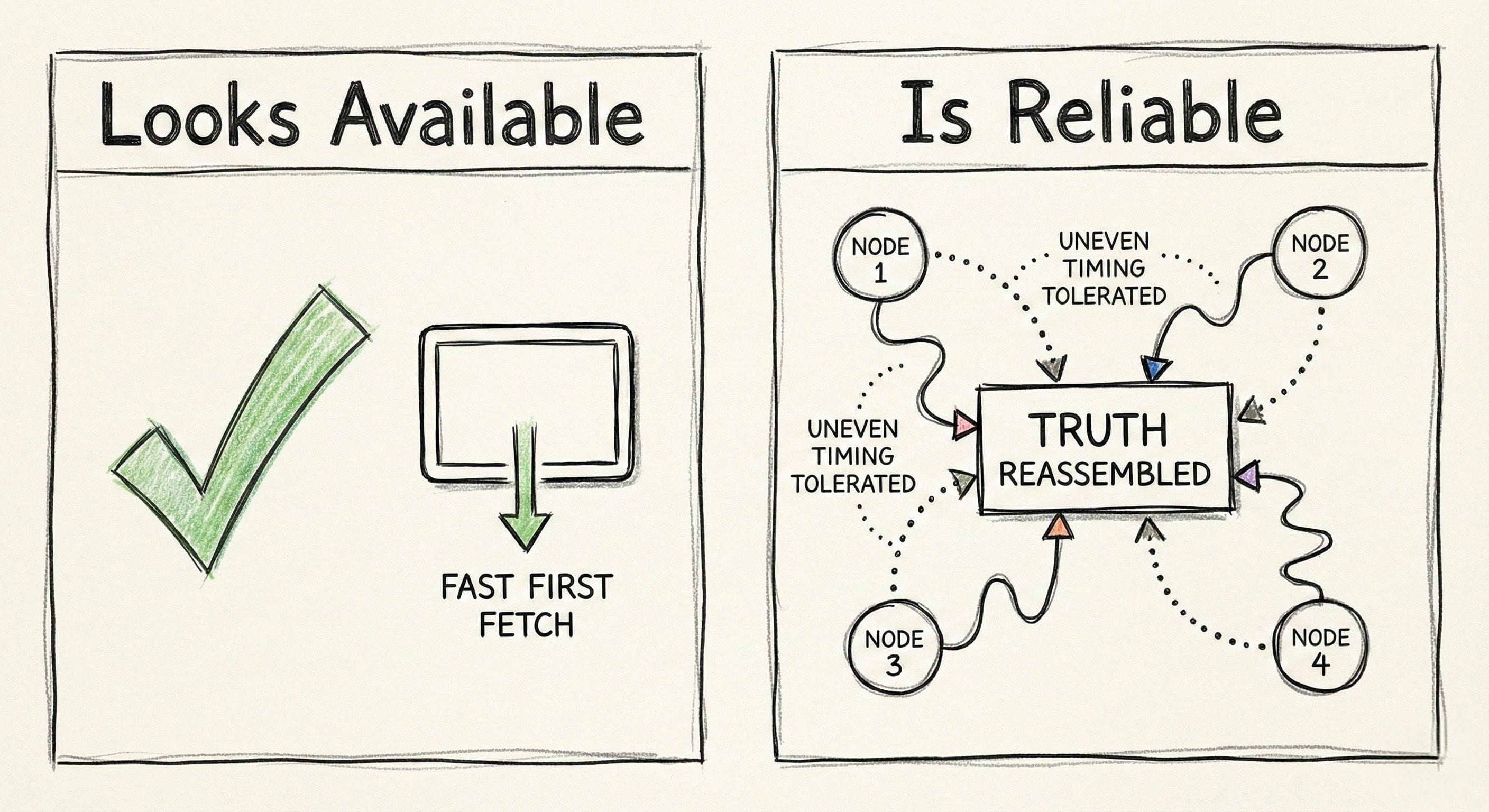
You can feel the difference between “the blob exists” and “the blob is still reconstructible” without anyone explaining it to you. Existence is a screenshot. Reconstructible is a property that survives bad timing, missing pieces, and the kind of partial silence that makes centralized systems start lying politely.
That’s the weird comfort of erasure-coded storage when you experience it from the edge.
Not as math. As behavior.
Pieces don’t show up in a tidy line. They arrive like a room full of people answering at different speeds. Enough of them respond and the story holds. A few don’t, and the story still holds. That’s the point—but it also means you stop relying on “all clear” signals and start relying on “can the system still assemble reality right now?”
And that question isn’t poetic when you’re shipping something that has users.
Because users don’t care about architecture. They care about whether their thing loads on a bad day.
This is where “cost-efficient” gets misunderstood too. Cheap storage is easy if you only price upload. Cheap storage is easy if you pretend repair traffic is free, or if you hide retries behind a spinner and call it resilience. But when a network actually keeps large files available through churn, the cost shows up somewhere—bandwidth, operator discipline, time.
Sometimes the cost is visible as nothing more than a pause that makes your hand hover.
And censorship resistance has a similar shape. People talk about it like a flag you wave. In practice it’s quieter: no single party can decide your file is inconvenient. No single provider can “resolve” an incident by deleting the evidence. The system doesn’t negotiate with authority—it negotiates with reconstruction.
Still, the part that stays with me isn’t the ideology.
It’s the feeling of watching the system refuse to bluff.
A clean UI can say “done” and still leave you with doubt. A decentralized storage system can feel imperfect uneven, slightly asynchronous, occasionally awkward and still be more honest, because it doesn’t pretend smoothness equals truth.
I didn’t leave that moment feeling more confident.
I left it feeling more careful about what I call “real.”

