
The first thing I noticed wasn’t a feature.
It was how little noise the system made while it did something that should’ve been noisy.
A blob stayed reachable through the kind of day that usually produces excuses. Someone’s node disappears for a while. A request comes in twice. A read arrives right when something else is already moving. And still, no announcement, no “degraded mode” theater, no dramatic pause that lets humans feel involved.
It just… kept going.
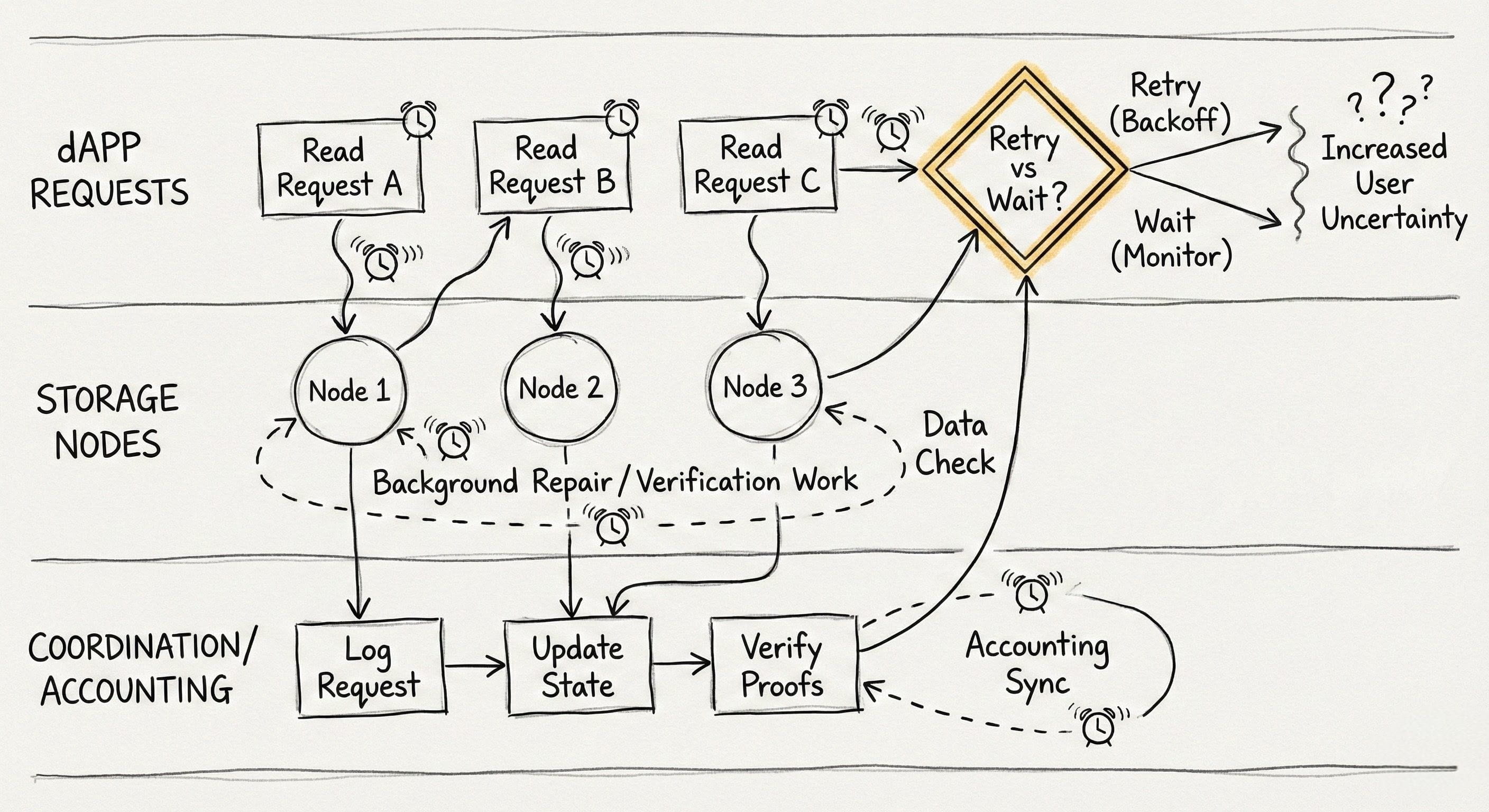
That’s the part that’s easy to misunderstand. People say “decentralized” and picture freedom. In practice it’s more like shared responsibility without a manager. If nobody owns the work, it doesn’t get done. If everybody owns it, you get arguments. So the system has to make responsibility feel unavoidable without making it feel personal.
$WAL shows up in that gap.
Not as a number you flex. As the quiet mechanism that makes “someone else will handle it” stop working as a plan. You can feel it when the network is busy and nobody can pretend they didn’t notice. Reads still complete, but not politely. Things arrive with just enough uneven timing to remind you the system is doing more than one job at once.
Serving. Repair. Verification. Accounting.
And the uncomfortable part is: you don’t get to choose which one matters today.
I watched a dApp behave like it was calm while the backend clearly wasn’t in a clean mood. No error. No red badge. Just a small stretch between click and result that made me look at my own hands. Do I retry? Do I wait? Do I create the problem I’ll blame on “the network” later?
Nothing told me what to do.
That was the pressure.
Governance gets talked about like it’s ideology, but it feels more like maintenance when you’re inside the moment. The rules that decide what counts as “still real,” how long the network forgives drift, what gets penalized, what gets ignored—those choices don’t look dramatic. They look like a system refusing to let ambiguity become a lifestyle.
Staking feels similar. People treat it like participation, like joining a club.
But in the background it reads like collateral for behavior.
If coordination ever becomes optional, the system starts depending on goodwill. And goodwill is the first thing to vanish when the week gets annoying. When requests stack. When storage stops being a quiet promise and becomes a rotating set of obligations that have to be honored even when nobody is watching.
That’s why the best days on Walrus are the days you don’t notice anything.
Until you do.
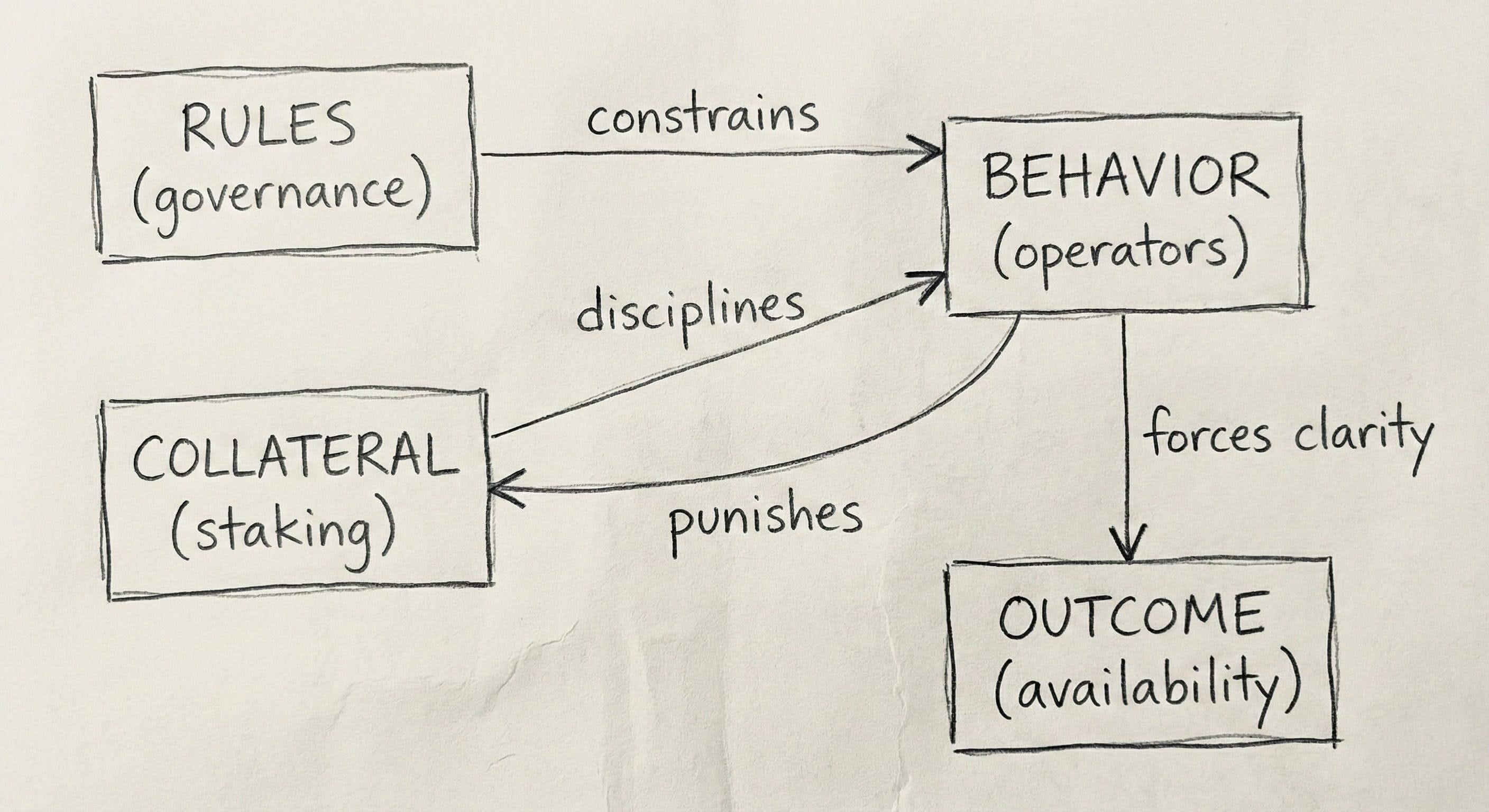
A small mismatch. A late response. A piece of work you can’t point to, but you can feel because your confidence starts moving slower than your cursor. And you realize the network isn’t “smooth”—it’s disciplined. Smooth is what centralized systems fake with buffering and apologies. Discipline is what decentralized systems have to enforce without asking anyone to trust a story.
What happens if that discipline ever slips?
Not “down.”
Something worse: two different truths that both sound plausible.
A screenshot that says it worked. A user who says it didn’t. A team that can’t prove which one counts without turning into detectives. The whole argument becomes timing, and timing becomes leverage.
I didn’t come away thinking Walrus was “fast.”
I came away thinking it was harder to lie to.

