
The contract executed clean.
Logs look normal. Gas paid. Return value makes sense. The kind of neat transaction that should let everyone exhale and move on to the next problem.
Nobody moves.
Two different people say “done” in two different meanings and you can hear the split immediately, one voice trusting the EVM receipt, the other refusing to treat it as settled. “EVM says done,” someone says, almost annoyed that anyone is still staring. “Settlement says wait,” someone else answers, quieter, like they’re trying not to start a fight they’ve already lost before.
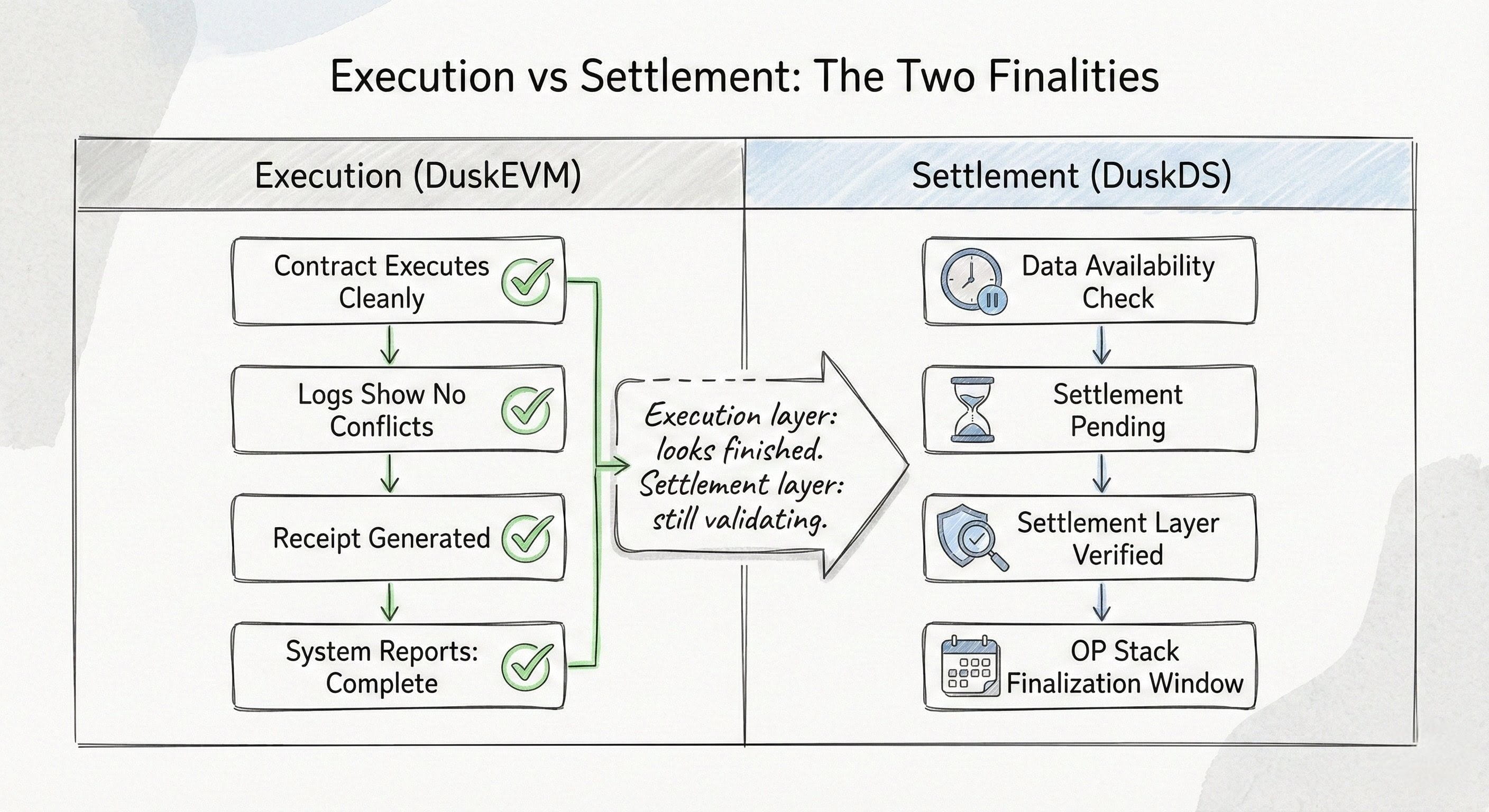
Same room, two truths, and the only reason it stays polite is because everyone has been burned by this exact shape. The worst incidents don’t start with loss. They start with a clean surface that gives the wrong team permission.
On Dusk, execution is a layer. DuskEVM is allowed to feel finished. That’s its job. It produces the thing engineers recognize: receipts, logs, deterministic-looking output. It gives you enough closure that your brain tries to call it final, even when the system hasn’t agreed to treat it that way yet.
Then DuskDS shows up like the adult in the room. Not dramatic. Just structural. Settlement and data availability don’t care that your contract returned the right number. They care about what the network is actually willing to treat as the record, because that’s the only record you can cite later without sounding like you’re negotiating reality.
So ops does what ops always does: they go hunting for the one place nobody can argue with later. Not the app dashboard, not the EVM explorer view with its satisfied checkmark—DuskDS, the settlement surface everyone trusts when it gets uncomfortable. You can see the shift happen in real time: the confident person gets quieter, the silent person starts asking for the DuskDS view, the settlement proof, the “what does the chain treat as real” answer.
Somebody tries to relax the room with, “it’s on OP Stack anyway,” and the opposite happens. People get more careful, not less, because “anyway” is where assumptions hide.
Because “done” on DuskEVM currently carries an asterisk people don’t like saying out loud: the OP Stack finalization window. That temporary 7-day constraint sits behind the interface like a calendar nobody wants to acknowledge. It doesn’t mean your execution is fake. It means your certainty has a shelf life until the settlement story is defensible.
The argument that follows is never philosophical. It’s practical and slightly ugly, and it always sounds like two departments protecting themselves. Engineering wants to ship the downstream call because the contract already behaved; risk wants to wait because the settlement layer is where liability lives. Someone tries to smooth it over with “it’s fine, it executed,” and someone else replies, “executed where?” like the word “where” is doing all the work.
That’s when the modular architecture stops being a slide-deck benefit and becomes a workflow problem. When you have multiple layers, you also have multiple moments that look like completion. Handoffs multiply. Ownership gaps appear. The team starts passing responsibility the same way they pass links, an EVM explorer link, a DuskDS status link, a screenshot for the ticket, a timestamp someone copied by hand, each one adding comfort without adding finality.
If you’re unlucky, privacy gets pulled into the room too. Hedger gets mentioned in the same tone people use when they talk about “weird math” that makes auditors nervous. Homomorphic encryption, zero-knowledge proofs, real tools, real guarantees, but none of it answers the question ops is actually asking when the clock is running and the downstream leg is waiting.
Because the follow-up always arrives. It’s never “did it execute.” It’s “what did you rely on,” and “what was final when you acted,” and “who approved treating that as settled.”
So the room waits, staring at two kinds of completion and deciding which one is allowed to count today. DuskEVM wants to be the moment you leave. DuskDS is the moment you’re allowed to say you left. And you can feel the decision forming without anyone naming it: we’re not treating execution as final, we’re treating settlement as final, and we just wish the interface didn’t look so satisfied while we’re still in the waiting room.
Which layer are we allowed to treat as final today?
