
Imagine your most important data just shrugging off network outages, self-healing on the fly, and never missing a beat. That’s exactly what Walrus is building on Sui—a decentralized storage layer that doesn’t just survive Web3’s turbulence, it thrives in it. As AI agents and global businesses push reliability to the limit, Walrus’s fault-tolerant design steps up as the silent workhorse, making sure your data sticks around, no matter what chaos the network throws at it.
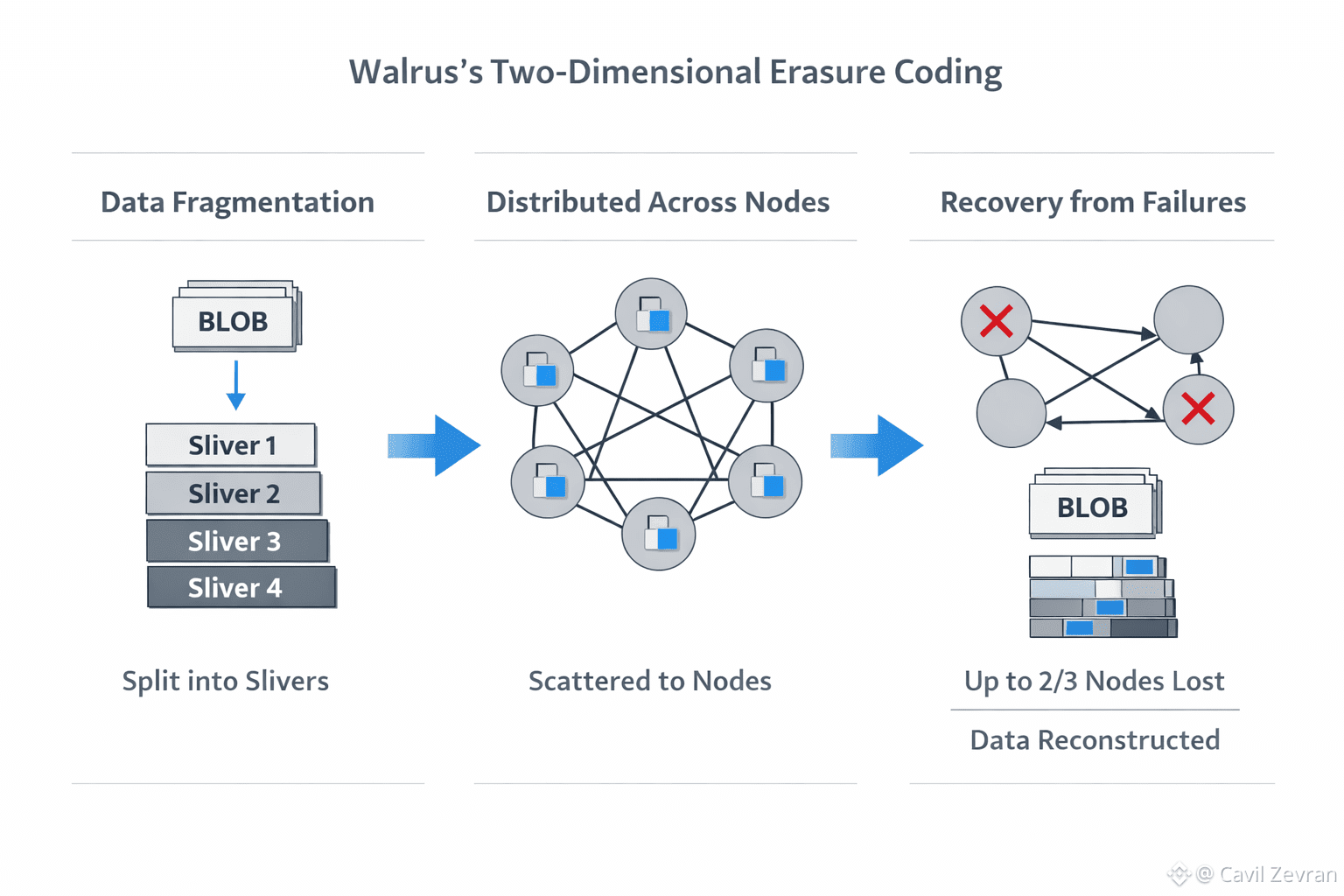
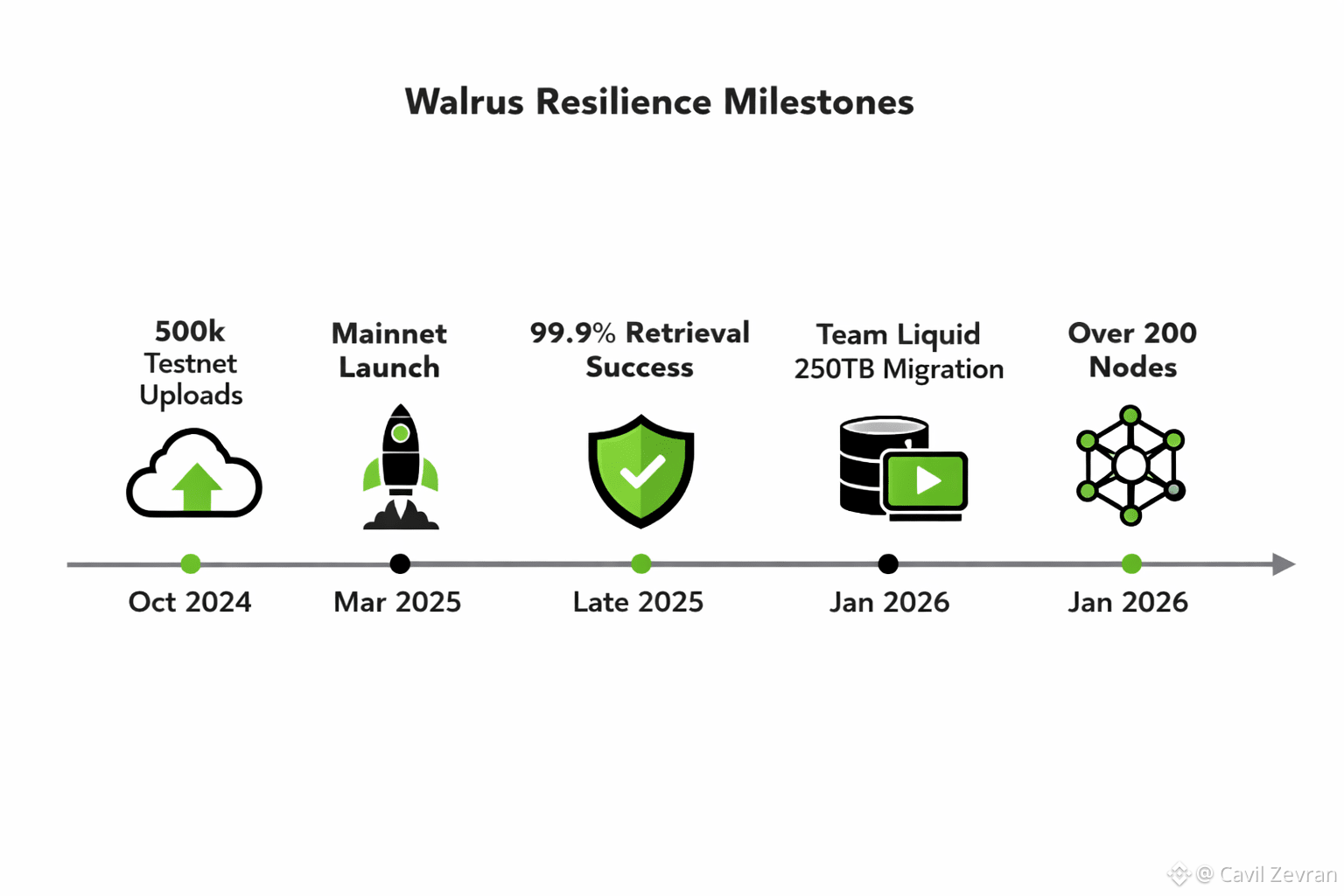
So, what’s actually under the hood? At the center, you’ve got erasure coding powered by the Red Stuff system. This tech chops data into tiny pieces and spreads it across nodes with almost no waste—just 4.5 times the original size. Forget lazy replication; this is tight, deliberate engineering. Even if two-thirds of the nodes disappear, your data still survives. Real stress tests in late 2025 showed 99.9% retrieval rates, even during wild network churn. Recovery bandwidth stays lean, growing only as fast as needed—so repairs don’t eat up the whole network. Nodes have to prove they’re actually storing data through quick cryptographic spot checks, so the network keeps latency low and everyone stays honest.
Walrus doesn’t stop there. Its quorum-based shard management system moves data around as nodes come and go, so the network naturally grows—no need for some central authority to step in. Picture this: January 2026, over 200 active nodes, all expanding capacity on their own. If things go sideways, a multi-stage reconfiguration system keeps everything consistent during stake changes—no network pauses, just smooth transitions. The results? Walrus smashed testnet records with 500,000 blob uploads since October 2024, gearing up to handle 1.5 terabytes daily on mainnet. And when someone drops the ball? Challenge windows let anyone call out slacking nodes, hitting them with stake penalties and redistributing WAL, so everyone’s got skin in the game.
Real teams are already putting Walrus to the test. Look at Team Liquid’s huge migration in January 2026: 250 terabytes of esports footage, behind-the-scenes clips, and fan archives pulled from scattered hard drives and dropped straight into Walrus’s decentralized pool. ZarkLab handled the migration, layering in AI meta-tagging so searches are lightning-fast. Now, 4.5 million blobs are instantly available worldwide—no silos, no downtime, always on. Suddenly, content becomes an on-chain asset, ready for fan drops or new revenue streams. Over at Humanity Protocol, they’ve stored more than 10 million credentials (over 300 GB, with their sights set on 100 million by mid-2026), using Walrus’s verifiable custody anchored to Sui. The chain stays lean, privacy stays tight, and data stays accessible, even as the network churns.
There’s more. Walrus runs on 30-day epochs, where prepaid WAL spreads out fairly to operators and stakers. Stake-weighted pricing keeps costs a fraction of traditional clouds—10x cheaper, in fact. Integrations keep stacking up: Alkimi Exchange runs 25 million daily ad impressions on Walrus, while io.net and Yotta Labs (just partnered up in January 2026) use it to store AI artifacts that hold up under node turnover. Pipe Network, with its 280,000+ points of presence, syncs with Walrus’s self-healing engine, turning what should be network disasters into total non-events.
Step back, and this isn’t just another flashy Web3 project. It’s a $140 million-backed vision (with a16z and Standard Crypto in the mix) for data that just doesn’t quit. Mainnet’s been live since March 2025. The Haulout Hackathon (January 2026) has already surfaced innovative new builds. Walrus is locking down Web3’s data backbone, turning “what if it breaks?” into “don’t worry, it won’t.” If you’re betting your business—or your AI workflow—on your data’s survival, this is the protocol you want in your corner.