
Dusk Network ($DUSK) is positioning itself at a rare intersection where privacy and regulation coexist by design. As of January 20, 2026, market sentiment around Dusk has strengthened notably, with the token trading near $0.20, a market capitalization of roughly $51 million, and a sharp surge in both price momentum and trading volume. With the mainnet upgrade scheduled for Q1, Dusk is entering a critical phase—shifting from long-term technical buildup toward real institutional-scale deployment.
The upcoming upgrade focuses on three core areas. First, the Succinct Attestation consensus will be refined to deliver faster and more reliable finality. Second, the full release of Hyperstaking will introduce privacy-preserving staking with customizable logic. Third, performance improvements to the Lightspeed Layer 2 will significantly increase throughput while reducing latency, strengthening the chain’s readiness for production-grade financial use cases.
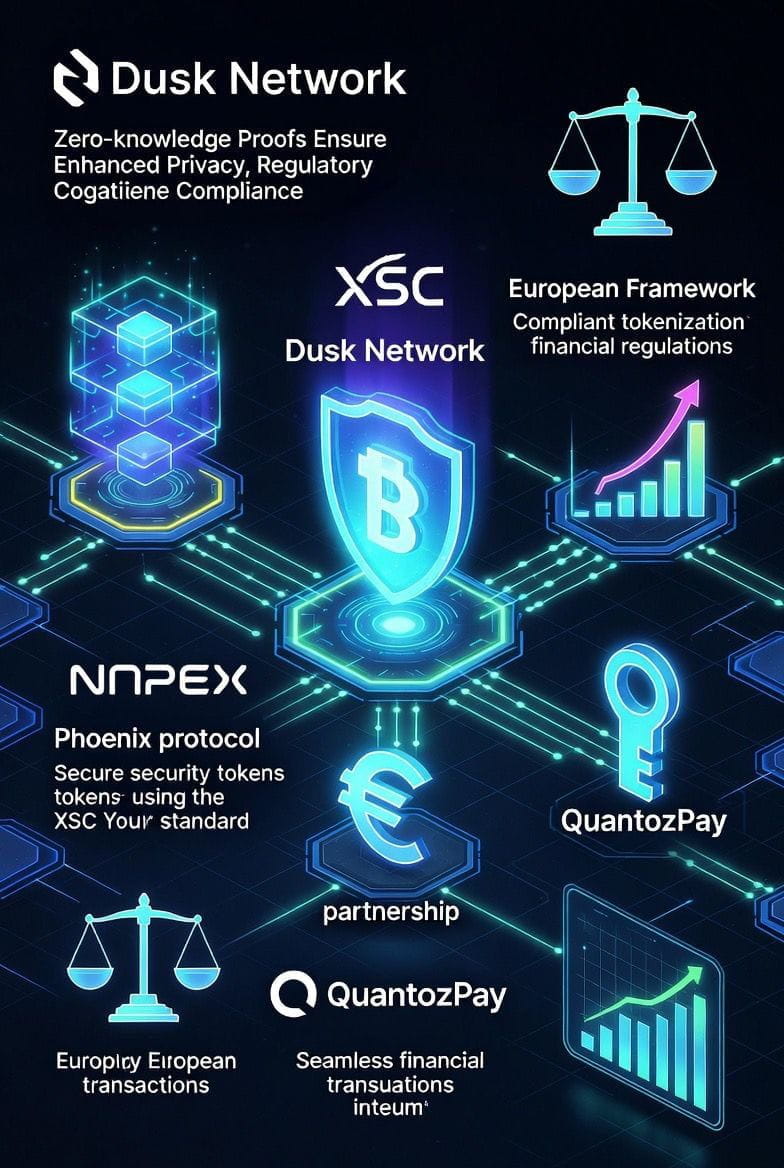
Dusk’s key advantage lies in its protocol-level integration of zero-knowledge privacy with regulatory compliance. Through the Phoenix protocol and zk-SNARKs, transaction data and smart contracts are encrypted by default. At the same time, selective disclosure via viewing keys allows authorized auditors to verify activity without exposing sensitive business information. This architecture closely aligns with European regulatory frameworks such as MiCA, MiFID II, and the EU DLT Pilot Regime, giving institutions practical compliance tools on a permissionless public blockchain.
For real-world asset tokenization, Dusk introduces the XSC contract standard, purpose-built for regulated securities. It enables encrypted investor registries, programmable transfer restrictions, automated dividend distribution, and on-chain lock-up enforcement. These capabilities are already being tested in real environments: the NPEX collaboration has expanded European security token pilots to approximately $30 million in value, QuantozPay has integrated the MiCA-compliant EURQ stablecoin for corporate payments, and Cordial Systems is deploying a zero-trust custody solution on the network. Together, these use cases enable a fully on-chain issuance, clearing, and settlement process—cutting issuance timelines from months to days and reducing operational costs by nearly 90%.
From a developer perspective, Dusk’s EVM-compatible layer allows Solidity-based applications to migrate with minimal friction while retaining native zero-knowledge privacy. Transaction fees remain low, finality is near-instant, and staking is optimized for usability through auto-compounding light wallets. Annual staking yields typically range between 12% and 18%, with modest penalty risks. Tokenomics further reinforce long-term alignment: a fixed supply of 500 million tokens, over 95% already in circulation, a 36-year emission schedule with gradually declining inflation, and no significant unlock overhang.
Community engagement is also accelerating, supported by initiatives such as the Binance CreatorPad campaign running through early February, which is helping expand visibility and participation across the ecosystem.
Rather than competing on raw throughput or mass consumer adoption, Dusk deliberately targets the regulated finance niche. Many high-performance chains sacrifice privacy, while modular and L2-heavy designs often struggle with compliance. Dusk embeds both privacy and regulatory logic directly into its base layer, creating a defensible and difficult-to-replicate moat. If the Q1 upgrade delivers as planned and institutional pilots continue to scale, Dusk could transition from an overlooked project into a foundational infrastructure for European RWA. At its current stage, it resembles a value-oriented opportunity where the benefits of trusted, compliant privacy are only beginning to be priced in.
