
In the broader blockchain landscape, infrastructure projects focused on data availability and storage are gaining renewed attention. @walrusprotocol is emerging as a protocol designed to address one of the ecosystem’s persistent challenges: how to store large volumes of data in a decentralized, verifiable, and cost-efficient way. Rather than competing directly with execution-focused blockchains, Walrus aims to complement them by providing scalable storage that applications can rely on.
Walrus is closely aligned with modern blockchain needs, particularly for ecosystems that generate heavy data loads such as NFTs, gaming assets, AI-related data, and on-chain applications that require reliable off-chain storage. By focusing on programmability and integration, Walrus seeks to reduce friction for developers while maintaining decentralization guarantees. The $WAL token underpins the network’s economic model, helping to align incentives between users, storage providers, and validators.
Key points:
Designed for decentralized and scalable data storage
Built to support data-heavy blockchain applications
Focuses on efficiency, programmability, and verification
$WAL plays a central role in securing and incentivizing the network
Complements existing blockchains rather than replacing them
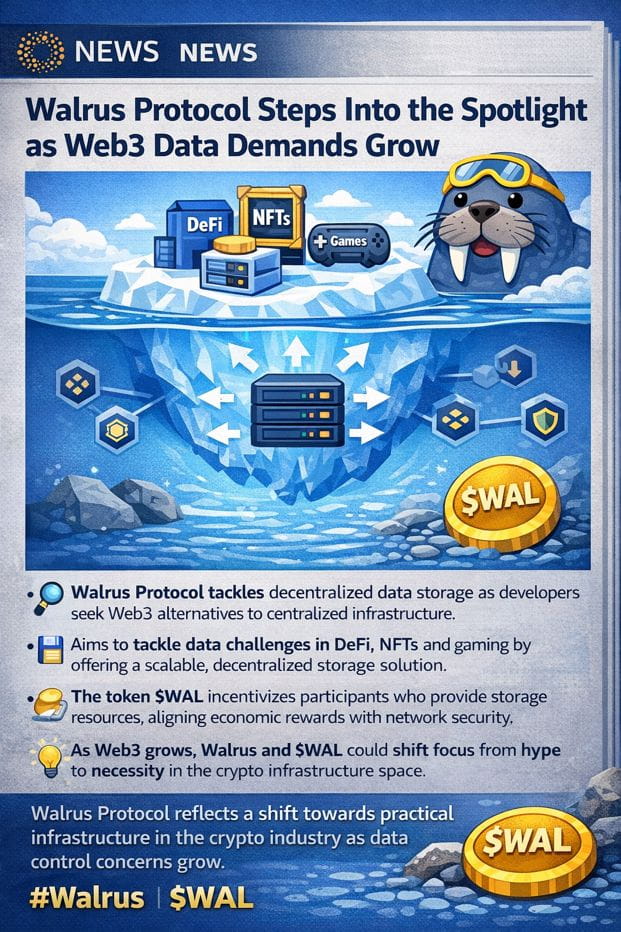
As demand for decentralized infrastructure continues to grow, Walrus Protocol represents a targeted approach to a specific bottleneck in the crypto stack. By prioritizing data availability and developer usability, @Walrus 🦭/acc positions Walrus as a utility-driven asset tied to real network usage. If adoption trends continue, Walrus could become a foundational layer for data-intensive Web3 applications. #walrus

