
Most storage systems are built around a single moment. Data is uploaded, acknowledged, and then forgotten by the system itself. Responsibility quietly disappears once the transaction is complete. Walrus is designed from a different starting point. It assumes that the real challenge of storage begins after upload, not at it. The moment data enters the Walrus network, the protocol takes on a long term obligation to keep that data accessible, reconstructible, and alive.
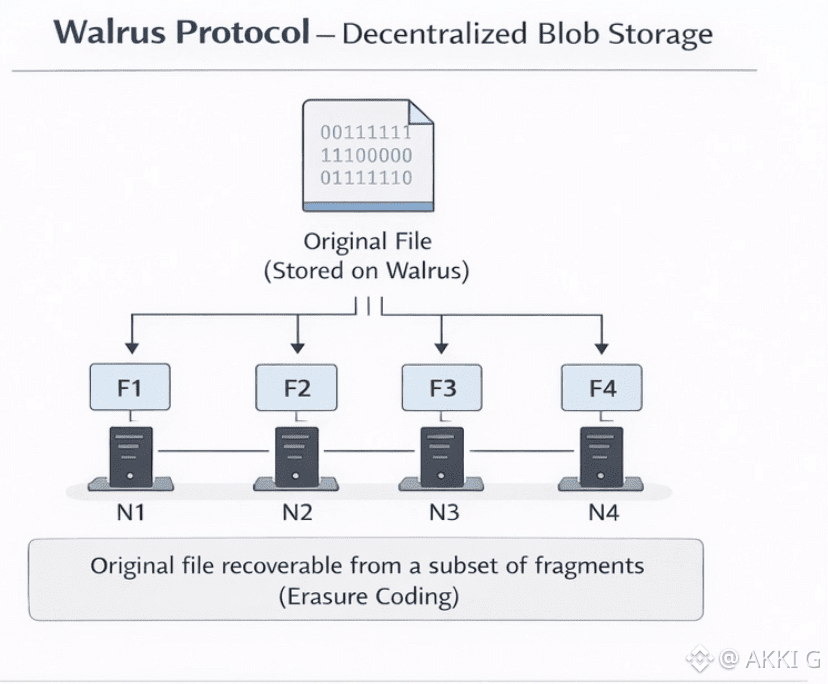
This is why Walrus does not treat storage as a static service. Large files are transformed into distributed objects through blob storage. Instead of relying on a single copy or a single machine, each file is split into multiple fragments and spread across independent Walrus nodes. No individual fragment is valuable on its own, and no single node becomes a point of failure. The system is built with the expectation that nodes will fail, leave, or behave unpredictably. Data survival is achieved not by preventing failure, but by designing around it.
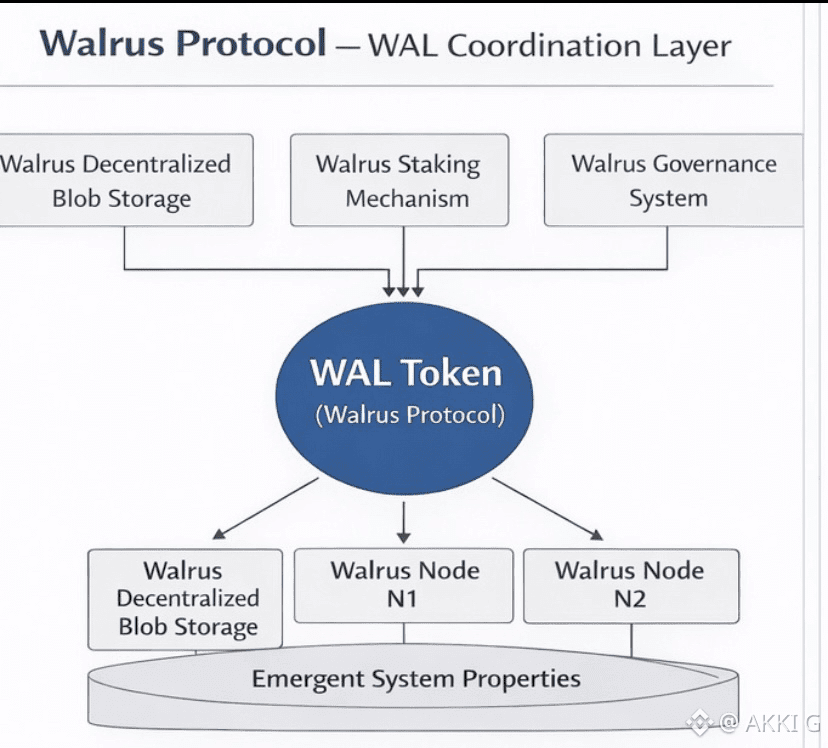
At the center of this system sits the WAL token. WAL is not positioned as a reward instrument or a speculative layer. Its role is coordination. WAL connects storage, staking, and governance into a single behavioral system. Storage defines what the network must preserve. Staking enforces responsibility by putting economic weight behind correct behavior. Governance allows the protocol to adapt without central control. WAL binds these components together so that long-term data availability remains economically rational, not optional.
What makes this design distinct is the way outcomes emerge naturally from structure. Sustainability is not enforced through promises. It emerges because participants are continuously incentivized to keep data alive. Censorship resistance does not rely on ideology. It emerges because no single actor controls enough fragments to suppress access. The protocol does not ask participants to behave well. It assumes they will not, and designs incentives accordingly.
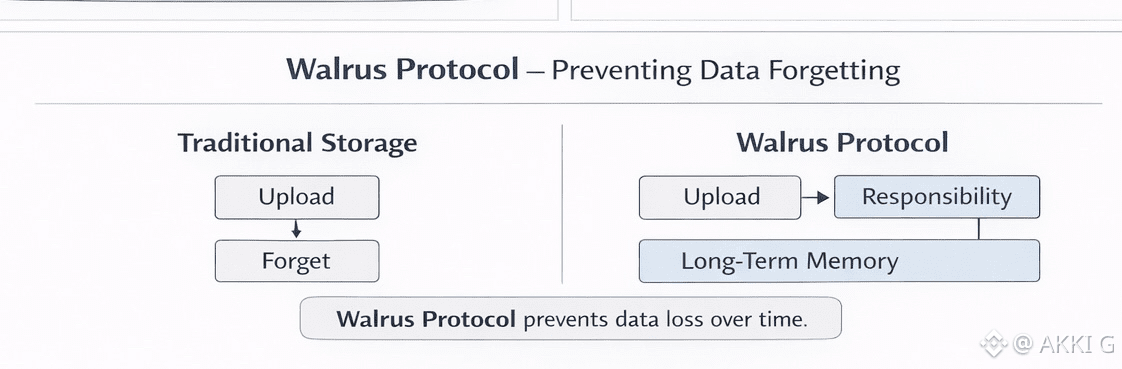
The contrast becomes clear when compared to traditional storage models. In conventional systems, data is uploaded and forgotten until something breaks. In Walrus, upload is only the beginning. Responsibility persists. Memory is maintained. Data is treated as something that gains importance over time rather than decaying into irrelevance.
My take is simple. Walrus is not trying to win on convenience or speed. It is trying to win on endurance. In a digital world that constantly overwrites itself, a system designed to remember is not just useful. It is necessary.

