Walrus protocol generally falls into two main categories.
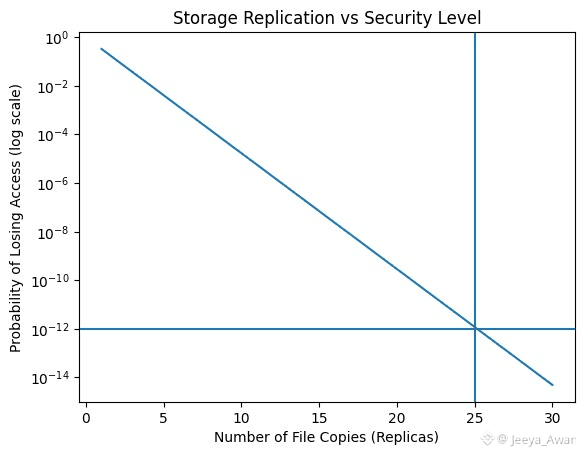
• The first category includes systems with full replication. The main advantage of these systems is the complete availability of the blob on the storage nodes, which allows for easy access and seamless migration if node goes offline. This setup enables a permissionless environment since storage nodes do not need to rely on each other for file recovery. However, the reliability of these systems hinges on the robustness of the selected storage nodes.
For instance, assuming a classic 1/3 static adversary model and an infinite pool of candidate storage nodes, achieving “twelve nines” of security– meaning a probability of less than 10−12 of losing access to a file– requires storing more than 25 copies on the network3.
This results in a 25x storage overhead. A further challenge arises from Sybil attacks, where malicious actors can pretend to store multiple copies of a file, undermining the system’s integrity.
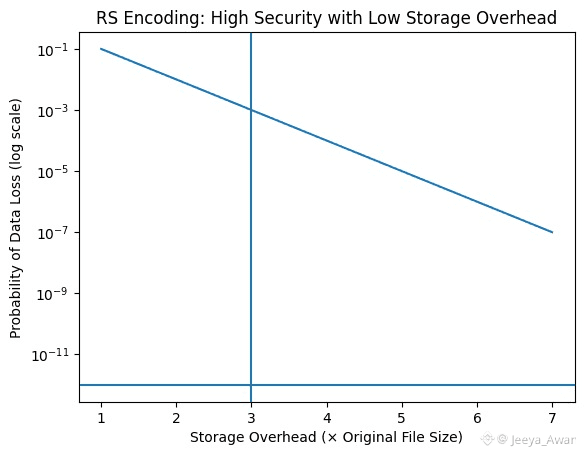
• The second category of decentralized storage services uses Reed-Solomon (RS) encoding. RS encoding reduces replication requirements significantly. For example, in a system similar to blockchain operations, with𝑛 nodes, of which1/3maybemalicious, andinanasynchronousnetwork,RSencodingcanachievesufficient security with the equivalent of just 3x storage overhead. This is possible since RS encoding splits a file into smaller pieces, that we call slivers, each representing a fraction of the original file. Any set of slivers greater in total size to the original file can be decoded back into the original file.