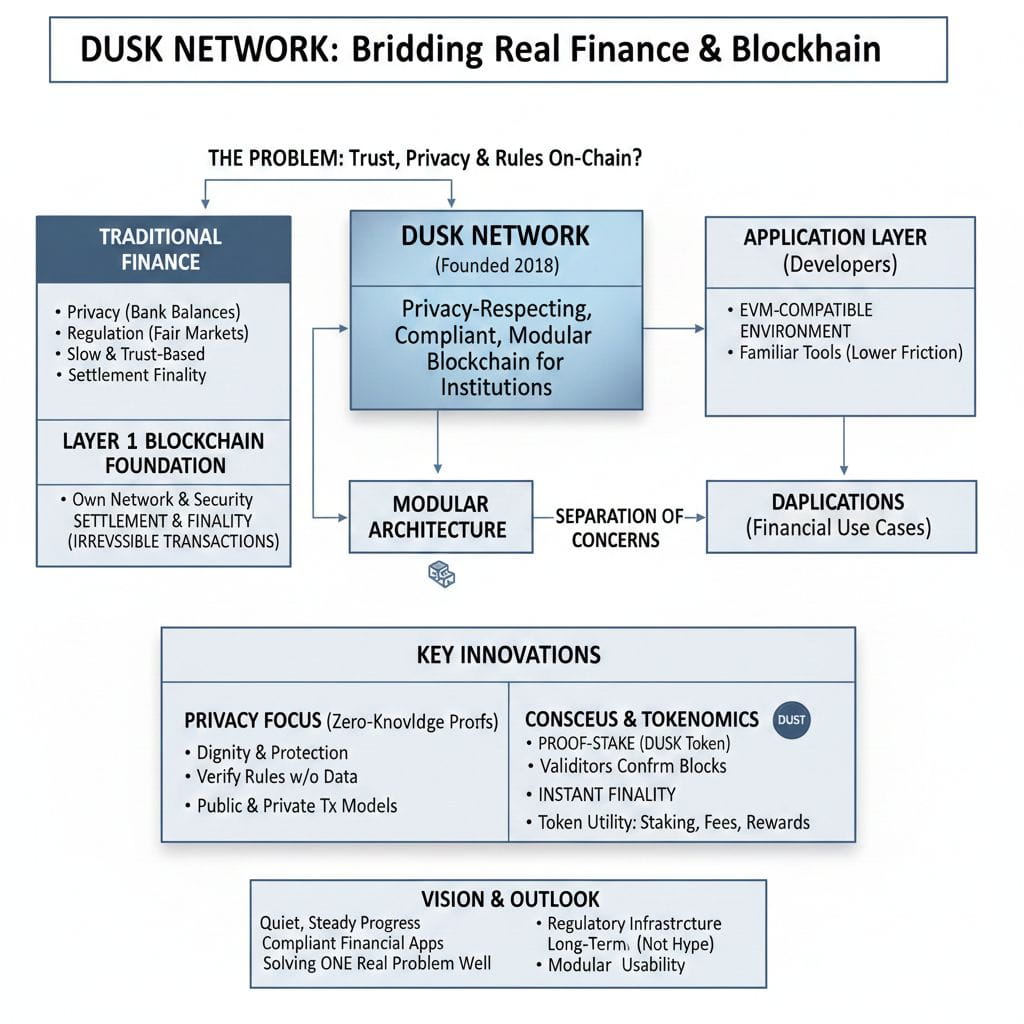
Dusk Network began in 2018 with a very human question that most blockchains never really stopped to ask: how do we bring real finance on-chain without breaking trust, privacy, or the rules that protect people? While many crypto projects were built for openness at all costs, Dusk Network was designed for a world where not everything can be public.
In traditional finance, privacy is not a luxury, it is a responsibility. Your bank balance is private for a reason. A company’s internal trades are protected for a reason. Regulators exist not to slow progress, but to keep markets fair and stable.
Dusk sits right in the middle of this reality, trying to create blockchain infrastructure that institutions can actually trust. I’m often struck by how calm this vision feels compared to the noise of crypto, because it accepts that finance moves slowly and that trust is earned, not demanded.
At its core, Dusk is a layer 1 blockchain, meaning it runs its own network and security, but it is built in a modular way. Instead of forcing everything into one rigid system, Dusk separates the foundation from the applications.
The foundation focuses on settlement and finality, which simply means that when something happens on the chain, it is truly finished. In real financial systems, “maybe final” is not good enough.
Once a transaction settles, people need to sleep at night knowing it will not suddenly reverse. This design choice tells you a lot about who Dusk is built for.
On top of that solid base, Dusk allows developers to build applications using familiar tools through an EVM-compatible environment.
This is a practical decision. Instead of asking builders to relearn everything, Dusk meets them where they already are, lowering friction and making adoption more realistic. Privacy is where the project’s philosophy really shows. Many people hear the word privacy in crypto and immediately think of hiding or escaping oversight.
Dusk treats privacy differently. Here, privacy is about dignity and protection, not secrecy for its own sake. Using zero-knowledge proofs, the network can verify that rules were followed without exposing sensitive details.
You can think of it like proving you are eligible for something without revealing your entire personal history. The system checks the truth, not your private data.
Dusk even supports both public and private transaction models on the same network, because real finance is not black or white.
Some things should be visible, others should be shielded.
They’re trying to give institutions and users a choice instead of forcing them into extremes. Agreement on the network happens through a proof-of-stake system where participants lock up DUSK tokens to help secure the chain.
These validators confirm transactions and produce blocks, and once a block is confirmed, it is final.
There is no long waiting period filled with uncertainty. We’re seeing more blockchains move toward this kind of certainty, but Dusk treated it as a requirement from the start because finance does not tolerate ambiguity.
The DUSK token itself is not just something to trade. It is the economic heartbeat of the network. It is used for staking, for paying fees, and for rewarding honest participation.
This creates alignment between the health of the network and the incentives of the people running it. In the early years, token emissions help support security, while the long-term goal is for real usage to carry the system forward.
If adoption grows, the network grows stronger. If not, pressure builds. That is the honest tradeoff. Judging Dusk properly means looking past excitement and focusing on quiet signals.
Network stability, validator participation, developer progress, and reliable tools matter more than headlines. Access through Binance helps with liquidity and visibility, but long-term trust comes from consistent execution.
Of course, Dusk is not without risk. Building privacy that regulators can accept is extremely hard. Regulations can change. Institutions move slowly. Modular systems add complexity.
Usability can suffer if things become too complicated. These weaknesses do not mean failure, but they do mean patience is required. It becomes clear that Dusk’s future is unlikely to arrive with fireworks.
Success here would look quiet and steady. Stable infrastructure. A handful of serious financial applications. Gradual trust from cautious players. That kind of progress rarely trends on social media, but it compounds over time.
If even a small portion of regulated finance finds a safe and compliant home on Dusk, that alone would justify its existence. Not every blockchain needs to conquer the world.
Some just need to solve one real problem well. In the end, Dusk feels like a project built by people who understand that finance is not just code, it is responsibility.
I’m drawn to that maturity. They’re not promising miracles. They are building rails. We’re seeing crypto slowly grow up, learning that cooperation can be as powerful as disruption.
If you follow Dusk with realistic expectations and a long-term view, you may find something rare in this space: not hype that fades fast, but confidence that grows quietly, and that is a future worth waiting for.