
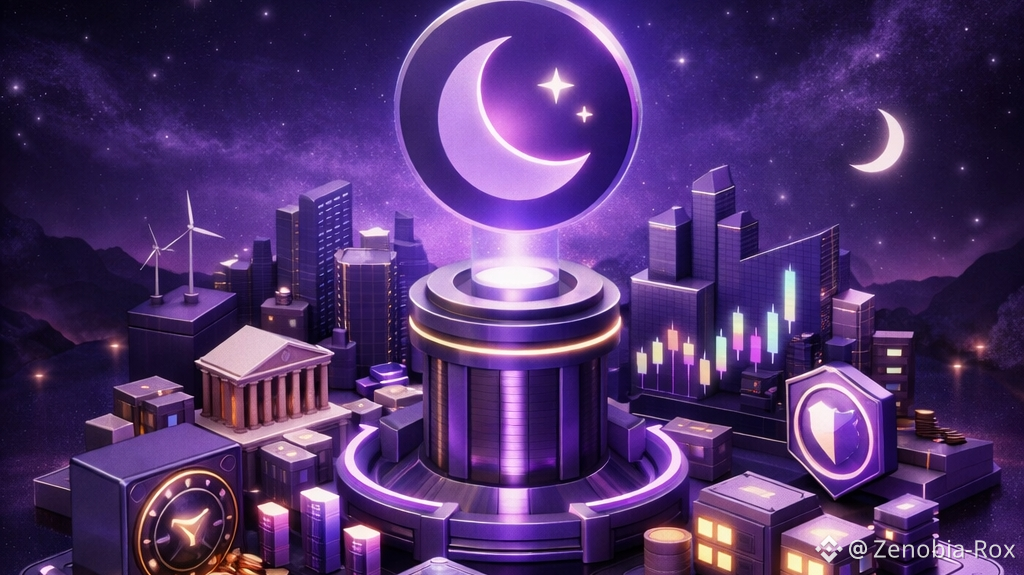

Dusk Network was not created from noise or rebellion. It was created from discomfort. A quiet discomfort felt by people who understood finance and also believed in blockchain. For years, public ledgers promised freedom through transparency, but somewhere along the way, transparency began to feel like exposure. Every transaction visible forever. Every balance traceable. Every action remembered without forgiveness. At first, it felt honest. Then it felt unsafe. Real life does not work this way, and neither does real finance. Dusk began as a response to that human truth.
In traditional finance, privacy is not a trick. It is a responsibility. Salaries are private. Trades are confidential until settlement. Audits happen behind closed doors but still happen. They’re not hiding wrongdoing. They’re protecting people, companies, and markets from unnecessary harm. Dusk looked at public blockchains and asked a simple but powerful question. What if we could keep the openness of blockchain while restoring the discretion that finance needs to function? I’m bringing this up because that question shaped everything that came next.
From the very beginning, Dusk rejected extremes. It did not chase full anonymity, and it did not accept full transparency as a moral default. Instead, it focused on control. Control over what is revealed, when it is revealed, and to whom. If it becomes possible to prove compliance without exposing everything else, then trust changes its shape. It becomes mathematical instead of emotional. We’re seeing this idea expressed through selective disclosure, where information stays private unless there is a clear reason for it to be shared.
As the project moved forward, the team understood something that many blockchain projects learn too late. Finance cannot survive uncertainty. A system that wants to support real markets must feel stable. Settlement must be final. Outcomes must be predictable. When Dusk reached mainnet and began producing real blocks, the project crossed an invisible but powerful line. From that moment, it was no longer an experiment. It became infrastructure. Every block carried responsibility. Every failure would matter. This is where many visions collapse under pressure, but Dusk chose patience instead of speed.
The structure of the network reflects this maturity. At its core lies a settlement layer designed to do one thing well. Decide what is true and lock it in place. It does not chase flexibility. It chases certainty. Above that foundation sit execution environments that allow developers to build applications without disturbing the core truth layer. This separation is not just technical. It is emotional. Builders can create without fear. Institutions can integrate without anxiety. The ground does not move while people are standing on it.
Even the way the network communicates reveals its personality. Instead of flooding the system with noise, Dusk uses structured communication that reduces unpredictability and wasted effort. This may sound unexciting, but in financial systems, excitement is often a warning sign. Calm systems earn trust. Predictable systems invite participation. Dusk leans into that calm deliberately.
Consensus within the network is treated as a shared duty rather than a competition. Validators are not racing for chaos. They are cooperating to maintain order. Once consensus is reached, it is meant to hold. This deterministic finality matters deeply for anyone building serious financial applications. It tells them that once a transaction settles, it stays settled. That confidence is not just technical. It is psychological.
Privacy in Dusk is not a single feature you turn on or off. It is a flexible design choice. Some transactions can be public. Others can be shielded. Values and participants can remain hidden while correctness is still proven cryptographically. This matters because real financial life is not uniform. A public payment and a confidential settlement do not belong in the same category. Dusk accepts this reality instead of pretending one model fits all.
For developers, the experience is built around respect. You are not asked to abandon the tools you already understand. You are invited to use familiar environments while benefiting from a base layer that understands privacy and compliance natively. For advanced use cases, deeper interaction with the settlement layer is possible. For simpler applications, higher level execution environments provide comfort and speed. They’re options designed around people, not ideology.
When people talk about metrics, they often look for speed numbers or transaction counts. But the most important metrics in Dusk are quieter. How safe does settlement feel? How predictable is behavior under stress? How sustainable are incentives over time? Dusk’s economic design reflects long term thinking. Early network participants are rewarded to secure the system, but the goal is not endless inflation. The goal is organic usage that eventually sustains itself.
Of course, no system like this is without risk. Regulated environments move slowly. Institutions require clarity. Privacy systems demand constant scrutiny. Modular architectures require discipline. Dusk does not deny these challenges. Instead, it builds around them. Continuous audits. Incremental upgrades. Layered design that prevents small issues from becoming systemic failures. Trust is not outsourced. It is embedded.
Looking forward, Dusk does not appear obsessed with attention or hype cycles. Its long term direction feels grounded. Payment rails that respect confidentiality. Tokenized real world assets that can exist inside legal frameworks. Financial applications that feel steady rather than stressful. If it becomes successful, it will likely happen quietly, through reliability rather than spectacle.
In the end, Dusk is not just asking whether blockchain can scale or move faster. It is asking something more human. Can we build financial systems that respect dignity? Can privacy exist without fear? Can rules be followed without humiliation? We’re seeing a world where exposure is constant and trust is fragile. In that world, a blockchain that chooses balance over extremes feels almost radical