

Dusk Network’s vision extends beyond protocol mechanics—it is about cultivating a thriving, interconnected ecosystem where developers, enterprises, and decentralized communities can innovate without friction. Unlike traditional blockchains, where adoption often relies on speculative incentives or limited application scope, Dusk prioritizes developer-first accessibility. The network provides modular infrastructure, SDKs, and libraries designed to streamline integration, reduce onboarding friction, and encourage experimentation. This approach transforms the network into a platform where creativity and practical utility intersect seamlessly.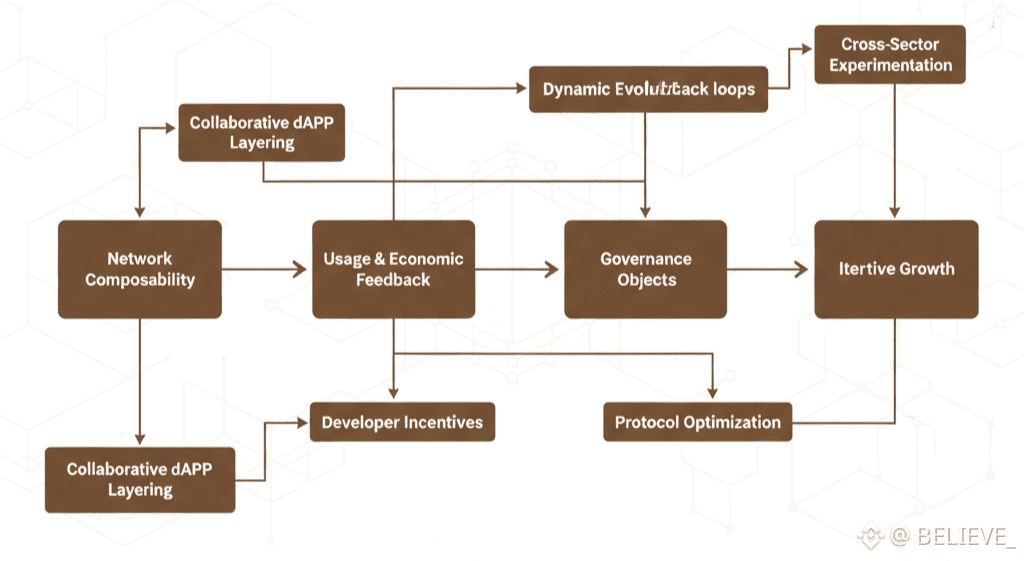
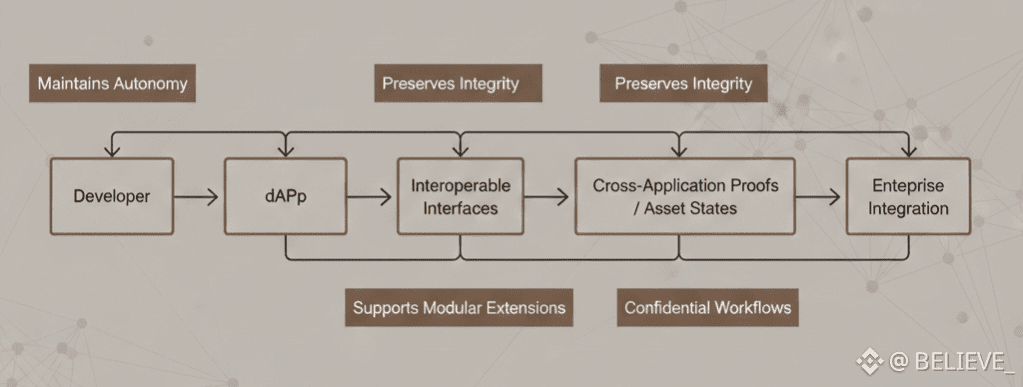
At the core of this ecosystem expansion is interoperable application scaffolding. Dusk enables developers to design decentralized applications (dApps) that can interact with one another while maintaining autonomy. For instance, marketplaces, identity solutions, and financial services can share verified proofs, asset states, or computational outputs without compromising integrity. By standardizing cross-application interfaces, Dusk encourages a collaborative environment in which projects can layer functionality and scale organically, avoiding the siloed development patterns that often slow blockchain adoption.
Dusk also emphasizes real-world applicability through enterprise-grade integration. Companies exploring decentralized finance, supply chain management, or confidential data workflows can leverage Dusk’s flexible architecture to maintain compliance without sacrificing innovation. By providing mechanisms for selective disclosure, verifiable computation, and controlled automation, the network allows enterprises to implement blockchain solutions that respect regulatory boundaries while remaining fully decentralized. This balance is critical for organizations seeking both operational efficiency and auditable trust.
A defining feature of Dusk’s ecosystem growth strategy is developer incentives aligned with long-term engagement. Beyond standard grants or hackathon rewards, the network fosters contributions through mentorship programs, community-led research, and early access to infrastructure upgrades. Developers are encouraged to experiment with composable application layers, create reusable protocol modules, and contribute tooling that enhances overall ecosystem robustness. This approach ensures that innovation is distributed, sustainable, and directly tied to the network’s evolution.
The network’s modular infrastructure also supports cross-sector experimentation, enabling dApps to integrate functions traditionally restricted to centralized systems. For example, secure asset tokenization, confidential auctions, and multi-party computational workflows can coexist in a single ecosystem, allowing developers to test novel business models or collaborative mechanisms in a permissionless environment. This adaptability attracts projects that require both technical freedom and operational security, expanding the range of industries engaging with Dusk.
Crucially, ecosystem expansion is reinforced by network composability and feedback loops. Applications can monitor usage patterns, track economic activity, and interact with governance objects, creating a self-regulating digital environment. Insights gathered from application interactions feed back into protocol optimization, enabling continuous improvement without manual intervention. This iterative growth model ensures that the network evolves in parallel with user and developer behavior, fostering a resilient and adaptive ecosystem over time.
Dusk’s strategic partnerships further strengthen its ecosystem. Collaborations with developer communities, research institutions, and enterprise consortia provide technical support, shared infrastructure, and cross-project validation opportunities. These alliances accelerate adoption while maintaining alignment with Dusk’s core principles of privacy, efficiency, and verifiable integrity. By embedding collaboration into its expansion model, Dusk positions itself not as a standalone network but as a connective layer for decentralized innovation.
Ultimately, Dusk Network reimagines what it means to build a blockchain ecosystem. By integrating developer empowerment, enterprise readiness, interoperable application design, and collaborative growth mechanisms, the network enables digital economies that are dynamic, resilient, and inclusive. The focus shifts from merely processing transactions to facilitating an environment where innovation, utility, and trust are co-dependent, creating long-term value for all participants.
Dusk is not just infrastructure; it is a living, growing ecosystem capable of supporting the next generation of decentralized applications, bridging creativity with operational rigor, and ensuring that both developers and enterprises can thrive in a decentralized future.
