

What everyone knows about crypto is that game and metaverse projects fail because users get bored. Just look around: people get distracted, token economics dwindle, and users splinter. It's a simple theory; it feels right. But it doesn't tell us very much. What really kills most game and metaverse projects has little to do with users: it happens much earlier, at the infrastructure level. Information costs a lot to store, can't be trusted when it comes time to access it, and ends up relying on some central service just to not hit a wall when it tries to scale. As soon as that occurs, things get sluggish and then just break. Player experience: bad performance. Dev experience: tech debt.
This is the gap Walrus Token fills. It’s not a gaming service, or a metaverse property, but a set of infrastructural needs related to large and meaningful datasets over a substantial period of time. Its relevance to gaming and virtual worlds comes not from ambition but from necessity.
Founding Intent Driven by Limits, Not Stories
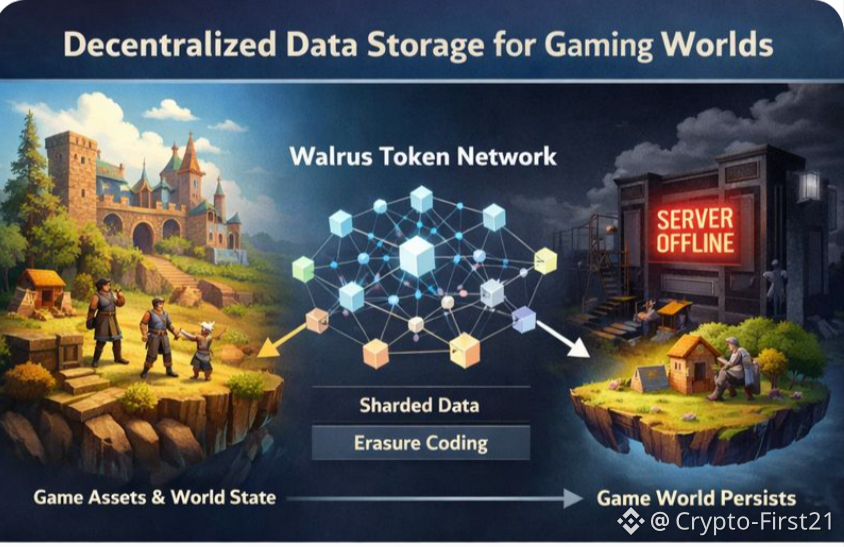
Walrus wasn't built with the notion of a new game token in mind. Walrus was not built with the concept in mind that there is a need for another gaming token. It was built with the concept in mind that onchain is great for coordination and settlement but has issues with large data sets. Games and the metaverse are large data sets by design and nature. Textures, maps, avatars, inventories, replays, and world states are not small in size. It is inefficient and impractical to build those directly around a blockchain technology.
The initial purpose of Walrus was to consider data availability a first-class problem. Not marketing data, but rather a kind of data that has to be persistent even in scenarios when a business closes down, when a server goes dark, or when a studio shifts focus. The purpose created a set of constraints. Data storage had to be a non-chaotic process and very much decoupled. It had to be a sustainable process without speculated economics.
These are the kinds of constraints that make it seem less exciting than other game tokens. It was never intended to be seen. It was intended to be reliable.
How the Architecture Works without Using Technical Terms
On a simplistic level, Walrus is a decentralized storage and availability layer. This means that instead of transferring a file from one location, the file can be fragmented, encrypted, and distributed into many autonomous nodes. This is not new either. What matters most here is the execution and the payment mechanism.
Walrus employs erasure coding so that the data can be rebuilt, even if the nodes go down. Indeed, with erasure coding, not all pieces are required, but only up to a threshold.
This is an important consideration when it comes to gaming and virtual reality because down time is not an optional component. The absence or damaged state of an asset is enough to break the immersion barrier instantly.
The coordination between these components is facilitated by the Walrus Token. This token is deployed to pay for the data’s storage space. Additionally, the token is used to reward nodes to act appropriately and penalize those that do not. However, it is crucial to point out that the token is not a representation of data ownership. Rather, the token is a representation of data availability.
As a builder, Walrus is seen like a outside service with cryptographic assurances. In so far as it may be seen as a service to a building constructor, it is like an external service secured by cryptography. In so far as it may be seen by a regulator, it is like infrastructure rather than a speculative thing. This ambivalence is not an accident.
Why Modularity is Important in Games & Virtual Worlds
One of the things that experience in the last decade of software has quietly taught us is that tightly coupled systems will fail in unpredictable ways. Games that integrate their logic, assets, identity, and economics into one stack will prove brittle.
Walrus is designed to be modular. It is not a game engine, an identity layer, or a settlement network. It is solely focused on the availability and integrity of data. This enables a modular solution, allowing developers to pick and choose: A game might use one chain for logic, another for financials, and Walrus for assets, game world state, and more.
This modularity matters even more in the metaverse, where it’s unlikely that any one platform will be dominant. There will be overlapping worlds. There will be the transfer of assets. There will be the reuse of identity. A game may have one chain for logic, another for payment processing, and Walrus for assets and world state.
The importance of modularity will be even more pronounced within metaverses: ultimately, there will be no dominant platform. The worlds will intersect. The assets will migrate. The identity will collide. The storage level, one that is based on a premise of permanence rather than dominion, will have a place within such a reality.
Privacy As Selective Visibility, Not Secrecy
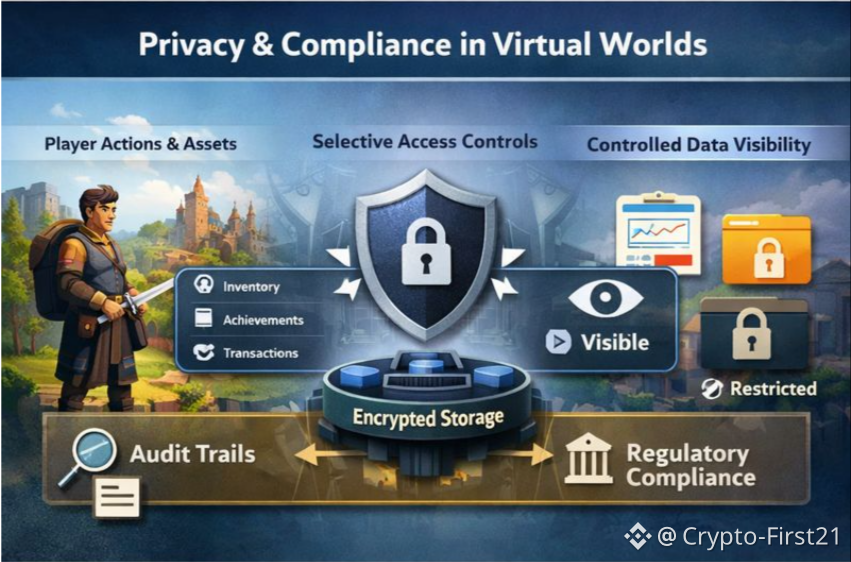
Gaming and the metaverse fail to understand privacy. Privacy is seen as anonymity or is simply disregarded. In effect, privacy in persistent virtual worlds is about controlling views and when those views are seen.
Walrus enables selective visibility through decoupling data storage and access control. Data can be decentralized for storage, and access permissions can be managed by cryptographic proofs and external logic. This helps a game enforce that select assets only be hidden until unlocked, states visible only to participants, and records audit-able if necessary.
This has implications for compliance. Games are increasingly mingling with financial infrastructure, identity, and even regulated assets. Thus, when privacy is treated from the standpoint of an embedded system rather than an afterthought, the problem of retrofits or other solutions that are difficult or very costly to implement is avoided.
Compliance as Architecture, not Paperwork
Vast majority gaming projects consider regulation as something to be dealt with when their size is such that it draws their attention. At this stage, their systems have developed to the point that resists regulation.
Walrus differs because it enables data to be auditable without being public. The data can be traced through storage proofs, access, and economic incentives where it can undergo auditing if necessary. This means surveillance but it also indicates that it is possible to prove that everything is following the guidelines without the intervention of central systems.
It is important for institutional participants investigating gaming and metaverse platforms. Pension funds and studious platforms require infrastructure which does not falter when it is put to the test. It does not guarantee acceptance because it eliminates a major hurdle.
Where this is already being tested
It has been integrated into testnets; the early focus was on large data availability. These include gaming-related use cases like asset storage, replay storage, and snapshots, among others. However, others are infrastructure related but with shared requirements.
It is not the number of partnerships but their type. It is not a brand play. It is a system integration test. It checks if it performs as expected under load, in time, and in fail scenarios. This is where infrastructure matters.
A concrete example: game worlds as dynamic environments
Take, for example, a multi-player game that is built for decades and not for seasons. They construct buildings, change terrain, and make artifacts that have importance because they are long-lasting. When the company shuts down, everything goes to pieces. This is the default position as of now.
With the decentralized storage layer such as Walrus, the world state can exist independently of the studio. This can be taken up by some other team. The community can archive it. The regulators can see certain parts of it, if necessary. The game will become less like a service and more like a place.
This is not inevitable because of hype. This is inevitable because players want continuity, and institutions want resilience.
Where this particular strategy positions within the general marketplace
The market is slowly separating the wheat from the chaff. The token that exists solely for the purpose of gaining attention fails. The system that solves a problem quietly will last even if it goes unnoticed.
The Walrus Token is the second type and finds itself in the category because the work it does in gaming and metaverse platforms is not making the process interesting but making it survivable, which is not as glamorous but much more sustainable.
As virtual worlds become economically significant, the supporting structure that underpins those worlds is going to be held to the same rules as those for economic systems, rules that include reliability, auditability, and controlled transparency. Walrus is the reflection of this. It is a reaction to that which has already been destroyed.
This is why it matters.

