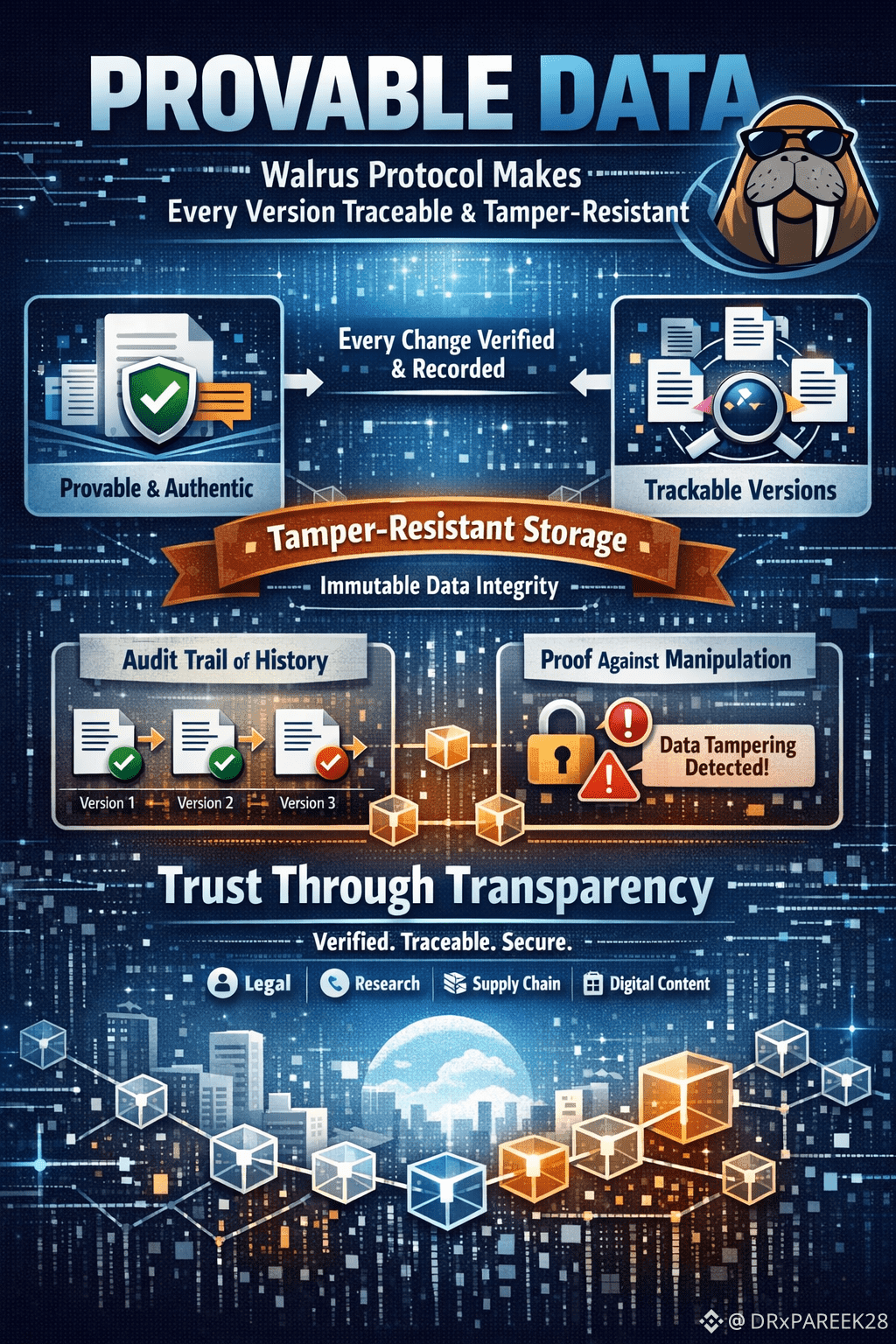
In Web3, “storing data” is not enough anymore. The real challenge is proving that the data is authentic, unchanged, and truly belongs to the history it claims. Because once information moves across apps, chains, and users, trust becomes fragile. A single edited file, a replaced document, or a missing version can break the credibility of an entire system. That’s why the idea of provable data is becoming one of the most important foundations for the future internet — and this is exactly where Walrus Protocol shines.
Walrus Protocol is designed with a powerful vision: make every piece of stored data provable, traceable, and tamper-resistant. It doesn’t just store files like traditional storage networks. Instead, it turns stored data into something that can be verified like a blockchain transaction. This changes the game for creators, developers, institutions, and even everyday users because it ensures that data stays reliable not just today, but years later when proof matters most.
At the heart of this idea is integrity. When you upload content to Walrus, the system creates a unique cryptographic identity for it. This means even the smallest modification — a single pixel changed in an image or a comma changed in a contract — produces a completely different identity. So if someone tries to tamper with your data, the network instantly exposes it. It’s not based on “trust me”, it’s based on math. The proof is built into the data itself.
But Walrus goes beyond proving that a file is original. It also makes every version of the data trackable. In real life, data evolves — documents get updated, research gets revised, product info changes, project files get replaced. Walrus protocol makes this versioning provable, meaning you can trace the exact history of an asset over time. This creates a clean timeline that shows what changed, when it changed, and which version is the authentic one. Instead of losing the past, you carry it with proof.
This version-level traceability becomes extremely powerful in areas where history matters. Imagine legal documents, academic research, financial reports, AI training datasets, supply chain certificates, or even creator content. With Walrus, you don’t just publish a file — you publish verifiable truth with an audit trail. Anyone can confirm that they are viewing the correct version, and anyone can detect manipulation attempts. That level of transparency builds trust automatically, without needing a central authority to guarantee it.
Another key strength is that Walrus makes data tamper-resistant by design, not by policy. Traditional storage platforms can be pressured, hacked, or altered from inside. Even decentralized storage sometimes depends on weak verification of content history. Walrus takes a stronger stance: the network treats data like a permanent truth record. Data can be referenced, proven, and validated publicly, ensuring that what you store cannot be secretly swapped out or “rewritten” without leaving fingerprints.
This makes Walrus Protocol a major step toward a future where data becomes as reliable as money on-chain. Because in the upcoming digital era, value will not only be in tokens — it will be in information. And the winners will be networks that allow information to be proven, not just shared. Walrus brings that future closer by making data storage verifiable, traceable through versions, and resistant to manipulation.
In simple words: Walrus Protocol doesn’t just store data — it stores proof. And in a world full of fake content, altered records, and hidden edits, provable data isn’t optional anymore. It’s the new standard.