
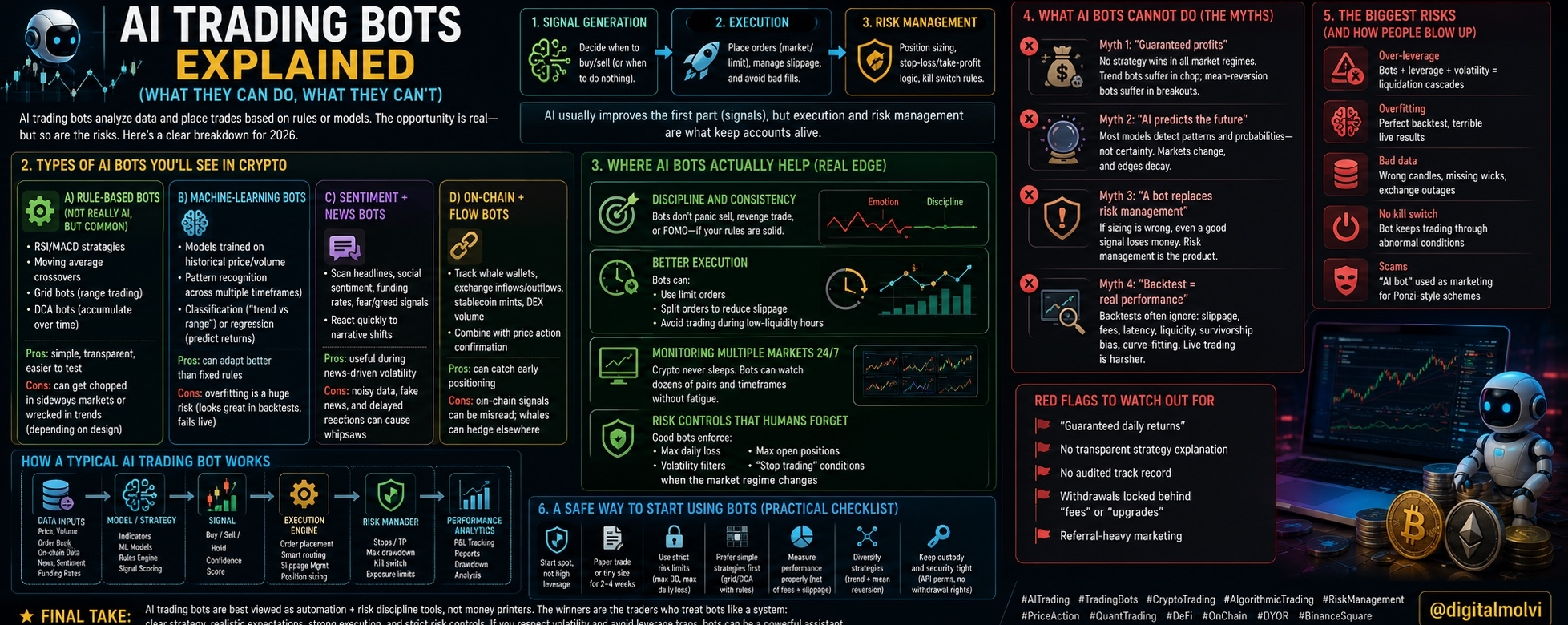
AI trading bots are automated systems that analyze data and place trades based on rules or models. In 2026, “AI bot” can mean anything from a simple indicator strategy to advanced machine-learning models that read order books, news, and on-chain flows. The opportunity is real—but so are the risks.
This article breaks down how AI bots work, where they actually help, and the red flags that trap most beginners.
1) What an AI trading bot is (in plain English)
A trading bot has three jobs:
Signal generation
Decide when to buy/sell (or when to do nothing).
Execution
Place orders (market/limit), manage slippage, and avoid bad fills.
Risk management
Position sizing, stop-loss/take-profit logic, max drawdown limits, and “kill switch” rules.
“AI” usually improves the first part (signals), but execution and risk management are what keep accounts alive.
2) Types of AI bots you’ll see in crypto
A) Rule-based bots (not really AI, but common)
RSI/MACD strategies
moving average crossovers
grid bots (range trading)
DCA bots (accumulate over time)
Pros: simple, transparent, easier to test
Cons: can get chopped in sideways markets or wrecked in trends (depending on design)
B) Machine-learning bots
models trained on historical price/volume
pattern recognition across multiple timeframes
classification (“trend vs range”) or regression (predict returns)
Pros: can adapt better than fixed rules
Cons: overfitting is a huge risk (looks great in backtests, fails live)
C) Sentiment + news bots
scan headlines, social sentiment, funding rates, fear/greed signals
react quickly to narrative shifts
Pros: useful during news-driven volatility
Cons: noisy data, fake news, and delayed reactions can cause whipsaws
D) On-chain + flow bots
track whale wallets, exchange inflows/outflows, stablecoin mints, DEX volume
combine with price action confirmation
Pros: can catch early positioning
Cons: on-chain signals can be misread; whales can hedge elsewhere
3) Where AI bots actually help (real edge)
1) Discipline and consistency
Bots don’t panic sell, revenge trade, or FOMO—if your rules are solid.
2) Better execution
Bots can:
use limit orders
split orders to reduce slippage
avoid trading during low-liquidity hours
manage entries/exits systematically
3) Monitoring multiple markets 24/7
Crypto never sleeps. Bots can watch dozens of pairs and timeframes without fatigue.
4) Risk controls that humans forget
Good bots enforce:
max daily loss
max open positions
volatility filters
“stop trading” conditions when the market regime changes
4) What AI bots cannot do (the myths)
Myth 1: “Guaranteed profits”
No strategy wins in all market regimes. Trend bots suffer in chop; mean-reversion bots suffer in breakouts.
Myth 2: “AI predicts the future”
Most models detect patterns and probabilities—not certainty. Markets change, and edges decay.
Myth 3: “A bot replaces risk management”
If sizing is wrong, even a good signal loses money. Risk management is the product.
Myth 4: “Backtest = real performance”
Backtests often ignore:
slippage
fees
latency
liquidity
survivorship bias
curve-fitting
Live trading is harsher.
5) The biggest risks (and how people blow up)
Over-leverage: bots + leverage + volatility = liquidation cascades
Overfitting: perfect backtest, terrible live results
Bad data: wrong candles, missing wicks, exchange outages
No kill switch: bot keeps trading through abnormal conditions
Scams: “AI bot” used as marketing for Ponzi-style schemes
Red flags:
“Guaranteed daily returns”
no transparent strategy explanation
no audited track record
withdrawals locked behind “fees” or “upgrades”
referral-heavy marketing
6) A safe way to start using bots (practical checklist)
If you want to use an AI bot responsibly:
Start spot, not high leverage
Paper trade or tiny size for 2–4 weeks
Use strict risk limits (max drawdown, max daily loss)
Prefer simple strategies first (grid/DCA with rules)
Measure performance properly (net of fees + slippage)
Diversify strategies (trend + mean reversion, not one bot only)
Keep custody and security tight (API permissions, no withdrawal rights)
AI trading bots are best viewed as automation + risk discipline tools, not money printers. The winners are the traders who treat bots like a system: clear strategy, realistic expectations, strong execution, and strict risk controls. If you respect volatility and avoid leverage traps, bots can be a powerful assistant.
If you tell me your style—spot only vs futures, and trend vs range—I can outline a simple bot framework (rules + risk settings) you can run safely.
#digitalmolvi #BinanceSquare #Aİ #TradingBot #article


