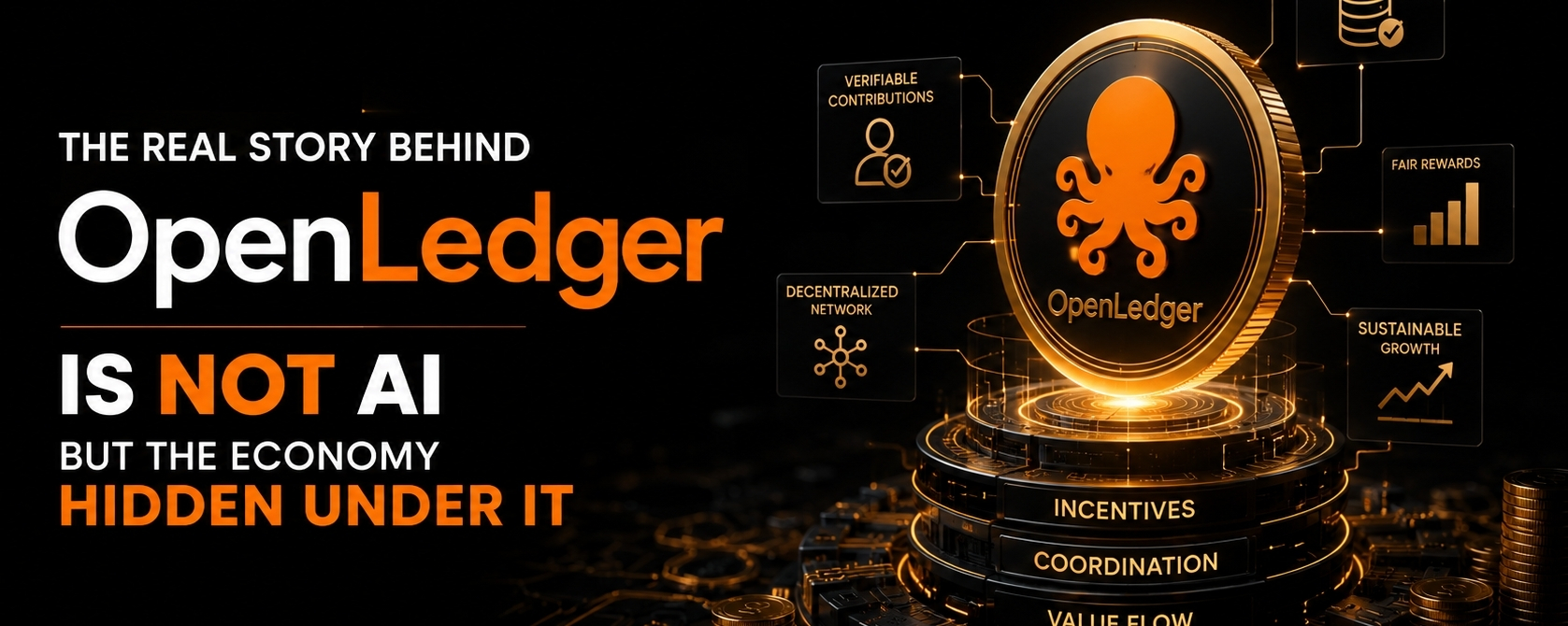

I’m tired of how familiar everything feels.
Every cycle arrives dressed like a new era, but after a while the promises start sounding reused. New words, new tickers, new dashboards, same hunger underneath. Everyone says this time the infrastructure is different, this time the incentives are better, this time the market finally understands the deeper layer. Maybe. But I have heard enough versions of that sentence to stop trusting it on first contact.
That is probably why OpenLedger caught me in a strange mood.
Not excitement exactly. More like suspicion mixed with curiosity. The kind that shows up late at night when you are reading about a protocol and slowly realize the headline is not the thing that matters.
The easy version is to say OpenLedger is about AI, data, attribution, and $OPEN. But that feels too clean. Too tradable. Too convenient.
What interested me was the uglier thought beneath it.
Every AI response looks effortless. You type something, an answer appears, and the whole process feels almost weightless. But nothing about it is weightless. Somewhere underneath, there is data, training, validation, infrastructure, contributors, costs, mistakes, corrections, and people trying to get paid for work that the final interface completely hides.
That hidden layer is where things usually get interesting.
Because once money enters, invisible work does not stay invisible forever. Someone asks who contributed. Someone asks who owns the value. Someone asks who deserves the reward. Someone builds a system to track it. Then someone else learns how to game that system.
That is the part I keep coming back to with OpenLedger.
Maybe it is not trying to make AI feel smarter. Maybe it is trying to give AI an accounting layer. A memory of who helped create the value behind the output. And if that works, even partly, then every AI response starts to look different. Not like a clean answer floating on a screen, but like the visible tip of a small economic machine running underneath it.
I like that idea.
I also distrust it.
Because markets do not treat incentive systems gently. They poke them, farm them, stress them, bend them. If rewards exist, people will optimize around them. If reputation matters, reputation will be manufactured. If contribution becomes measurable, people will learn how to look useful before they become useful.
That does not make the idea wrong. It just makes it harder.
And maybe that is the real question with OpenLedger. Not whether the narrative sounds intelligent. It does. Not whether AI needs better provenance and contributor economics. It probably does. The real question is whether the system can survive the behavior it invites.
Can it handle noise?
Can it handle scale?
Can it handle disputes?
Can it tell the difference between real contribution and well-packaged activity?
Can it keep working when the market stops being patient?
These are the questions I care about more now. I did not always. Earlier in crypto, I probably would have looked for the clean thesis, the big market, the elegant mechanism. Now I look for the pressure points. Where does it slow down? Where does it leak? Who benefits when nobody is watching? What happens when rewards become large enough to attract the wrong kind of intelligence?
OpenLedger might be pointing at something real. AI is becoming a surface layer for work, search, creativity, automation, maybe even decision-making. If that continues, then the economy beneath AI cannot remain vague forever. Data has a source. Models have contributors. Outputs have dependencies. Value does not appear from nowhere just because the interface makes it feel that way.
Maybe $OPEN is a bet on that hidden economy becoming visible.
Or maybe it becomes another beautiful idea that discovers human behavior is messier than the design assumed.
I cannot pretend to know yet.
All I know is that the visible AI story feels incomplete. Everyone is staring at the answer, but the more important question may be what the answer owes. Who gets counted. Who gets paid. Who gets erased. Who quietly builds the rails while the market chases the glow on the surface.
That is where OpenLedger becomes interesting to me.
Not as a clean promise.
More like a question sitting underneath every AI response.
If intelligence becomes economic activity, who keeps the books?
And when real capital, volatility, impatience, and survival instincts start moving through those books, we will find out whether the system was infrastructure or just another story the market wanted to believe for a while.
@OpenLedger #OpenLedger #OpenLedger # $OPEN