I’ve been watching OpenLedger (OPEN) over the past stretch of updates with a single question that keeps resurfacing in different forms:
Are we actually getting closer to a usable AI-attribution economy, or are we still just watching infrastructure-shaped promises slowly harden into something that might, eventually, matter?
There isn’t a clean answer yet. But the signal is no longer as blurred as it used to be. It’s starting to separate into things that feel operationally meaningful and things that still feel like architecture waiting for real demand to catch up.
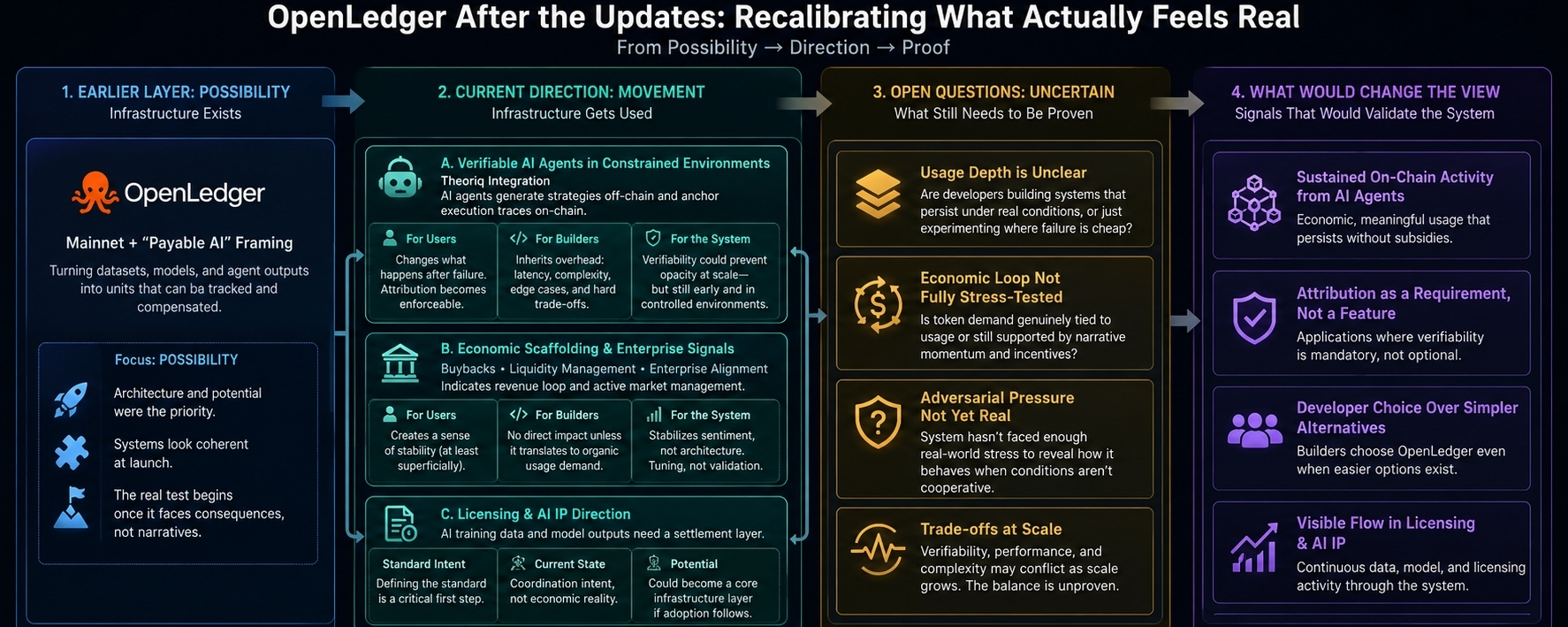
The mainnet phase and the “Payable AI” framing already belong to an earlier layer of the story. That part was about possibility—about turning datasets, models, and agent outputs into units that can be tracked and compensated. But I’ve learned not to overweight that stage anymore. Most systems look coherent at launch. The real question is what changes once the system has to live with consequences instead of narratives.
What’s more interesting now is the direction of movement after that initial reveal. There’s a visible attempt to shift from “infrastructure exists” to “infrastructure gets used,” and it’s happening through two main pressure points: verifiable AI agents in constrained environments, and economic scaffolding built around usage—buybacks, enterprise signals, licensing conversations. Neither of these is automatically proof of success, but they do indicate where the system is trying to stress itself.
The Theoriq integration stands out in that regard. It’s one of the few developments that doesn’t just add to the story but actually changes the shape of behavior. AI agents generating strategies off-chain and then anchoring execution traces on-chain introduces something that sounds clean in theory but becomes complicated immediately in practice.
Because once you can audit an agent’s behavior after the fact, you’re no longer just building intelligence systems—you’re building accountability systems.
That has very real consequences. For users, it doesn’t instantly make outcomes better or safer in a visible way. What it changes is what happens after failure. Attribution stops being an abstract concept and becomes something enforceable, which shifts how trust is even defined in these systems.
For builders, though, the cost is immediate. You inherit overhead that most AI systems don’t naturally carry: latency from logging, complexity from traceability, and edge cases where performance and verifiability start pulling in opposite directions. It’s not obvious yet whether that trade-off is acceptable at scale or whether it quietly filters out the very builders you need for adoption.
The system benefit is clearer but still theoretical. In a world where AI agents actually manage capital or execute strategies autonomously, verifiability could be the differentiator that prevents total opacity. But we’re not there yet. We’re still in controlled environments where the consequences are observable but not existential.
The buyback mechanism and broader enterprise-aligned liquidity signals sit in a different category entirely. They are often read as confidence, but I’ve started treating them more cautiously. They do suggest that some form of revenue loop exists and that the team is willing to actively manage market structure. That’s not insignificant, but it’s also not the same as proving organic demand.
For users, these mechanisms create a sense of stability, at least superficially. For builders, they don’t really change anything unless they translate into sustained usage demand that exists independently of incentives. And for the system itself, they mostly stabilize sentiment rather than validate architecture. It’s a form of tuning, not proof of ecosystem strength.
The licensing and AI IP direction is more interesting, even if it’s still early. The idea that AI training data and model outputs need a settlement layer is not controversial anymore—it’s increasingly a practical constraint. OpenLedger’s positioning here feels closer to a real infrastructure bet than most of the surrounding narrative.
But again, there’s a gap that hasn’t been crossed yet. Defining a standard is one thing. Seeing meaningful, continuous flow of data, models, and licensing activity through that standard is something else entirely. Right now, it still feels closer to coordination intent than economic reality.
And through all of this, the same core questions remain stubbornly unresolved. Actual usage depth is still unclear. It’s hard to tell whether developers are building systems that persist under real conditions or just experimenting in environments where failure is cheap. The economic loop still hasn’t been fully stress-tested—whether token demand is genuinely tied to usage or still partially sustained by narrative momentum and incentive structures. And perhaps most importantly, the system hasn’t yet faced enough adversarial pressure to reveal how it behaves when things stop being cooperative.
These aren’t roadmap gaps. They’re failure-mode gaps. And they only show up when scale removes the safety of controlled conditions.
So my view, if I try to compress it honestly, has shifted but not resolved. Earlier, this looked like interesting infrastructure wrapped in heavy narrative risk. Now it looks more like real infrastructure that hasn’t yet proven whether it can become unavoidable.
What has improved is directionality. There is a clearer push toward verifiable agents, more explicit economic tooling, and at least some movement into real-world adjacent domains like finance and licensing. What hasn’t moved enough is adoption depth, proof of organic demand, and evidence that the system remains usable once complexity compounds.
What would actually change that assessment isn’t another partnership or another milestone announcement. It would be something harder and less theatrical: sustained, economically meaningful on-chain activity from AI agents that persists without subsidies; applications where attribution is not a feature but a requirement; and visible proof that developers choose this system even when simpler alternatives exist.
Until then, it remains in a transitional state that is hard to categorize cleanly. Not hype, not validation. Just early infrastructure still trying to justify why it should become part of the default stack—without yet proving that the world needs it in exactly this form.