
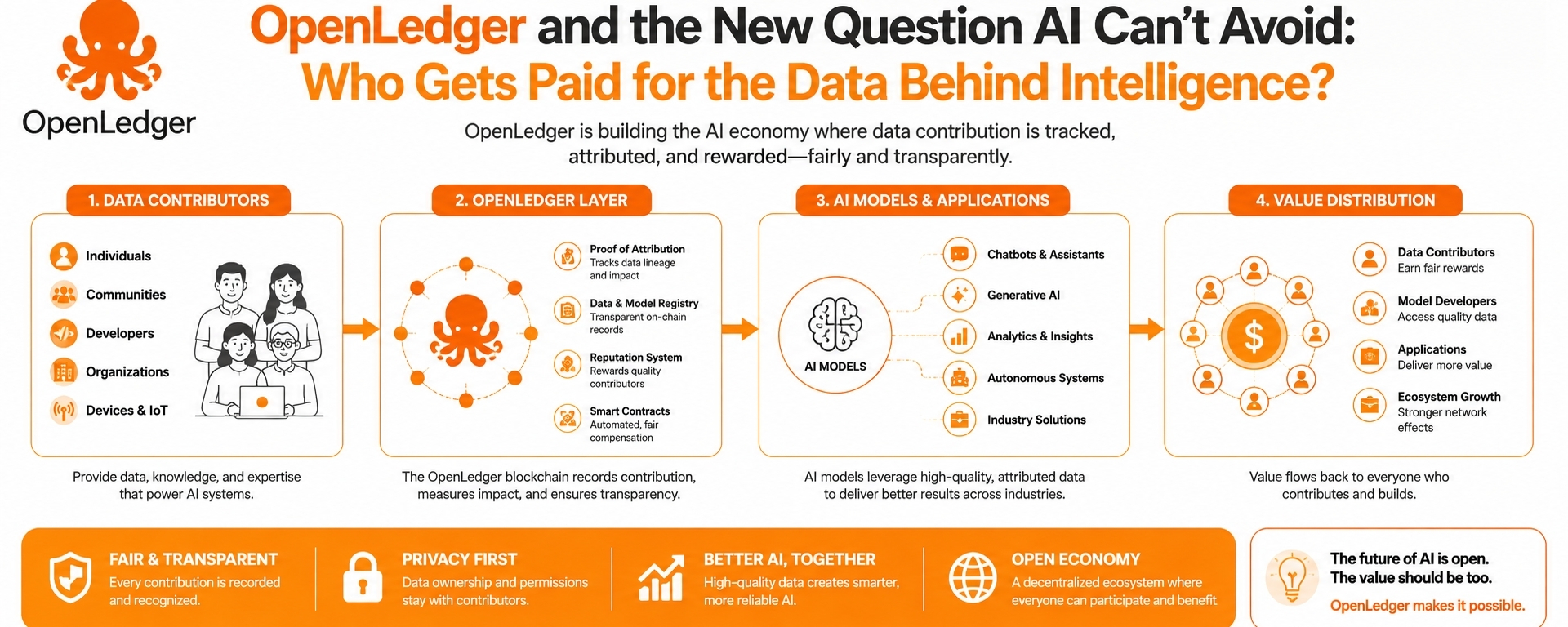
OpenLedger is one of those projects I keep coming back to because it touches a problem AI often tries to move past too quickly. Everyone likes talking about smarter models, better agents, faster automation, and the next big leap in machine intelligence, but much less attention goes to the raw material behind all of it. Data is treated like it just exists somewhere in the background, ready to be collected and used. But behind that data are people, communities, habits, expertise, labor, and sometimes years of shared knowledge that do not always get recognized once the AI system starts producing value.
That is the part I find interesting. OpenLedger is not just pointing at AI as a technology problem. It is pointing at AI as a value problem. If people contribute the information that makes systems better, then the natural question becomes whether they should stay connected to the value that information creates. It sounds simple when said that way, but the actual mechanics are much harder. Data does not become useful just because someone uploads it. Some data is rare. Some is messy. Some is repeated. Some only matters when it is combined with other pieces. Some needs to be cleaned, checked, labeled, or placed in the right context before it has any real use.
That is where the idea becomes less shiny and more serious. A system like OpenLedger has to do more than say contributors deserve rewards. It has to figure out what a meaningful contribution actually is. Is the most valuable person the one who provides the original data, the one who verifies it, the one who improves it, or the one who helps prove that it made a model better? In a simple story, all of those roles are easy to respect. In a working system, they can compete with each other for credit.
I think this is what many people overlook. Once rewards enter the system, behavior changes. People do not just contribute naturally anymore. They start watching the rules. They notice what gets rewarded and what gets ignored. If the system rewards volume, people may flood it with low-quality data. If it rewards rare data, people with better access may gain a bigger advantage. If the process feels unclear, smaller contributors may start to wonder whether the system is really fair or just difficult to understand. Even when the design is honest, confusion can still feel like unfairness from the outside.
There is also a human side to this that matters. When people are told their data has value, they begin treating it differently. Some become more careful, which is probably healthy. They ask better questions about permission, ownership, and consent. But some may become more guarded. They may stop sharing unless they know exactly what they will receive in return. Communities may protect knowledge that used to move more freely. Experts may become selective about what they contribute. That could create a more respectful data economy, but it could also make coordination slower and more complicated.
OpenLedger is sitting inside that tension. AI needs access to useful data, but contributors need a reason to trust that they are not just feeding another machine that captures most of the upside somewhere else. The difficult part is that trust cannot be built only through technical records. A ledger can show that something was contributed, but it cannot automatically prove that the contributor feels properly valued. It can record participation, but it still needs a believable way to explain impact, quality, and reward.
That impact is especially hard to measure in AI. A small dataset might not look important at first, but later it could improve a niche model in a meaningful way. A large dataset might look impressive but add very little if it repeats what the model already knows. A contribution may matter only because another person cleaned it or because a third person verified it. Value can be delayed, indirect, and shared across many layers. So the question is not only who contributed, but how much that contribution actually mattered once the system used it.
This is where power can quietly collect. Early users may understand the reward structure before others do. Large data holders may have more leverage because they can contribute at scale. Technical participants may learn how to shape submissions in ways that score better. Validators and curators may become powerful because they decide what is useful and what is noise. Even a project built around fair distribution can still create new advantages if the most valuable roles require access, timing, or expertise that not everyone has.
That does not make OpenLedger less important to watch. It makes it more realistic. Any project trying to build an AI data economy has to deal with imperfect incentives, uneven participation, and the constant risk of people gaming the system. The promise is not that every contribution can be measured perfectly. That may never happen. The real test is whether the system can become understandable and fair enough that people continue to participate even when rewards are not always obvious.
I also think OpenLedger speaks to where AI may be heading next. As general models become easier to access, the real advantage may come from specialized knowledge, cleaner data, trusted sources, and communities that understand specific problems better than broad systems do. In that world, data contribution becomes more than a background activity. It becomes part of the infrastructure. The question is whether that infrastructure can reward people without turning participation into another game where the largest players quietly capture most of the value.
That is why I keep watching OpenLedger with interest, but not with blind certainty. The idea feels important because AI cannot keep pretending that intelligence is created only at the model layer. A lot of value begins earlier, with the people and information that shape what the model can understand. But building a system that records contribution is only the first step. The harder part is proving that contribution can be valued in a way people still trust when the network grows, the incentives sharpen, and the real competition begins.