
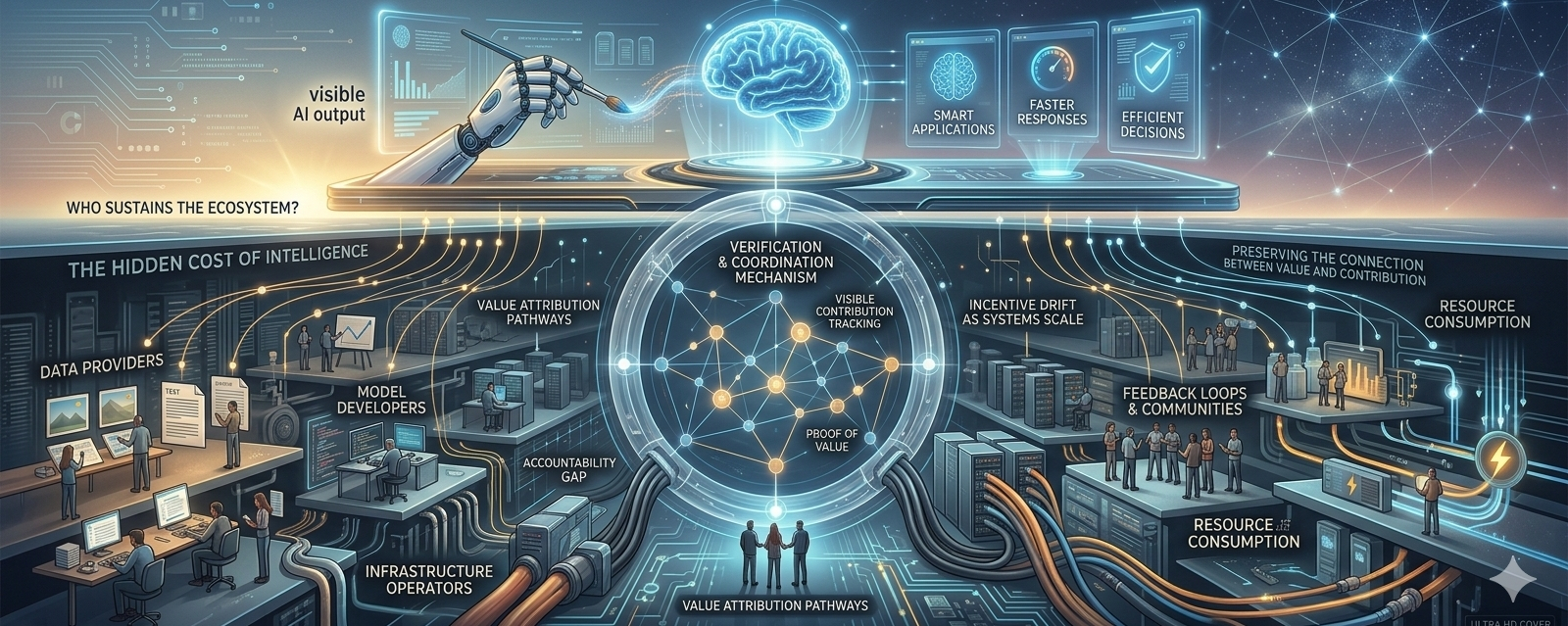
The more I kept thinking about it, the more something felt incomplete. Not wrong exactly, just too convenient. A lot of discussions around AI seem to focus on the visible outcomes—better models, smarter applications, faster responses, and new capabilities. Those things are easy to measure and even easier to market. But the further I looked beneath the surface, the more I found myself returning to a different question. Where does the value actually come from once these systems begin to scale, and who continues to carry that value when everyone else is focused on the final result?
What makes this question interesting is that most people never really ask it. We tend to judge systems by what they produce rather than by what they depend on. Yet intelligence does not emerge in isolation. It is built on countless layers of contribution. Data providers, model developers, infrastructure operators, feedback loops, and communities all play a role. The final output may look simple, but the path that created it is anything but simple. As ecosystems grow, that path often becomes harder to see.
Over time, visibility and contribution begin moving in different directions. The output remains visible. The contributors slowly disappear into the background. The system becomes more useful, but also more difficult to trace. This creates a subtle form of pressure that many people ignore. Not because it is unimportant, but because it stays hidden until scale forces everyone to confront it. When value can no longer be clearly connected to contribution, incentives begin to drift. And once incentives drift, behavior changes with them.
The longer I thought about this, the less it felt like a technology problem and the more it felt like a coordination problem. Every ecosystem develops habits. Some reward meaningful participation. Others reward proximity to the point where value is captured. At first the difference seems small. Over time it becomes culture. People naturally optimize for whatever the system rewards, whether those rewards were intentionally designed or not. Eventually entire networks begin reflecting those incentives.
This is where OpenLedger started standing out to me.
Not because it presents itself as an AI blockchain. Plenty of projects can attach themselves to popular narratives. What caught my attention was the underlying idea that contribution should remain visible instead of disappearing as systems become larger and more complex. The project appears to focus on creating a structure where data, models, and AI agents exist within a framework that can recognize where value originates rather than only rewarding where value ends up.
That distinction feels more important than most people realize. The challenge facing AI may not simply be building more intelligence. It may be preserving accountability around the process that creates intelligence in the first place. Without that, ecosystems risk becoming increasingly dependent on trust while becoming less capable of verification. Everything may continue functioning, but understanding why it functions becomes harder with each layer added on top.
Seen through that lens, the OPEN token feels less like a speculative instrument and more like a coordination mechanism. Its role is not simply to exist within the network but to connect participation, incentives, and accountability. If a system is serious about recognizing contribution, then some shared economic layer has to exist to support that process. The token becomes part of the structure that allows contributors to interact, participate, and be recognized within the same environment.
Of course, ideas always appear strongest when conditions are comfortable. The real test comes later. It comes when activity increases, when incentives are challenged, when disagreements emerge, and when transparency becomes expensive rather than convenient. That is usually the moment when systems reveal what they truly prioritize.
That is also the moment I will be paying attention to.
Not the announcements. Not the excitement. Not even the market performance.
I want to see what happens when the system is placed under genuine pressure and whether the connection between contribution and value remains intact when maintaining that connection becomes difficult. Because that is where durable systems separate themselves from compelling narratives.
For now, I still have questions. Maybe that is a good thing. The most interesting projects are rarely the ones that provide immediate certainty. They are the ones that force you to reexamine assumptions that have quietly become normal. OpenLedger sits in that category for me. Not because I know exactly how the story ends, but because it keeps pulling my attention back to a question that feels increasingly important as AI grows larger: when intelligence creates value, who should be able to prove where that value came from? And when the next real stress event arrives, will the answer still hold up? #OpenLedger @OpenLedger $OPEN


