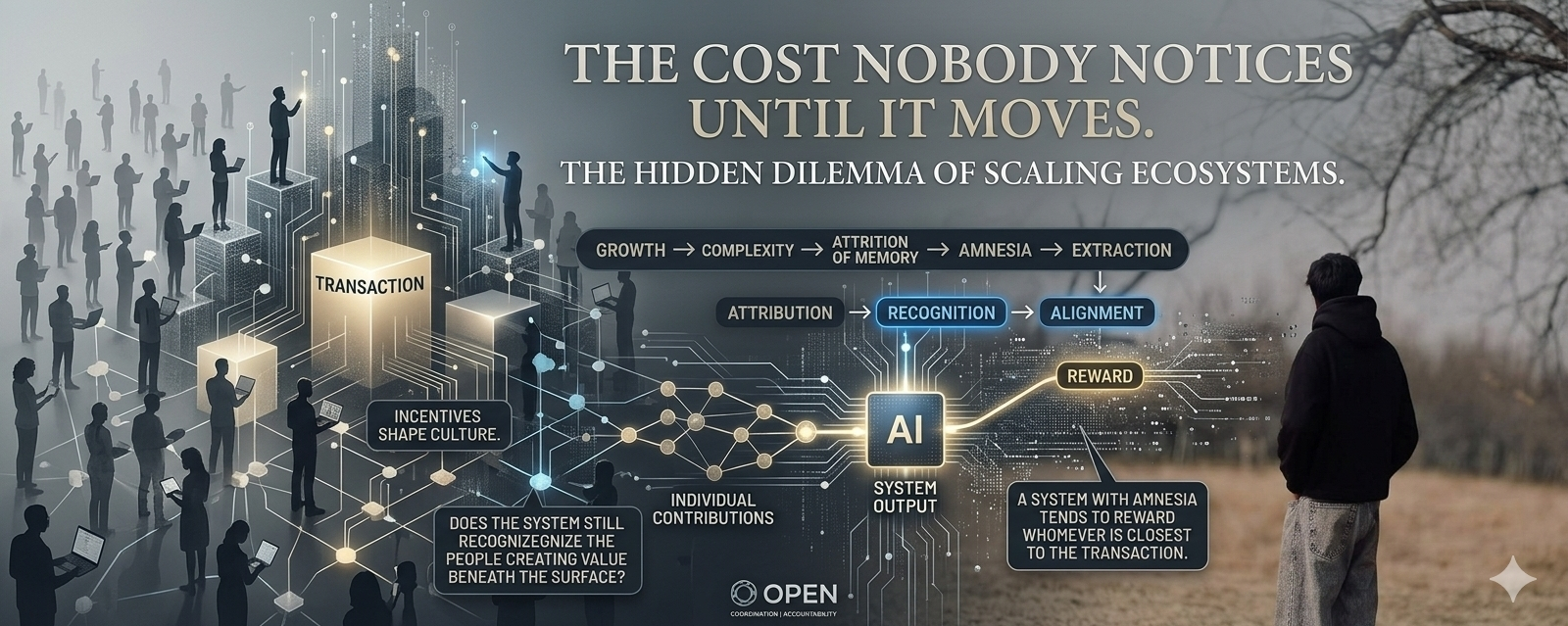
What kept bothering me was how neatly everyone talks about growth. The bigger a system gets, the more people seem to assume everything is working exactly as intended. More users arrive, more activity happens, more value is created. The story sounds clean. Almost too clean. Because whenever something scales that quickly, somebody usually ends up carrying a cost that nobody talks about anymore.
I found myself thinking about that more than I expected while looking at OpenLedger.
Not because of the AI angle. Not because of the blockchain angle either. Those narratives are everywhere now. What stayed in my head was a simpler question: when an ecosystem becomes large enough that thousands of people are contributing to it in different ways, who actually benefits from that contribution over time?
The obvious answer is everyone.
The honest answer is usually more complicated.
I've noticed that many systems start with good intentions. They want participation. They want collaboration. They want people to bring their ideas, their work, their knowledge. But as those systems grow, something subtle changes. The connection between contribution and reward becomes harder to see. The machine gets bigger. The outputs become more impressive. Yet the people feeding value into the system often become increasingly invisible.
Nobody plans for that to happen.
It just happens.
And once it does, behavior starts changing.
People stop asking, "How can I improve this?" and start asking, "How can I get mine before someone else does?" The culture shifts little by little. Not because people become worse, but because incentives quietly teach them different lessons.
That's the part I think many people overlook.
Technology gets most of the attention, but incentives shape the culture that grows around it. If a network rewards extraction more than contribution, people eventually learn to extract. If it rewards short-term gains, people become short-term thinkers. Over time, the system reflects those habits back at everyone using it.
The more I thought about OpenLedger, the more I felt like it was trying to address that invisible pressure point.
Not by creating another layer of intelligence, but by asking how intelligence should be connected to the people who help create it.
Because data doesn't appear out of nowhere.
Knowledge doesn't appear out of nowhere.
Useful outputs don't appear out of nowhere.
There are always people behind them.
The challenge is that as systems become larger, those people become harder to see.
That's why attribution kept standing out to me. Not as a technical feature, but as a cultural one. Attribution forces a system to remember. It creates a record that says value came from somewhere. Someone contributed. Someone took a risk. Someone spent time building, collecting, improving, or maintaining something that made the final outcome possible.
Without that memory, ecosystems develop amnesia.
And systems with amnesia tend to reward whoever is closest to the transaction rather than whoever created the foundation underneath it.
Maybe that's why OpenLedger feels interesting to me. It seems less focused on making AI bigger and more focused on making contribution harder to ignore. Whether it succeeds is a different question entirely, but I think the intention matters.
Because the real test isn't what happens when everything is working.
The real test is what happens when things get messy.
When activity explodes.
When demand increases.
When participants start competing for rewards.
When incentives begin pulling people in different directions.
That's when you learn what a system actually values.
A lot of projects look aligned during calm periods. Stress reveals the truth.
And that's where OPEN starts making sense to me. Not as something separate from the system, but as a way of coordinating behavior inside it. A mechanism that connects participation, accountability, and rewards. Its value, at least in theory, comes from helping the network remember who contributed and how value should move through the ecosystem.
That sounds straightforward.
In practice, it rarely is.
Human behavior has a way of finding shortcuts. Every network eventually faces pressure. Every incentive model eventually gets tested. The question is whether the original principles survive once real money, real competition, and real scale enter the picture.
I don't know the answer yet.
That's why I'm still watching.
The next time the market becomes chaotic, the next time activity surges and everyone starts optimizing for their own interests, I'll be paying attention to one thing.
Does the system still recognize the people creating value beneath the surface?
Or does it start forgetting them the moment remembering becomes inconvenient?
For me, that's where the real story begins. Not in the technology itself, but in whether the people behind the value remain visible when the pressure arrives. And I suspect that's a much harder problem than most of us like to admit.