
I’ve been watching AI and crypto slowly move toward each other for a while now. Not in the loud, overhyped way people usually talk about online, but more quietly — almost underneath the surface. A few years ago, most projects felt obsessed with attention. Bigger promises, faster narratives, louder communities. But lately I’m noticing something different. The projects that seem more interesting aren’t trying to dominate headlines anymore. They’re trying to build infrastructure.
That shift is probably why OpenLedger stayed in my mind longer than I expected.
At first glance, it sounds like another ambitious AI-blockchain experiment: an AI-native chain focused on monetizing data, models, and autonomous agents. But the deeper I looked, the less it felt like a typical crypto pitch and the more it felt like an attempt to redesign how AI participation itself works.
And honestly, I’m still not completely sure what to make of it.
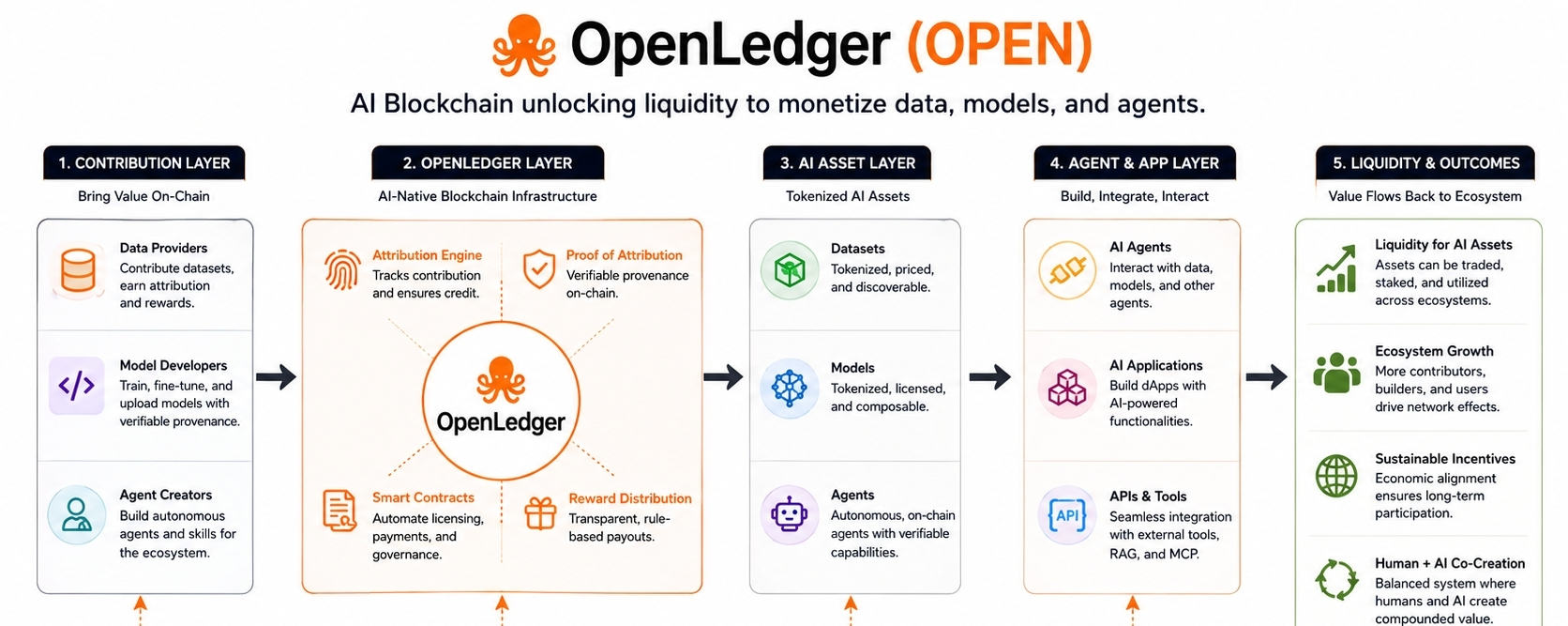
The idea behind OpenLedger is relatively simple to explain but harder to fully unpack. Instead of treating AI as something happening off to the side, the project wants AI activity to exist directly within blockchain infrastructure. Training models, deploying them, connecting wallets, interacting through smart contracts, coordinating agents — all of it becomes part of the network itself. The Ethereum compatibility and integration with L2 ecosystems make that vision feel intentionally grounded in existing crypto architecture rather than disconnected from it.
But what keeps pulling me back isn’t the technical side.
It’s the underlying assumption.
OpenLedger seems built around the belief that data and intelligence should become liquid assets — traceable, rewardable, and economically active. In theory, that sounds fair. AI systems today rely on enormous amounts of invisible contribution. People create data constantly without ownership, context disappears into training pipelines, and value often concentrates around whoever controls the models at the end.
So when a project starts talking about attribution and on-chain participation, part of me understands the appeal immediately.
Still, another part of me keeps wondering whether turning everything into an economy actually fixes the problem or just reorganizes it into a cleaner-looking system.
That tension feels impossible to ignore.
Crypto was originally framed around decentralization — reducing dependence on centralized control. AI, meanwhile, seems to be moving toward increasing automation and decision-making at scale. When those two ideas merge, something strange happens. You end up building decentralized environments that may eventually rely heavily on autonomous systems operating faster than humans can realistically follow.
OpenLedger appears aware of this contradiction. A lot of its design philosophy leans toward transparency, attribution, and verifiable interaction. But transparency alone doesn’t necessarily create trust. Sometimes it simply makes systems easier to measure while leaving the deeper questions unresolved.
And maybe those questions don’t have clean answers yet.
The part I find most interesting is the agent layer. OpenLedger doesn’t seem focused only on hosting AI models. It imagines agents actively interacting with networks, tools, data, and economic systems on-chain. That changes the role of blockchain itself. The chain stops feeling like a place where assets are stored and starts feeling more like an environment where machine coordination happens continuously in the background.
That idea is fascinating.
It’s also slightly uncomfortable.
Because once intelligence becomes deeply tied to incentives, efficiency starts becoming the priority very quickly. Systems optimize themselves around speed, output, and participation. More data flowing. More agents operating. More transactions happening automatically. And somewhere in that process, I keep wondering where human intention actually fits anymore.
Maybe projects like OpenLedger create healthier ecosystems where contributors finally receive value for what they provide.
Or maybe they slowly normalize a world where every interaction, every dataset, and eventually every decision becomes part of an endless economic loop.
Right now, I genuinely don’t know.
But I think the uncertainty is what makes projects like this worth paying attention to in the first place. Not because they already have the answers, but because they reveal where the industry seems to be heading before most people fully notice it.
And honestly, OpenLedger feels less like a finished vision to me and more like an early signal.
A sign that AI and blockchain are no longer evolving separately.
And a reminder that the infrastructure being built quietly today may end up shaping the way intelligence itself operates tomorrow.