
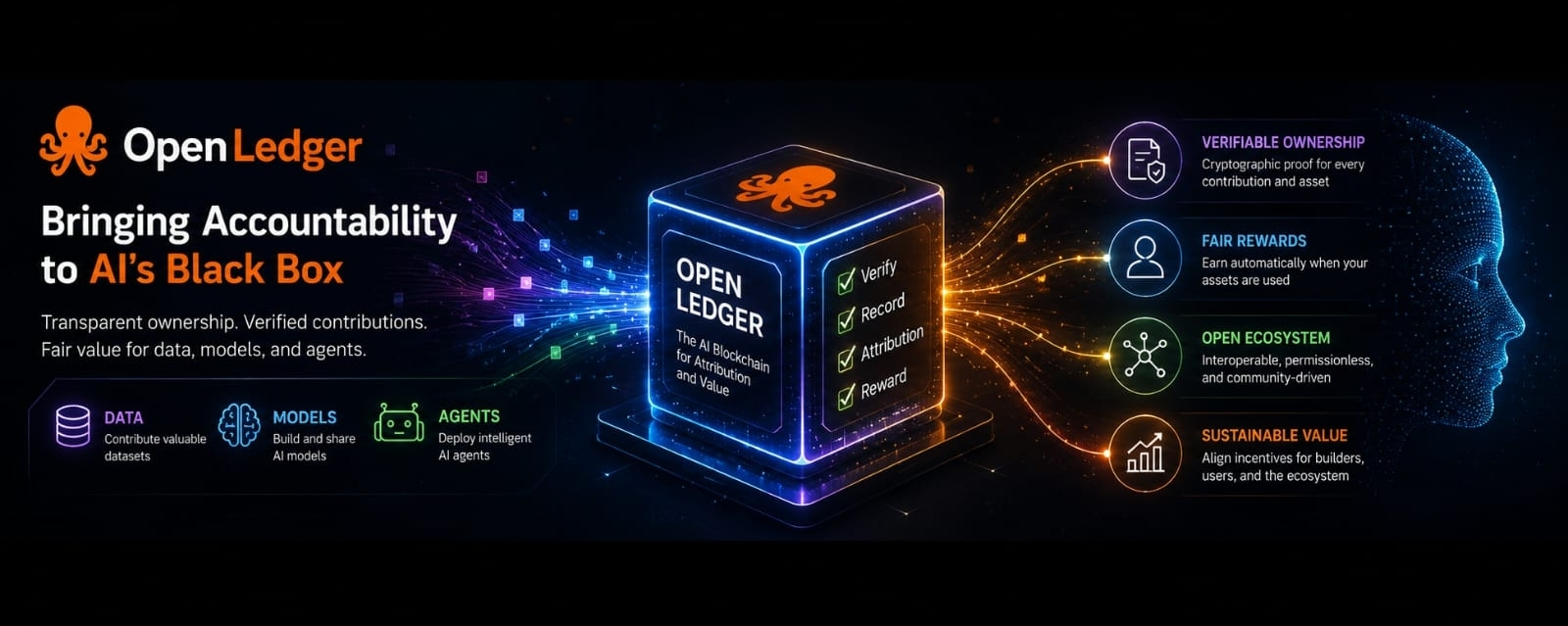
OpenLedger is trying to deal with one of those ugly problems crypto usually pretends is already solved.
Ownership.
Not ownership in the loud, slogan-heavy way. Not “own your data” printed on a landing page with neon gradients and a token ticker underneath. I mean the boring, painful version. The version where someone creates useful data, trains a model, builds an agent, contributes something real, and then somehow the value disappears into someone else’s platform.
We’ve all seen this movie.
Look, crypto has always been good at promising fairer systems. Fairer access. Fairer rewards. Fairer ownership. Then you actually use the products and half the time it turns into a mess of fake users, farmed airdrops, wallets pretending to be communities, and incentives that reward whoever has the most patience to click buttons for six weeks.
That’s the trauma.
People build. Farmers extract. Platforms capture. Real users get buried somewhere in the middle.
So when OpenLedger talks about data, models, and agents, I don’t hear some shiny AI narrative first. I hear plumbing. I hear infrastructure under the hood that is supposed to answer a very basic question: if something has value, who created it, who used it, and who gets paid?
That sounds simple.
It isn’t.
Honestly, this is the kind of thing crypto should have been better at by now. Tracking contribution. Paying the right people. Making ownership less dependent on trust and more dependent on records that don’t quietly change when a platform feels like changing the rules.
But crypto has also taught me not to clap too early.
Because every cycle has projects that point at a real problem and then bury it under nonsense. AI makes that even worse. The second a project says “AI agents,” my guard goes up. Not because agents are useless. Some of them might actually matter. But because the market has turned AI into a costume. Put it on anything and suddenly people pretend it has depth.
The thing is, OpenLedger is at least aiming at a real mess.
AI is eating data from everywhere. Models are trained, reused, modified, packaged, and sold. Agents are being pushed as the next layer of the internet, even though half of them still feel like overconfident interns with a browser tab. And behind all of that, there are people and teams creating the inputs.
Datasets.
Models.
Workflows.
Agents.
Small pieces of value that can become very valuable when plugged into the right system.
But who tracks that properly?
Who pays the people behind it?
Who decides what is real and what is just repackaged junk?
That’s where OpenLedger becomes interesting. Not exciting. Interesting.
There’s a difference.
Exciting is what influencers sell when they need engagement. Interesting is what you feel when a project is touching a problem that probably matters, even if you’re not sure the solution will work.
OpenLedger seems to be trying to create a place where AI-related assets can be owned, used, and monetized in a more structured way. Data, models, agents — all the stuff people keep talking about, but usually without explaining how anyone gets paid fairly.
That part matters.
Because right now, the AI economy feels like a giant scraping machine with a payment problem.
A lot goes in.
A few people capture the upside.
Everyone else gets a thank-you note, if they’re lucky.
Crypto people should understand that pain. We’ve watched protocols reward fake activity while real users got ignored. We’ve seen airdrops go to wallet clusters that contributed nothing except time and scripts. We’ve used bridges that felt like sending money through a haunted tunnel. We’ve paid gas fees that made a simple transaction feel like a financial mistake.
So yes, when a project says it wants to make ownership and monetization cleaner, I listen.
Carefully.
Not happily. Carefully.
Because this is hard to build.
Really hard.
If OpenLedger wants to be useful, it has to do more than create a market around AI assets. A market without quality control is just another junk drawer. Crypto already has enough junk drawers.
If someone lists a dataset, is it actually useful?
If someone shares a model, is it original or copied?
If an agent is monetized, does it actually do anything reliably?
If people are earning from contributions, can the system tell the difference between real value and spam?
That last one matters a lot. Crypto incentives attract games. Always. The moment there is a reward, someone will find a way to farm it, fake it, automate it, or split it across 400 wallets.
That’s not cynicism.
That’s history.
OpenLedger has to survive that history.
It has to build something that real builders use after the easy rewards are gone. That’s the test. Not hype. Not token volume. Not a few viral posts. Real usage when the market is bored and nobody is pretending every AI coin is the next big thing.
It’s not flashy.
It’s just necessary.
And maybe that’s the best version of OpenLedger. Not some grand future machine economy story. Just working infrastructure for a messy corner of AI that needs better records, better attribution, and better payment rails.
Still, the token question sits there.
It always does.
If OPEN exists in this system, then it needs a reason beyond being tradable. I don’t care how clean the token page sounds. I want to know what it actually does under pressure. Does it help coordinate the network? Does it give access to something useful? Does it secure anything? Does it connect to real demand?
Or is it just another asset floating next to a decent idea?
Look, that question is not unfair. Crypto earned that suspicion.
Too many tokens have been sold as essential and then turned out to be decorative. Useful in theory. Optional in practice. Great for speculation. Weak for actual product value.
OpenLedger cannot afford that if it wants to be taken seriously.
Because AI infrastructure needs trust. Not blind trust. The practical kind. The kind where a developer uses the system because it saves them trouble. The kind where a data provider lists something because they can actually earn from it. The kind where buyers return because the assets are not garbage.
That takes time.
It might be slow.
It might be ugly.
And honestly, that would make it more believable.
Real infrastructure usually doesn’t arrive looking perfect. It breaks. It gets patched. People complain. The docs need work. The first version feels clunky. Then, maybe, if the team keeps going and users actually care, it becomes part of the background.
That’s what good plumbing does.
Nobody celebrates it when it works.
They only notice when it fails.
OpenLedger is trying to build in that kind of category. The unsexy part of AI crypto. The part that asks who owns what, who gets paid, and how value moves between people who contribute and people who use the contribution.
That’s not a small problem.
But it’s also not automatically a winning product.
There are legal issues around data. There are trust issues around AI outputs. There are quality issues around models. There are adoption issues because most people still hate using crypto tools when a normal login button exists.
And the hardest part is this: centralized platforms are easier.
They are not fairer.
They are not always better.
But they are easier.
OpenLedger has to make the harder path worth it.
That’s the whole game.
Maybe it does. Maybe it doesn’t. Maybe it becomes useful infrastructure for people building around AI assets. Maybe it gets swallowed by the same hype cycle that eats everything else. Maybe people talk about it loudly for a while, then move on to the next narrative with a cleaner chart and a dumber name.
I don’t know.
Nobody really does.
What I can say is that OpenLedger is at least pointing at something real. The AI economy has a contribution problem. Crypto has an incentive problem. Builders have a monetization problem. Users have a trust problem.
That is the mess.
If OpenLedger can make even part of that mess easier to deal with, then it has a reason to exist.
But it has to prove it.
Not with slogans.
Not with hype.
With infrastructure that actually works.