
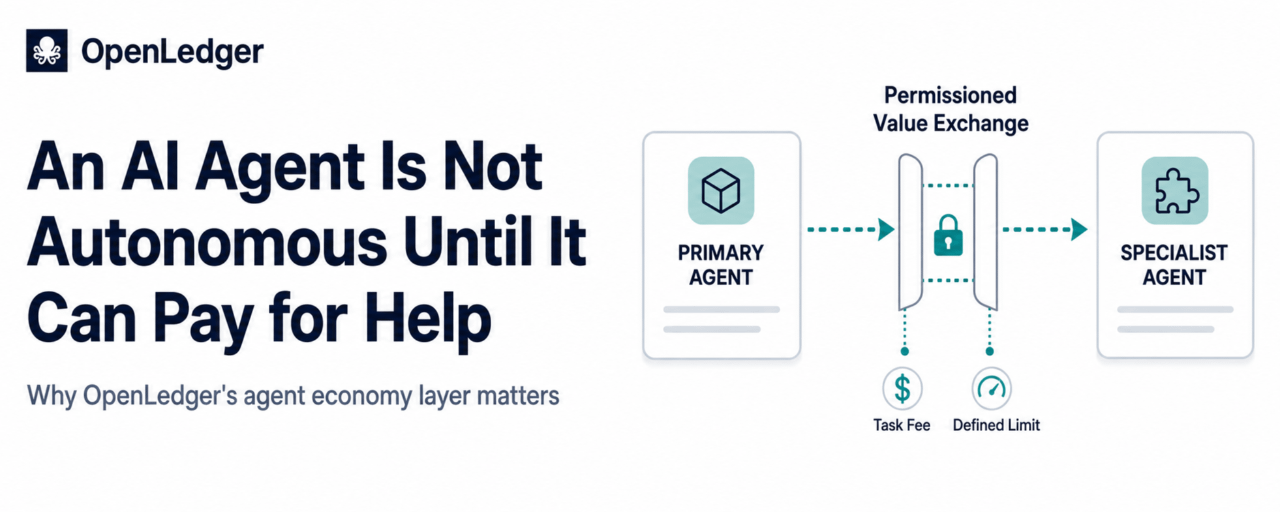

An agent can look like it's capable until it requires another service. It can come up with a workflow and give a useful answer. Then it needs a specialist model, a paid data call or another agent’s work. A human has to approve the cost, balance the charge and decide who gets paid. At this stage the agent is not actually an economic agent. It is software waiting on a human finance department.
I keep seeing the agent story is all about action. Can it investigate, create, and execute? Those things matter, but the harder layer starts when one intelligent service has to buy another within the same activity. If the agent can’t afford its dependencies, the builder is still left with prepaid accounts, secret billing logic and manual revenue splits.
That missing layer is clearly named in OpenLedger’s 2026 plan. Its Agent Economies focus is built around agents that may charge per task, pay other agents for services, and transfer revenue automatically. The agent infrastructure strategy also aims to enable AI systems to authenticate themselves, hold assets and work within established permissions. I don’t count that as finished market proof.” I'm thinking of it as a major problem selection.
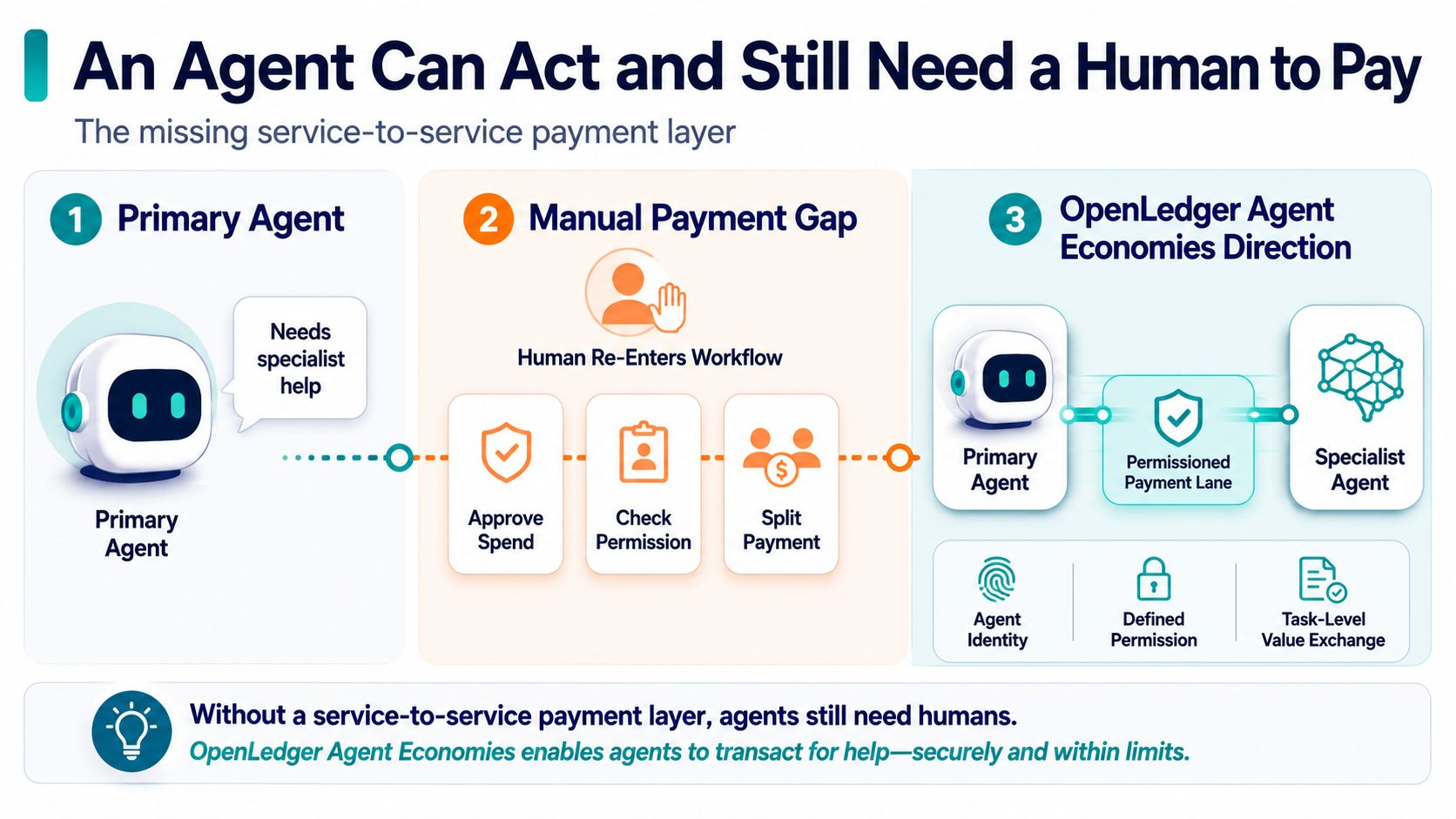
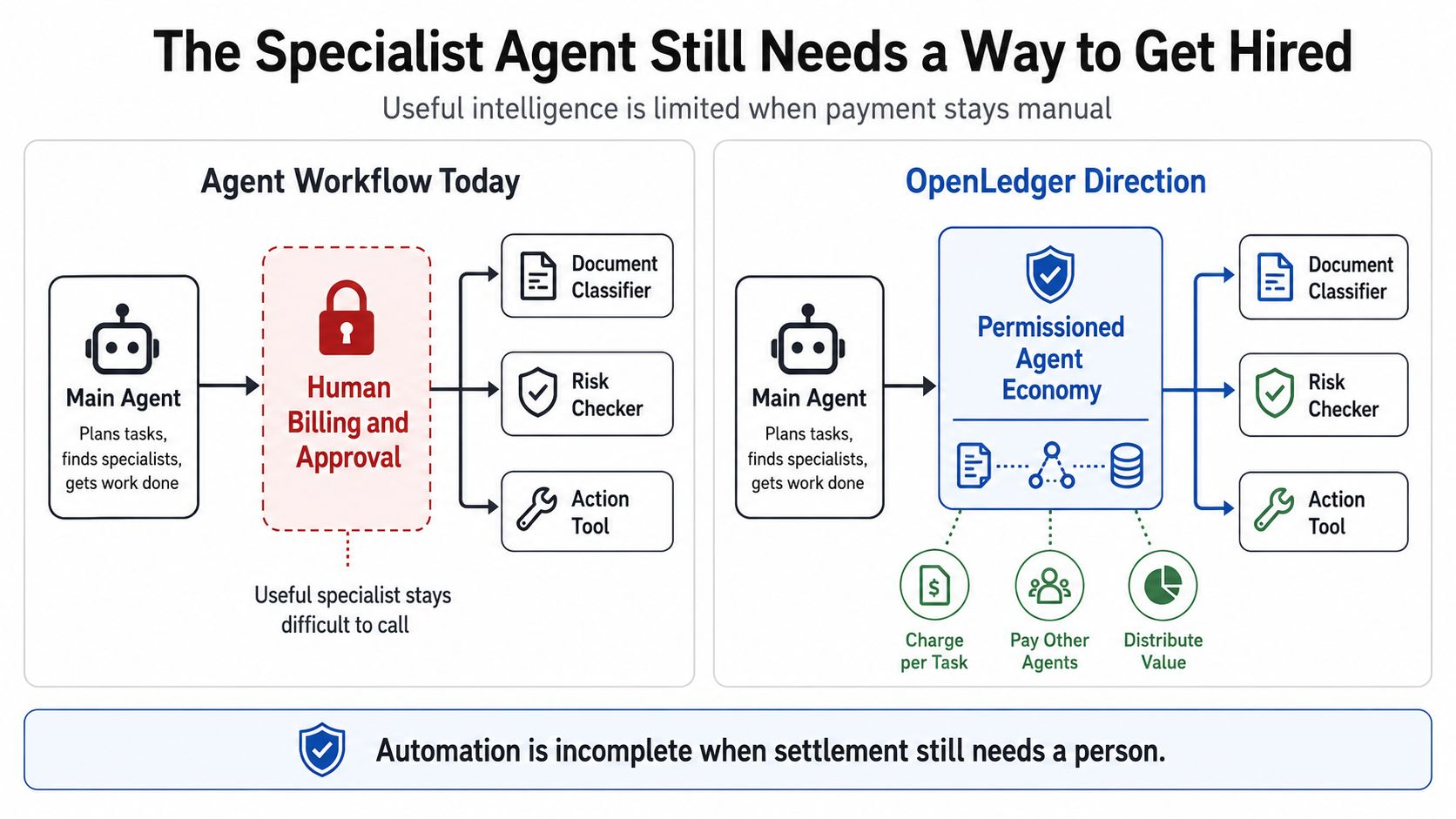
Suppose a research agent for a corporation makes one judgment. It may require a specialty model to classify a document, a specialist agent to evaluate risk, a last instrument to perform an approved action. The question is not whether an agent can write fluent writing around that workflow. It is whether the workflow can afford the specialist work it needs, stay within the spending permission, route value, all without the builder having to write a new payment workaround every time another component is added.
That load comes after the demo works. A builder can get a few smart tools together and demonstrate one strong result. But keeping the system economically usable is another matter. Composition is expensive until it is scalable if each new agent relationship requires a separate billing rail and human check on settlement. The tiniest specialist is in the weakest position. It could help a job, yet still be too cumbersome to get paid in the flow it requires.
This is where OpenLedger may turn agents into more than callable features. A network that has identifiable agents, restricted permissions, and task-level value exchange would give builders incentive to construct services that are supposed to be hired by other services. Another agent wanted the same piece of work, and a specialized skill might be inserted into a bigger stream of labor and make money.
There is a tough test in this thesis. Having autonomous payment without tight permits is no development. It is a quicker path to wasteful spending or to services that charge but don’t provide productive job. Just because the flow is on-chain, builders won’t provide agents economic freedom. They require clear boundaries, a solid identity, and a payment history that makes failure bearable. The direction was provided by OpenLedger. It still needs to make the permissioned version feasible enough for teams to prefer it over having humans in every approval loop.
This creates a sharper market question for the token than simply whether agents are popular. The true signal would be agents developed on OpenLedger purchasing, selling and settling beneficial services regularly in real processes. A token connection is gained ONLY when the network takes part in activity that couldn't be handled properly before.
The agent economy will not be decided by whatever bot talks best. It will be when another piece of software can employ a little specialist and execute one valuable job and get paid under specified boundaries and disappear from the workflow without leaving a human to clean up the bill. That is the layer I am watching OpenLedger presently attempt to construct.
@OpenLedger #OpenLedger $OPEN
