Most AI conversations still feel trapped in the same phase.
Smarter models.
Faster inference.
Bigger context windows.
Cheaper generation.
Useful improvements obviously.
But I think the market is slowly missing where the real pressure starts appearing.
Not at the model layer.
At the behavior layer.
Because once intelligence becomes cheap to generate, the internet doesn’t become smarter automatically.
It becomes noisier first.
That’s the part people underestimate.
We already live in an environment where content production massively exceeds human attention capacity.
AI accelerates this imbalance even harder.
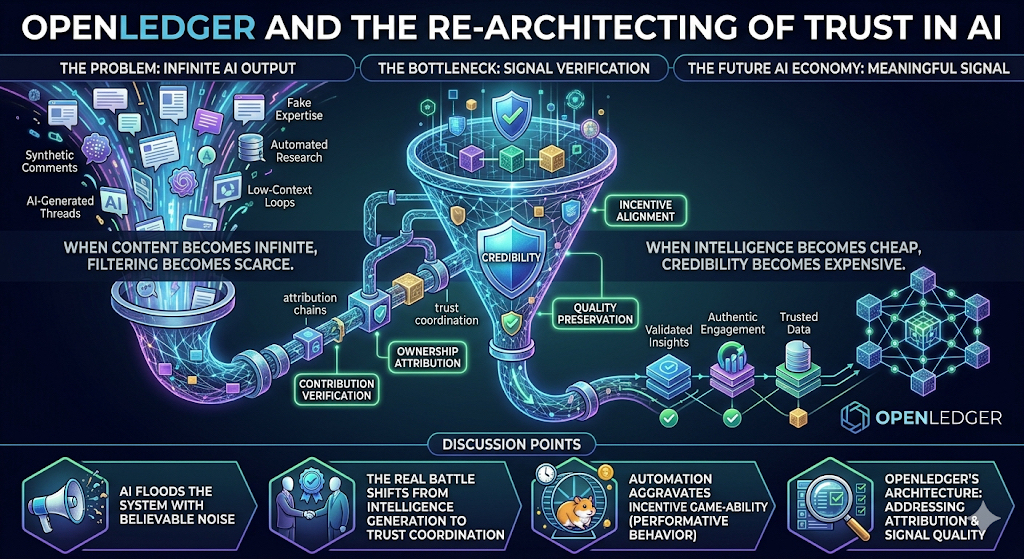
Soon every platform gets flooded with:
AI-generated threads
AI-generated comments
AI-generated research
AI-generated engagement
AI-generated “expertise”
And the scary part is most of it will look believable enough.
That changes the internet structurally.
The bottleneck stops being information access.
The bottleneck becomes signal verification.
That’s why OpenLedger caught my attention more from a systems perspective than a hype perspective.
Because eventually AI economies don’t compete only on intelligence generation.
They compete on trust coordination.
Who contributed useful information?
Who verified it?
Who owns attribution?
Who preserves quality once incentives distort participation?
Those questions become extremely important once synthetic contribution scales.
Crypto already gave us previews of this dynamic years ago.
Every incentive system eventually changes user behavior.
Always.
Protocols usually begin with organic participation.
Then rewards appear.
Then optimization behavior slowly takes over.
The ecosystem still looks active on the surface.
Metrics still grow.
Dashboards still look healthy.
But underneath, behavior becomes increasingly performative.
People stop contributing naturally.
They start contributing strategically.
That distinction matters more than most founders realize.
Because systems eventually reflect the incentives they create.
Not the intentions behind them.
I noticed this heavily during the points farming era.
At first communities felt alive.
Then timelines slowly became flooded with low-context engagement loops:
recycled replies
forced discussions
manufactured participation
copy-paste “insights”
Technically the ecosystem was growing.
Behaviorally it was deteriorating.
And honestly, AI ecosystems could face an even more aggressive version of this problem.
Because now optimization itself becomes automated.
That changes the scale completely.
You’re no longer coordinating humans manually participating in systems.
You’re coordinating humans using AI against systems attempting to distinguish meaningful contribution from synthetic output.
That becomes a very difficult infrastructure problem.
And I think most AI narratives still underprice this issue because speculative markets naturally focus on visible products first.
Models are visible.
Trust infrastructure isn’t.
But historically, invisible infrastructure layers become the most valuable once ecosystems mature.
Especially when coordination complexity increases.
That’s partly why OpenLedger feels directionally interesting.
The focus around attribution and contribution systems seems closer to the real bottleneck forming underneath the AI economy.
Not just:
“How do we generate intelligence?”
But:
“How do we maintain signal quality after intelligence generation becomes infinite?”
Completely different challenge.
And probably the more important one long term.
Because abundance changes value structures.
When content becomes infinite, filtering becomes scarce.
When intelligence becomes cheap, credibility becomes expensive.
That’s the transition I think many people still haven’t fully processed yet.
The future AI economy may not be dominated by whoever produces the most outputs.
It may be dominated by whoever builds the strongest trust coordination systems around those outputs.
Still early obviously.
And skepticism matters because crypto is full of infrastructure narratives that sound profound before real adoption arrives.
A lot of projects won’t survive long enough to prove their positioning.
That’s reality.
But behaviorally, I think the direction around contribution verification and attribution becomes much more important over time.
Because eventually every digital ecosystem faces the same problem:
how do you preserve meaningful signal once incentives and automation begin overwhelming the system?
That’s the deeper layer I keep watching with OpenLedger.
Not hype velocity.
Not announcement cycles.
The coordination architecture underneath.