
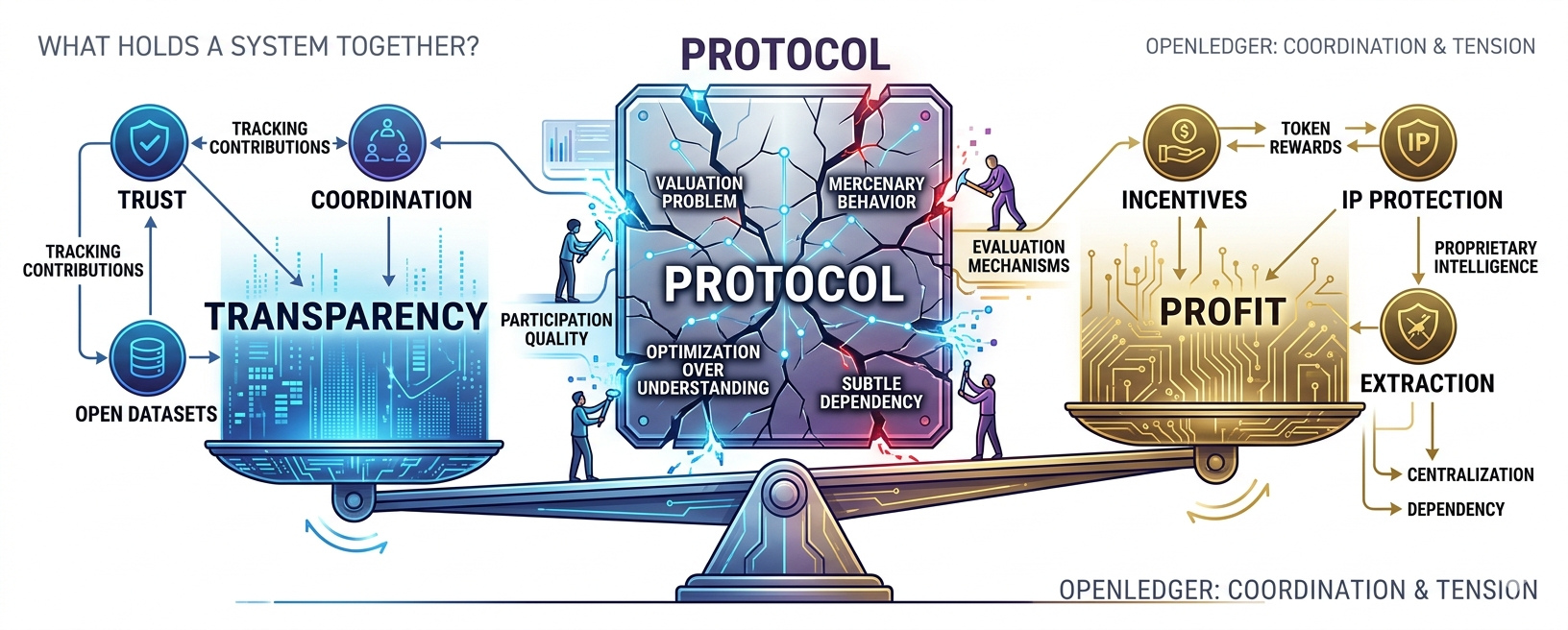

What actually holds a system together when transparency and profit start pulling in opposite directions?
I keep coming back to that question while thinking through OpenLedger. And every time I try to pin it down, it shifts slightly, like the answer is distributed across different layers of the protocol instead of sitting in one place.
On paper, OpenLedger is trying to coordinate something very specific: AI models, agents, and datasets inside a shared economic framework where contributions can be tracked and rewarded. That already raises a quiet tension. Because transparency is supposed to improve trust, but proprietary intelligence survives precisely because it isn’t fully exposed.
So I keep asking myself again… how does the protocol balance those two things without collapsing one into the other?
If everything is too transparent, valuable intelligence gets copied, extracted, diluted.
If everything is too closed, then coordination becomes meaningless.
That’s not a small distinction.
And then I drift into incentives.
Token systems always start with alignment stories. Contributors are rewarded, participation grows, innovation accelerates. I understand the appeal of that design. It’s clean in theory. But I’ve seen enough systems now to notice how slowly priorities begin to shift once rewards become predictable. Research stops being curiosity-driven and starts becoming output-optimized.
Why might token incentives gradually distort research priorities? I think it’s because optimization always finds the shortest path to reward, not the deepest path to understanding.
That’s where it starts to feel different.
Then there’s the question of extraction. At what point does a model stop being productive intelligence and start becoming an extraction layer on top of the ecosystem itself? If a few agents consistently outperform others, do they strengthen the system… or quietly centralize value until everything else becomes dependency?
And honestly, I get why that happens. Efficiency wins in almost every economic system. But efficiency doesn’t always mean resilience.
The evaluation problem feels even harder. How does OpenLedger ensure model performance isn’t just socially coordinated? If agents can learn how to “look good” in evaluation environments, then the signal itself becomes part of the game. Not truth, but alignment with measurement.
That changes what this system actually is.
Because then trust in outputs isn’t just about model quality anymore. It becomes trust in the entire incentive architecture behind those outputs. And I’m not sure users naturally think at that level. They shouldn’t have to. But in financially incentivized AI systems, maybe they eventually do.
Another loop I keep returning to is participation quality. How does a system discourage short-term mercenary behavior without closing itself off? Open participation sounds inclusive until you realize it also invites transient actors who optimize extraction over contribution. The protocol has to filter behavior without accidentally filtering innovation.
That trade-off doesn’t feel clean. It feels constantly negotiated.
And I can’t ignore the possibility that the most profitable agents inside such a system might slowly reshape it. Not through governance takeover in an obvious sense, but through subtle dependency. When infrastructure, evaluation, and liquidity concentrate around a few performant actors, openness becomes structurally uneven even if it looks decentralized on the surface.
That’s where I pause.
Because I keep circling back to the same unresolved point: if intelligence is being priced, evaluated, and rewarded continuously, then what exactly is the system optimizing for over time… and who gets to decide when “good enough” becomes the dominant definition?
I don’t think that answer is stable. And maybe it’s not supposed to be.
It just keeps shifting as incentives accumulate weight.