
The more time I spend watching Pixels, the less it feels like just another Web3 farming game. It starts to feel like a place. Not in the visual sense, but in the way routines form. You log in, you check your land, you complete a few tasks, maybe coordinate with someone, maybe optimize something small. Nothing dramatic happens, but you come back anyway.
That is what makes it interesting.
Most Web3 games talk about interoperability like it is just about moving assets around. But moving something does not automatically give it meaning. You can take a token from one game and drop it into another, and it still feels empty. Players can tell when something is just visiting.
What Pixels seems to be building is different. It is slowly creating habits. And habits are what give value weight.
If you have spent enough time in Pixels, you start to understand how effort turns into progress. You get a feel for timing, for where to focus, for how to cooperate or compete. So when PIXEL shows up somewhere else, it is not just a number. It carries that experience with it. You already “get it” on some level.
That is why these early cross-project experiments matter more than they look. It is not about a campaign or a temporary event. It is about whether your time in one game makes another game feel more familiar instead of more confusing. That is a subtle shift, but it is a big one.
Pixels is also quietly nudging players toward thinking in systems, not just actions. Task boards are not just chores. They are decisions. Land is not just ownership. It is production. Staking is not just passive yield. It is choosing where your value sits. And social play is not just chatting. It is coordination.
None of this is forced on you. That is what makes it work. You slowly grow into it.
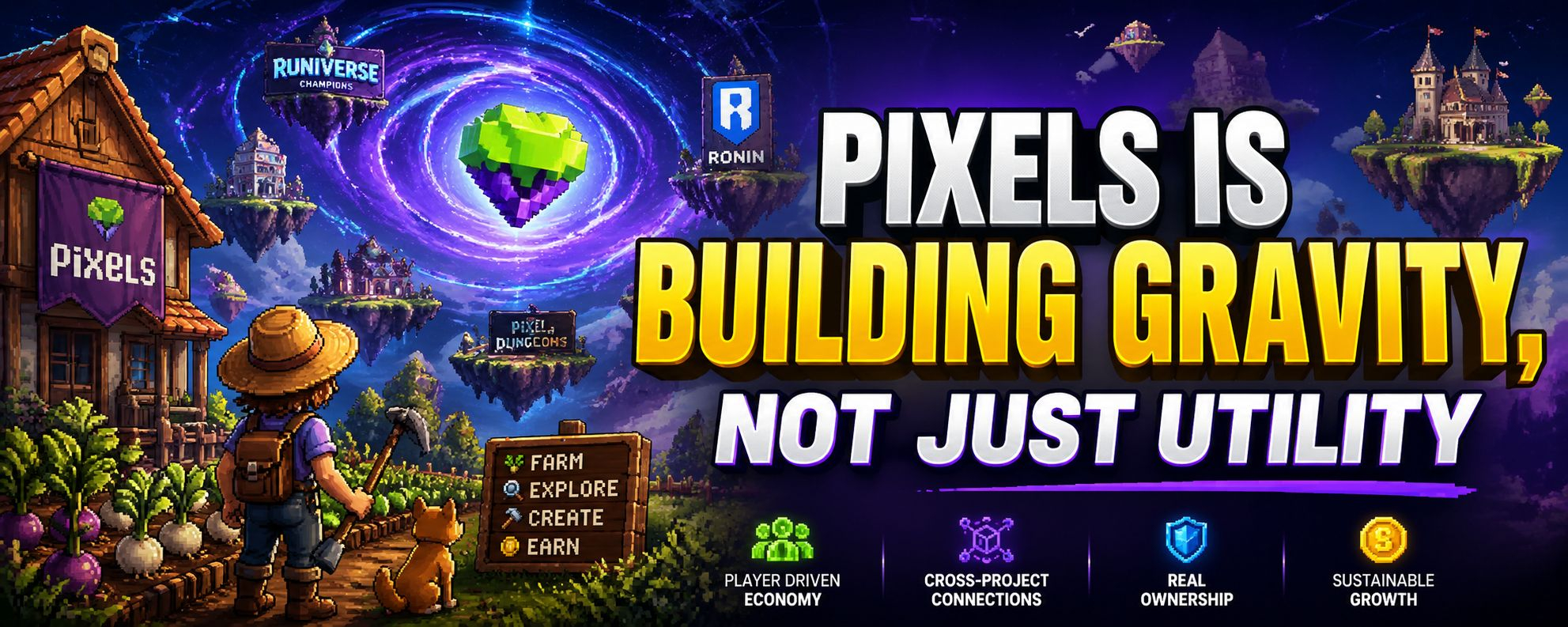
And that is where the idea of “economic gravity” starts to make sense. If enough players build these habits inside Pixels, other games on Ronin are not just getting new users. They are getting players who already understand how to operate inside an economy. That is a very different kind of onboarding.
But it is also fragile.
If Pixels leans too hard into being everywhere, it risks losing what makes it feel grounded in the first place. Players do not build trust in something that feels like a router for rewards. They build trust in something that feels consistent, even a little boring, in a good way.
I think the strongest version of Pixels is not one where everything connects to it. It is one where connecting to it actually means something. Where PIXEL is not just usable in another game, but understandable there. Where your time in Pixels quietly shapes how you approach other worlds.
That is not easy to build. It cannot be rushed with announcements or features. It has to come from behavior repeating over time.
Most Web3 games are still trying to prove that assets can move across projects. Pixels might be testing something deeper, whether meaning can move with them.
If it works, it will not feel like a big moment. It will feel like something small that just makes sense. And then suddenly, players will start carrying their habits from one world to another without even thinking about it.