

The internet feels increasingly fragmented, and crypto amplifies that fragmentation.
A significant portion of the time is spent trying to distinguish what is real, what is AI-generated, and why executing a simple action requires navigating multiple applications. Signing in one place, verifying in another, claiming tokens elsewhere, switching wallets, switching chains, refreshing repeatedly, hoping the transaction completes as expected.
This level of friction is inefficient.
That is what initially made Sign stand out. Not because of narrative momentum or speculative positioning, but because its approach appears to focus on reducing complexity rather than adding another isolated layer.
The SuperApp concept is a useful starting point.
The term itself has been overused. In many cases it simply refers to bundling excessive features into a single interface. However, the underlying idea here is more structural. A unified environment where identity verification, signing, token claiming, and payments can be executed within a single session without cross-platform dependencies.
One application. One login. Minimal context switching.
That is not just convenience, it is a reduction in operational overhead.
TokenTable is another component that deserves closer attention.
Token distribution in crypto has historically been inconsistent. Airdrops, vesting contracts, spreadsheets, and manual interventions coexist without a standardized framework. This introduces both inefficiency and risk.
TokenTable introduces programmable structure into this process. Distribution can be immediate, time-based, or conditional. Parameters such as delays, unlock schedules, and emergency controls can be embedded directly into the logic.
This is closer to how capital distribution is handled in traditional systems. It shifts token management from ad hoc execution to defined infrastructure.
The funding aspect reinforces this direction. A $25.5 million raise in October 2025 suggests a longer-term build strategy rather than a short-cycle token-driven approach.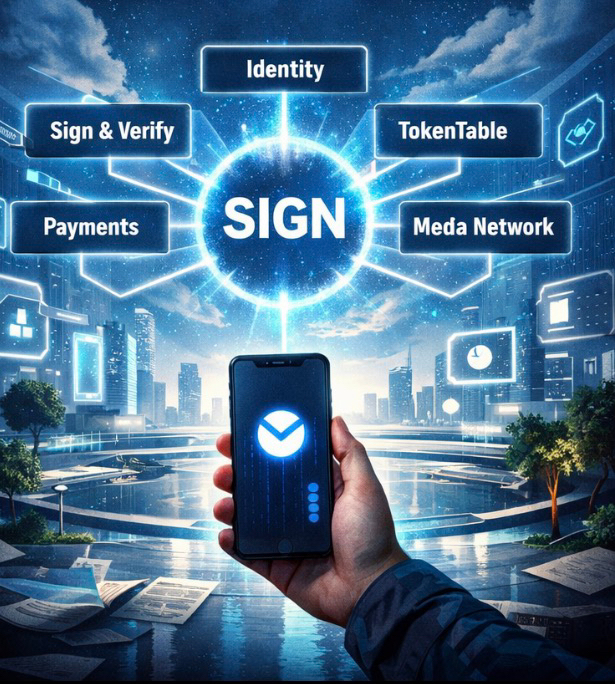
The Media Network initially appears less intuitive within this stack.
However, when contextualized within the current trajectory of AI-generated content, its role becomes clearer. As synthetic media becomes indistinguishable from authentic content, the ability to attach verifiable proof of origin and ownership becomes critical.
If content can carry an embedded, verifiable signature that confirms authenticity and source, it introduces a new trust layer for digital media. This is not an auxiliary feature, it is increasingly a necessary one.
On the technical side, delegated attestation is a key mechanism.
In simplified terms, Sign Protocol handles attestation processes on behalf of Lit nodes. Instead of each node managing the full attestation workload independently, this responsibility is delegated. Sign executes and signs accordingly.
From a systems perspective, this reduces redundancy and potential points of failure. Fewer independent processes typically lead to more predictable behavior under load.
However, this also introduces a shift in trust dynamics.
If attestation is delegated, then the integrity of the system depends on how that delegation is structured and secured. Questions around verification pathways, failure scenarios, and accountability become central.
Who is ultimately responsible for the signature
How trust is propagated across the system
Where the system can fail under stress
These are not theoretical concerns. They define the robustness of the infrastructure.
Any system can appear stable under normal conditions. The meaningful evaluation occurs under stress, during volatility, or when components fail. Observing behavior in those conditions provides a more accurate assessment than any documentation or presentation.
From an investment standpoint, this is where focus should remain. Not on surface-level narratives, but on system behavior, auditability, and resilience.
Despite these considerations, the direction Sign is taking is notable.
Instead of creating another isolated tool, it attempts to unify identity, signing, token distribution, payments, and media verification into a cohesive system. This is a systems-level approach rather than a feature-level expansion.
The ambition is significant.
Execution complexity will be equally significant. Delivering a seamless user experience, ensuring security at scale, integrating with institutional frameworks, and maintaining performance under load are all non-trivial challenges.
If successful, the outcome would not be a product users actively think about. It would be infrastructure that operates in the background, abstracting complexity away from the user.
That is ultimately the benchmark.
Technology that does not require constant attention
Systems that function as expected without friction
Infrastructure that becomes invisible through reliability
If Sign reaches that point, it moves beyond narrative and becomes utility.
#SignDigitalSovereignInfra @SignOfficial $SIGN
