
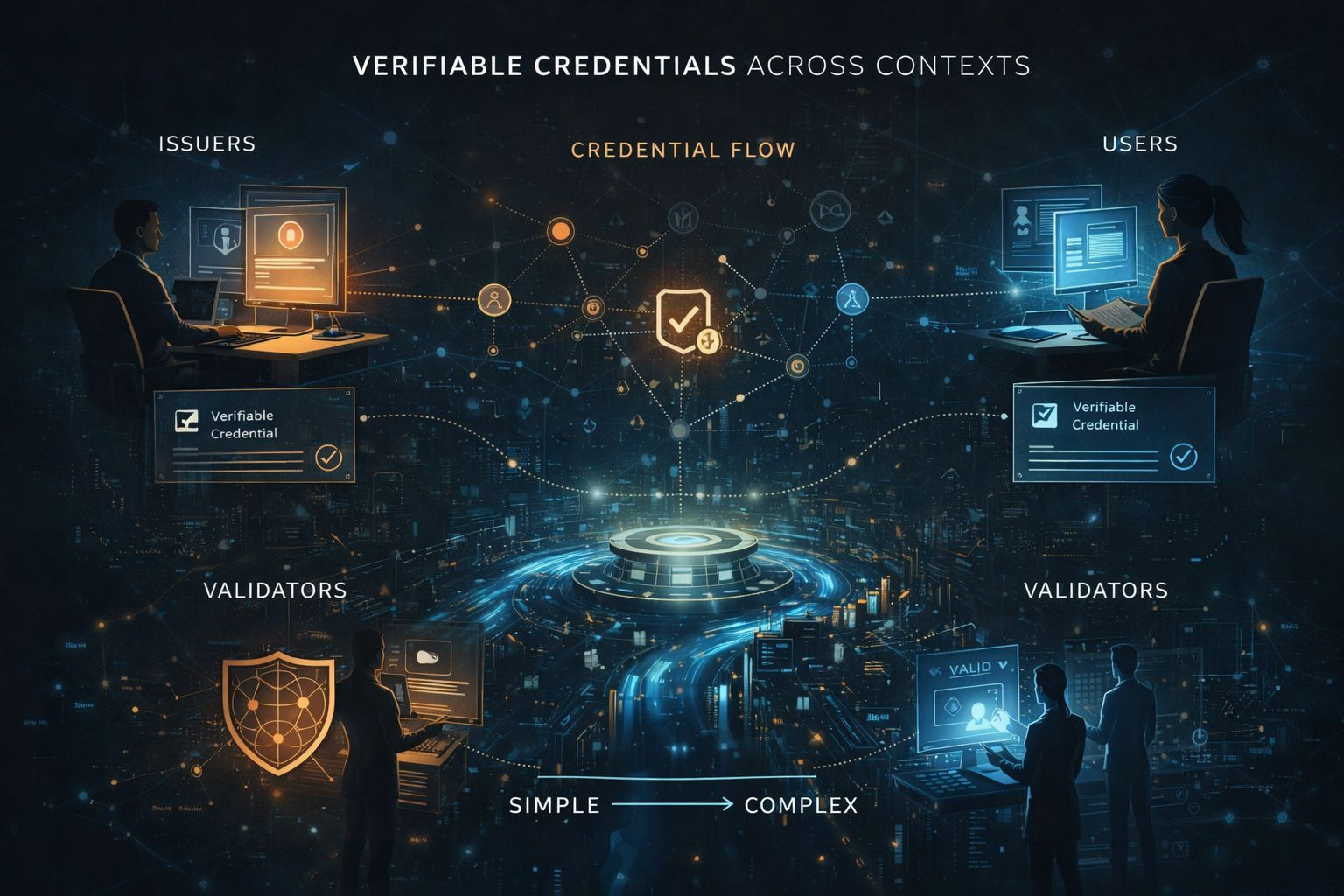
Sometimes I find myself staring at Sign and thinking—what does it really mean to have a system built around verifiable credentials that can flow across different contexts? On the surface, it’s neat: issuers create these credentials, validators confirm them, and users carry them forward. But there’s a subtle tension there I can’t ignore. On one hand, the architecture promises simplicity, a smooth chain of trust without friction. On the other, I wonder about the invisible boundaries—where control stops and autonomy begins. Who really benefits when a credential travels across systems, and how much do the intermediaries shape that journey?
And honestly, I get why the system is designed this way. It minimizes repetition and makes verification almost seamless. That part makes sense to me. But then I pause—what happens when something goes wrong? When a credential is misused or misinterpreted? There’s no dramatic crash, nothing that looks like failure in the logs, yet the outcome could still feel off, subtly skewing trust. That’s the kind of invisible risk I keep circling back to, imagining real-world stress scenarios where adoption is patchy, where users are confused, where institutions push back because the system threatens old hierarchies.
Another thing I notice is the balance between innovation and compromise. Sign doesn’t try to be everything at once, which I respect, but it does introduce trade-offs. Transparency for the user versus privacy at the institutional level. Flexibility versus rigidity in verification standards. Even the seemingly small decisions—like how credentials expire, or how proofs are timestamped—ripple outward, affecting how people and organizations actually interact with the system.
And there’s a subtle human dimension here. I think about adoption—not the technical specs, but people sitting at their desks, deciding whether to trust a credential, whether to integrate it into a workflow that’s already messy. Sign is designed to make that easy, but ease itself can hide friction. Users might accept credentials without fully understanding implications. Institutions might hesitate because adoption requires alignment, training, even cultural change. And that’s where the invisible stress accumulates.
Still, I can’t help but be drawn to what makes Sign different. The focus on provable, portable credentials, the quiet orchestration of trust across multiple actors, the elegance in how systems can talk to each other without centralized gatekeeping—it’s clever. But clever doesn’t remove ambiguity. I keep circling around that tension: the system works beautifully in theory, but in practice, human behavior, misaligned incentives, and unexpected edge cases introduce noise.
I keep asking myself—am I looking too closely, seeing problems where there aren’t any? Or am I noticing precisely the subtle cracks that will define whether Sign really becomes a durable layer of trust? Either way, I can’t stop thinking about it, because the project doesn’t just sit in a ledger; it lives in the messy interplay between design, adoption, and human judgment. That’s where its potential and its fragility coexist. And honestly, that’s the part I keep coming back to—how clean logic meets messy reality, and what it means for everyone who carries a credential forward.