
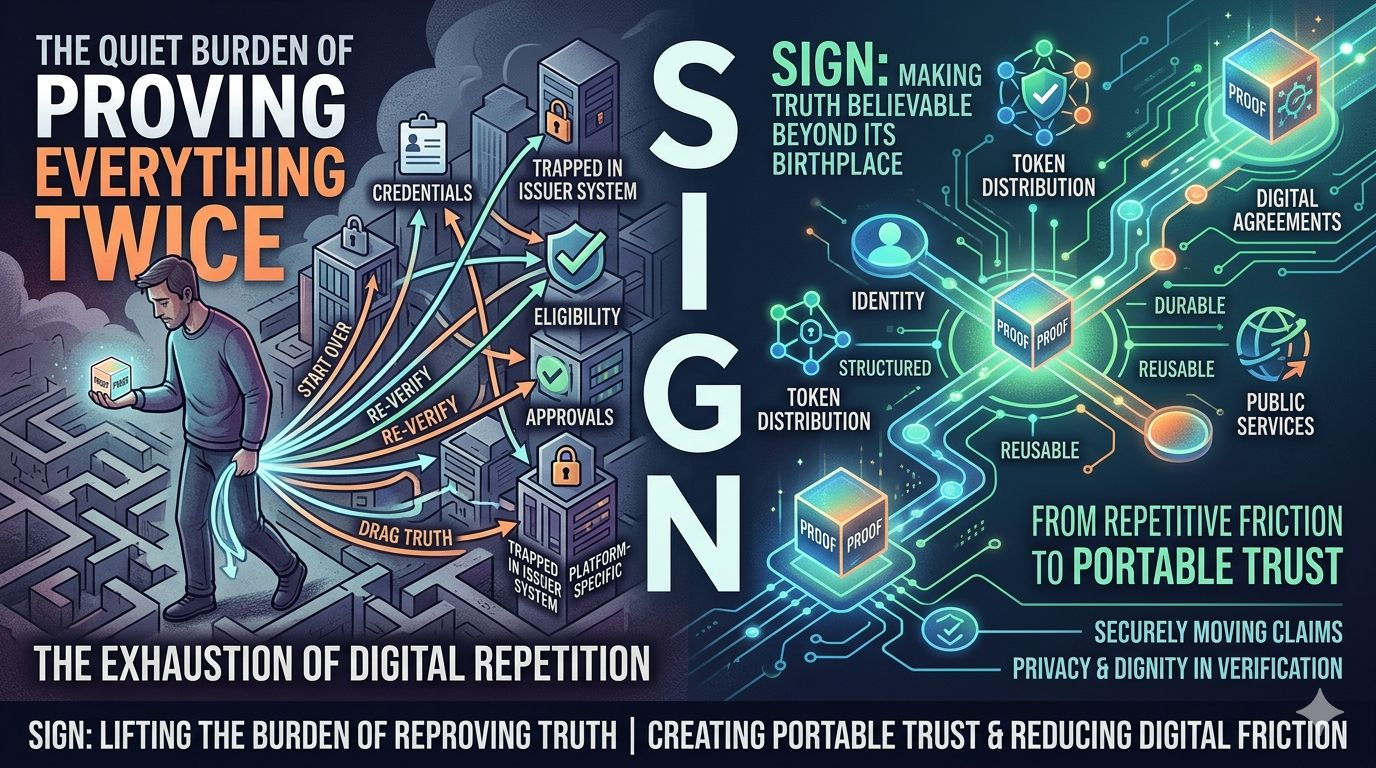
I still think one of the most exhausting parts of the digital world is how often a person has to start over. You verify yourself once, then again somewhere else, then again in a slightly different format for a system that refuses to recognize what was already proven. After a while it stops feeling like technology is helping. It starts feeling like you are dragging the same truth from door to door, hoping each new system will accept it. That is the space where SIGN begins to feel meaningful to me. Not as a flashy crypto idea, and not as another polished promise about the future, but as a response to something quietly frustrating that people deal with all the time. A person can be eligible, approved, authorized, registered, verified, or entitled to receive something, yet the proof of that fact often remains trapped in the place where it was first issued. The truth exists, but it does not travel well.
That is why SIGN feels more interesting when I stop looking at it through the usual crypto language and start looking at it through the experience of ordinary friction. The words credential verification and token distribution sound technical, maybe even a little cold, but underneath them is a very human problem. How do you prove something important once and not spend the rest of your digital life repeating yourself. How do you make a claim durable. How do you let proof move without making the person behind it unnecessarily exposed. That is where the project starts to feel less like infrastructure in the abstract and more like an attempt to fix a pattern that has become so common people barely even question it anymore. So much of digital life is filled with weak receipts, disconnected records, and approvals that only make sense inside the platform that created them.
What I find compelling about $SIGN is that it seems built around the idea that claims should not be vague, temporary, or locked inside isolated systems. They should have shape. They should be structured well enough to be checked, understood, and reused somewhere else. That may sound small at first, but it is actually a deep shift in thinking. A lot of systems do not fail because there is no data. They fail because the data is trapped, inconsistent, impossible to interpret, or trusted only by the people who issued it. In that kind of world, users carry the burden. They fill in the same forms, resubmit the same details, wait through the same verification steps, and hope nothing breaks in the handoff between one environment and the next. SIGN seems to look directly at that problem and say the real issue is not only storing information. It is making information believable beyond its birthplace.
I also like that the idea does not seem trapped in the usual fantasy that everything should simply be thrown onchain forever and called progress. Real life is messier than that. Some information needs permanence, but some needs discretion. Some needs to be provable without being fully exposed. Some needs visibility for auditors, while some needs protection for users. Systems break when they are designed for ideology instead of reality. What makes SIGN feel more grounded is that it appears to understand this tension. The goal is not radical transparency as performance. The goal is portable trust. That is a very different ambition, and honestly a much more useful one.
This matters even more when identity enters the picture. Verification today often feels strangely invasive. A system asks for one fact and ends up collecting ten more. It asks whether you qualify and quietly demands your whole profile in return. That has always felt like lazy design disguised as security. A better system would let someone prove what actually matters and nothing beyond that. That is part of why the direction SIGN is taking feels important. Privacy here is not just a feature you add for aesthetics. It is a question of dignity. It is the difference between a system that asks for enough and one that always wants too much. When verification becomes precise instead of hungry, the whole relationship between people and infrastructure starts to change.
The token distribution side becomes more interesting through that same lens. On the surface, sending tokens sounds simple. But anyone who has watched real allocation happen knows the difficult part is never just the transfer. The real difficulty begins with eligibility, timing, conditions, rules, proof, exceptions, and auditability. Who receives what, why, when, and according to which logic. The moment value is involved, distribution stops being a clean technical function and turns into administration. That is usually where confusion enters. That is where arguments begin. That is where trust gets thin. SIGN seems to understand that moving assets is easy compared to proving that the movement was justified, well structured, and accountable. That is why its role in token distribution feels more substantial than a simple utility label suggests. It is not just helping things move. It is trying to make the movement legible.
The same feeling extends to digital agreements and signatures. A signed document is not always the end of the story. Sometimes the signature matters less than the evidence surrounding it. Who signed, in what context, under what terms, with what structure, and in a form that can still be trusted later. So much digital activity creates records that are technically stored but practically dead. They sit somewhere as artifacts, but they do not travel well and they do not integrate into wider systems of trust. SIGN feels like it is trying to solve that problem too. Not just how something gets recorded, but how that record stays meaningful when another system, another institution, or another moment in time needs to inspect it.
That is why I do not really see SIGN as a narrow crypto product. I see it more as an attempt to modernize the life of a claim. That may sound abstract, but the effect is concrete. Whether the context is identity, capital, public services, distribution, or agreements, the same question keeps appearing underneath everything. How does something true remain trusted after it leaves the environment where it was first declared. Most systems still handle that badly. They record events, but they do not create trust that can travel. They store information, but they do not make it portable. They verify people, but they do it in ways that are repetitive, invasive, and disconnected.
Maybe that is why $SIGN feels different to me. It is not really selling excitement in the usual sense. It is addressing a form of exhaustion. The exhaustion of re-proving. The exhaustion of fragmented systems. The exhaustion of carrying the same facts from place to place because infrastructure refuses to speak a common language of trust. There is something very real about that problem, and it reaches far beyond crypto. People do not usually describe their frustration in technical terms. They just know when a system makes their life heavier than it should be. They know when proof does not stick. They know when a process that should have been simple turns into another cycle of forms, delays, and uncertainty.
That is why SIGN stays with me. It feels like an attempt to fix the receipt, not just decorate the transaction. And maybe that sounds less dramatic than the promises most projects make, but it also feels closer to reality. Real adoption rarely begins with spectacle. It begins when a process that used to be annoying, repetitive, and fragile suddenly becomes smoother, quieter, and more trustworthy. If SIGN can help create that kind of shift, then its value is not just in what it builds for crypto. It is in how it reduces the hidden friction people have been taught to tolerate for far too long.
#SignDigitalSovereignInfra @SignOfficial $SIGN
