
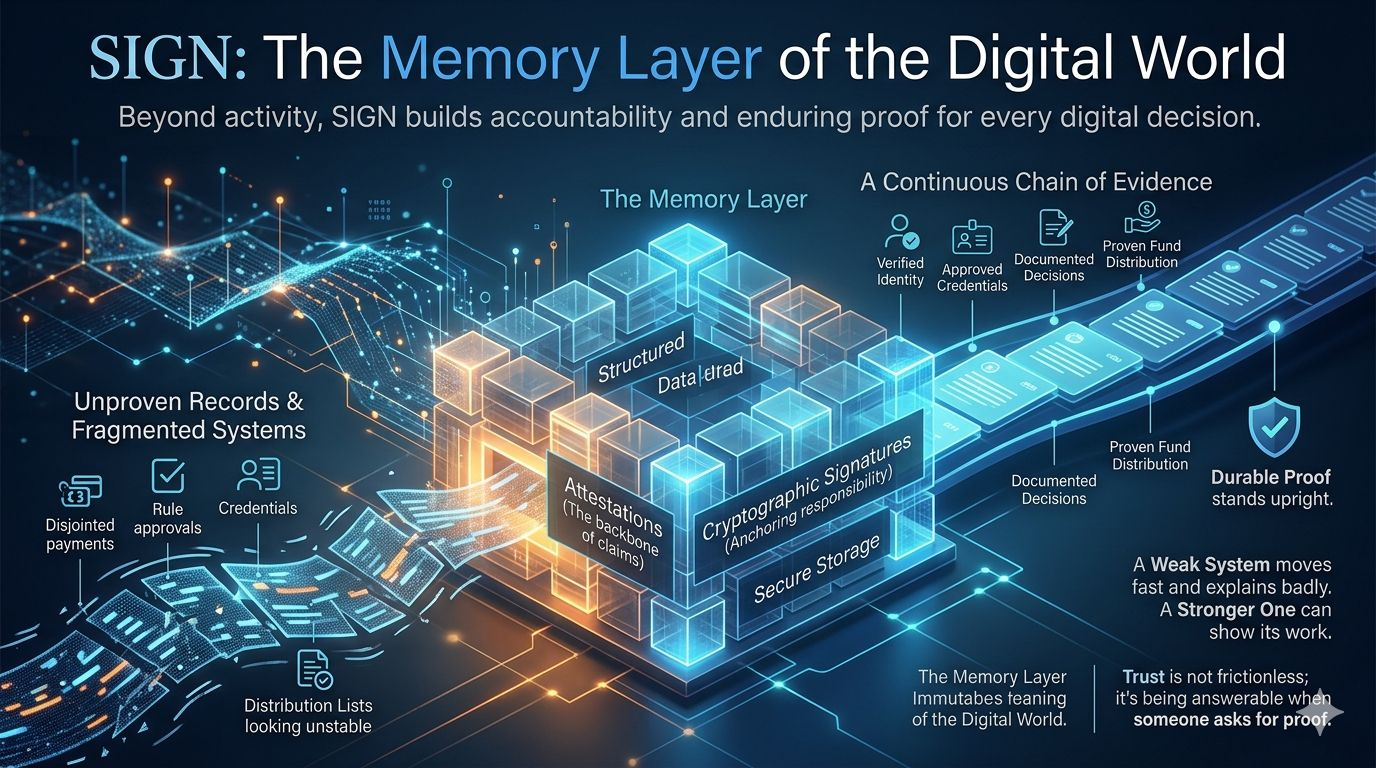
@SignOfficial A lot of digital systems look reliable right up until somebody asks for proof. That is the moment everything starts shaking. A payment was made, but where is the clean record. A person was approved, but under which rule. A benefit was distributed, but who decided the list. A credential was issued, but can anyone still verify it properly six months later when the people, the platform, and the politics around it have all changed. That is the part most people do not talk about because it is not exciting. It does not sound futuristic. It sounds administrative. But that is exactly why SIGN feels more interesting to me than the usual crypto project pitch.
Most projects want to be associated with movement. Faster transfers, smoother coordination, simpler tools, larger ecosystems. SIGN pulls my attention somewhere else. It makes me think about what happens after the movement, when the action is over and somebody asks what really happened. I think that is the real pressure point of digital life now. We are surrounded by claims. Someone claims eligibility. Someone claims ownership. Someone claims compliance. A platform claims fairness. A system claims a transfer followed the rules. We keep building faster ways to act, but not always better ways to remember those actions with enough clarity to survive scrutiny.
That is why SIGN does not feel, at least to me, like a story about a token or a trendy verification tool. It feels more like a story about evidence. Not evidence in a dramatic courtroom sense, but evidence in the ordinary, stubborn sense. The kind that lets a record keep its shape when people begin pulling at it. The kind that lets an institution explain itself without panic. The kind that stops a digital action from turning into a vague memory dressed up as certainty.
What makes that interesting is how ordinary the problem really is. People imagine digital failure as something explosive, a hack, a crash, a major outage. But many systems fail in quieter ways. They fail because records are fragmented. One part lives in a database. Another lives in a PDF. Another sits in an internal tool that only two people know how to use. Another is trapped in a vendor workflow nobody fully trusts. Everything appears functional until a dispute appears, or an audit begins, or a mistake is discovered, and suddenly the system cannot explain itself in one clean voice. It becomes a room full of partial truths.
That is the feeling SIGN seems to be pushing against. The core idea behind its infrastructure is not just that a fact can be stated, but that it can be structured, signed, stored, and checked later. Later is the key word. The present is easy. Everything always looks clear in the moment it is created. The real question is whether it will still be clear when incentives have changed. When money is involved. When someone challenges the decision. When the people who built the workflow are gone. When trust is no longer assumed and has to be earned line by line.
I think that is why the idea of attestations matters here, even if the word itself sounds technical. Strip the jargon away and the concept is very human. Someone is making a claim. Someone is standing behind that claim. The claim is recorded in a way that can be checked again. That alone changes the tone of a system. It moves from suggestion to accountability. It stops being a stream of activity and starts becoming a place where actions carry memory.
That idea becomes even more compelling when you think about money and distribution. Almost everyone talks about distribution like it is a logistics problem. Send the funds. Release the tokens. Process the grants. But real distribution is rarely difficult because of the sending. It becomes difficult because of the justification. Why this wallet. Why this person. Why this amount. Why this schedule. Why this rule. Why not someone else. Every distribution system eventually runs into these questions, and when it does, the true quality of the infrastructure gets exposed. A weak system moves fast and explains badly. A stronger one can show its work.
That is where SIGN starts to feel less like a crypto product and more like institutional plumbing. Quiet, essential, easy to ignore until it is missing. The ecosystem around it makes more sense when viewed that way. Identity, credentials, allocation, signatures, distribution. These are not separate stories. They are all variations of the same problem. A system needs to know who someone is, what they are allowed to claim, what was approved, what was distributed, and what can still be proven afterward. Most digital platforms solve these as separate tasks. SIGN seems to treat them as one continuous chain of evidence.
I find that more believable than the usual promise of reinventing everything. It is also more grounded. The internet has a habit of pretending that making something frictionless is the same as making it trustworthy. It is not. A process can feel effortless and still be impossible to defend later. A smooth interface can hide a weak record. A quick workflow can leave behind confusion instead of clarity. Trust is not created by how clean something looks during use. Trust shows up when somebody asks for proof and the answer does not wobble.
There is something almost old-fashioned about that. It reminds me that paper systems, for all their slowness, understood the emotional weight of a record. A signature meant something because it anchored responsibility. A stamped document meant something because it fixed a version in time. A file mattered because it gave an institution memory. Digital systems often improved speed while thinning out that feeling of weight. They made actions easier, but sometimes made responsibility softer. What SIGN seems to be doing is bringing some of that weight back without dragging everything backward into paper-era friction.
That is probably why the project feels more serious the longer I sit with it. Not louder. Serious. It is concerned with the part of technology that has to survive contact with reality. Rules. Eligibility. Authority. Auditability. Repeatability. These are not glamorous words, but they decide whether a system can graduate from experiment to infrastructure. Plenty of platforms can operate beautifully in ideal conditions. Far fewer can remain coherent once real institutions, real disputes, and real accountability enter the frame.
And that may be the most organic way to understand what SIGN is trying to become. Not a shiny layer on top of digital life, but a memory system for decisions that matter. A way to stop records from dissolving into explanation battles. A way to make a credential, an approval, a payment, or a distribution carry proof with it instead of requiring trust as a favor. That is a quieter ambition than most people expect from crypto, but maybe that is why it feels more durable.
The projects that stay with me are usually not the ones shouting the loudest about the future. They are the ones solving the problem that everybody quietly trips over but rarely names. SIGN seems to be working on one of those problems. The problem of how a digital system remembers itself with enough discipline to remain believable. The problem of how a claim becomes more than a claim. The problem of how a decision can still stand upright after the moment has passed.
That is why this matters. Not because verification sounds advanced. Not because token distribution sounds efficient. It matters because more and more of life now depends on invisible systems making decisions on our behalf, and invisible systems without durable proof eventually become machines for confusion. If SIGN can make those systems more answerable, more checkable, and more honest about what happened, then it is doing something much more important than adding another tool to the stack. It is giving digital decisions a backbone.
#SignDigitalSovereignInfra $SIGN
