
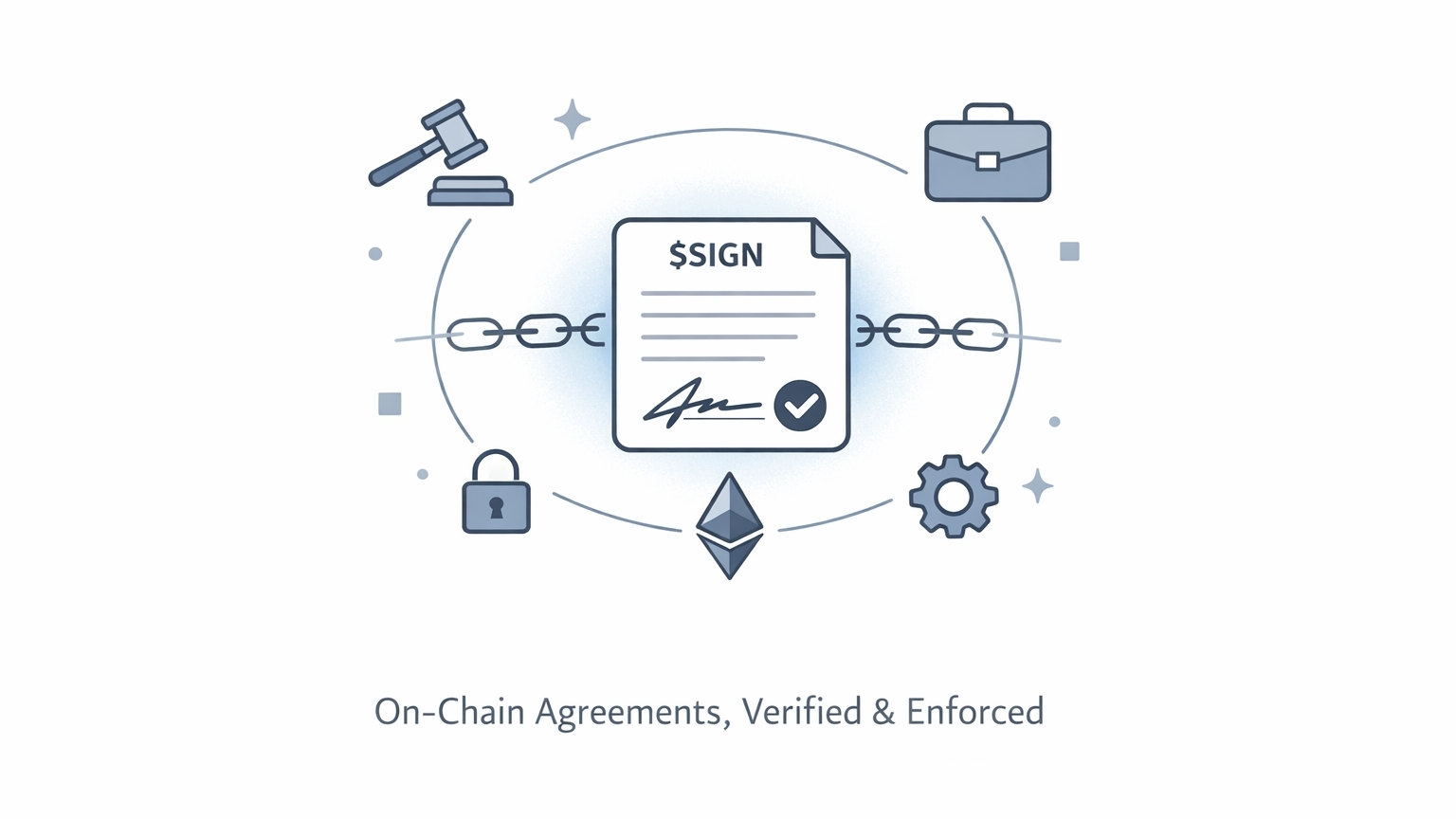
The easiest way to misunderstand $SIGN is to think of it as just another layer trying to bring signatures on-chain. That framing sounds familiar, almost boring. We’ve seen “digital agreements” before. We’ve seen “on-chain verification” before.
But that’s not where the real shift is happening.
The deeper issue is this: blockchains verify transactions well, but they struggle to verify intent, agreement, and coordination between parties. And that gap matters more than most people realize.
Because in the real world, value doesn’t just move — it’s agreed upon.
Every financial contract, every institutional workflow, every multi-party process relies on structured consent. Who approved what. Under which conditions. At what time. Traditional systems handle this through layers of legal frameworks, intermediaries, and off-chain enforcement.
Crypto largely ignores it.
We’ve built systems that can move billions in seconds, but still rely on fragmented, often informal ways of representing agreement. Wallet signatures exist, yes — but they’re low-context approvals, not structured commitments.
That distinction is where SIGN starts to matter.
Instead of treating signatures as a technical checkbox, it reframes them as a core primitive of coordination. Not just “did you sign?”, but what exactly did you agree to, and how can that be enforced, verified, and reused within a system?
This pushes signatures from the edge of UX into the center of infrastructure.
And once you see it that way, a different category emerges.
SIGN isn’t just about confirming actions — it’s about encoding agreements into programmable, verifiable objects. That means agreements aren’t static artifacts anymore. They become active components within on-chain systems.
That has serious implications.
Because once agreements are structured and machine-readable, they can integrate directly with execution logic. Payments can depend on conditions. Access can depend on approvals. Governance can depend on verifiable consent rather than abstract voting signals.
This is where most current systems fall short. They separate decision-making from execution. A vote happens here. A transaction happens there. A contract exists somewhere else.
SIGN compresses that gap.
It creates a layer where agreement, verification, and execution can operate in the same environment, without relying on external reconciliation.
From an infrastructure perspective, that’s not a feature — it’s a missing layer finally being addressed.
And it becomes even more relevant when you move beyond simple use cases.
Think about institutional workflows. Multi-sig approvals are only the surface. Real processes involve conditional approvals, hierarchical permissions, compliance checks, and audit trails. These aren’t easily captured by basic transaction signatures.
They require structured intent.
This is where $SIGN’s positioning becomes more interesting. It’s not trying to compete with wallets or replace existing signature schemes. It’s building a system where signatures carry context, logic, and enforceability.
That moves the conversation from “who signed?” to “what does the signature actually mean within a system?”
And that’s a much harder problem.
Because now you’re not just dealing with cryptography — you’re dealing with semantics, coordination, and system design. You’re defining how humans, institutions, and code align on shared commitments.
Most projects avoid this layer because it’s messy. It sits between technical execution and real-world behavior.
But that’s also where the value is.
The more complex on-chain systems become, the more they depend on clear, verifiable agreement structures. Without that, everything starts to rely on assumptions, off-chain coordination, or trust shortcuts.
SIGN is effectively trying to remove those shortcuts.
It introduces a model where agreements are not just recorded, but operationalized. Where signing something isn’t the end of a process — it’s the beginning of a programmable flow.
That changes how systems are designed.
Instead of building applications that assume trust and patch verification later, developers can build systems where trust conditions are embedded from the start.
And that’s where this starts to feel less like a niche tool and more like foundational infrastructure.
Because if blockchains are going to support real-world coordination — not just asset transfers — they need a way to represent agreement with the same precision they represent value.
Right now, that layer is thin.
SIGN is trying to thicken it.
Whether it succeeds depends on adoption and integration — not just technology. But the direction is grounded in an actual structural gap, not a manufactured narrative.
And in a space full of surface-level innovation, that alone stands out.