
I’ll be honest, the deeper I go on $SIGN, the less interested I am in the lazy “Web3 identity” summary that keeps floating around. It’s not that the label is completely wrong. It’s that it strips away most of the strategic value. And the part that really sharpened my view today is the regional angle, especially the idea of Sign as the digital sovereign infrastructure for Middle East economic growth.
That phrase sounds big, but I don’t think it’s empty if you actually trace what Sign is trying to build.
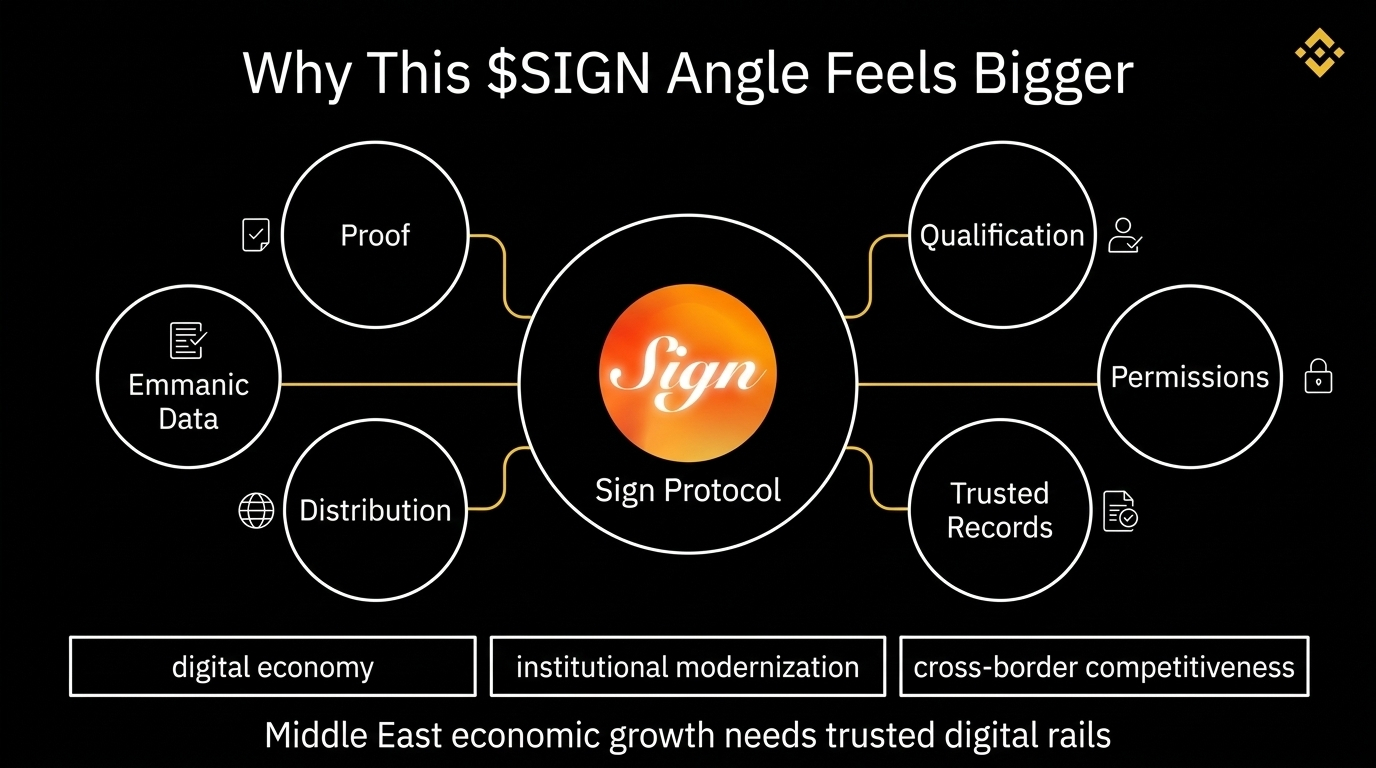
The reason this angle works for me is because sovereign digital growth is not just about having apps, wallets, and tokenized assets. It is about trust architecture. It is about how a system records qualifications, permissions, entitlements, agreements, and proof in a way that can scale. A lot of digital economies can build the front end. Much fewer can build the evidence layer properly. That’s why Sign Protocol feels more serious to me the more I look at it.
According to Binance Research, Sign’s product stack includes Sign Protocol, TokenTable, EthSign, and SignPass, and the protocol’s traction in 2024 was not small. Revenue reached $15 million, schemas reportedly grew from 4,000 to 400,000, and attestations rose from 685,000 to more than 6 million. TokenTable alone has distributed over $4 billion in tokens to 40 million-plus wallets. These numbers matter because they make the project look less like a future promise and more like a working digital rail already proving demand.
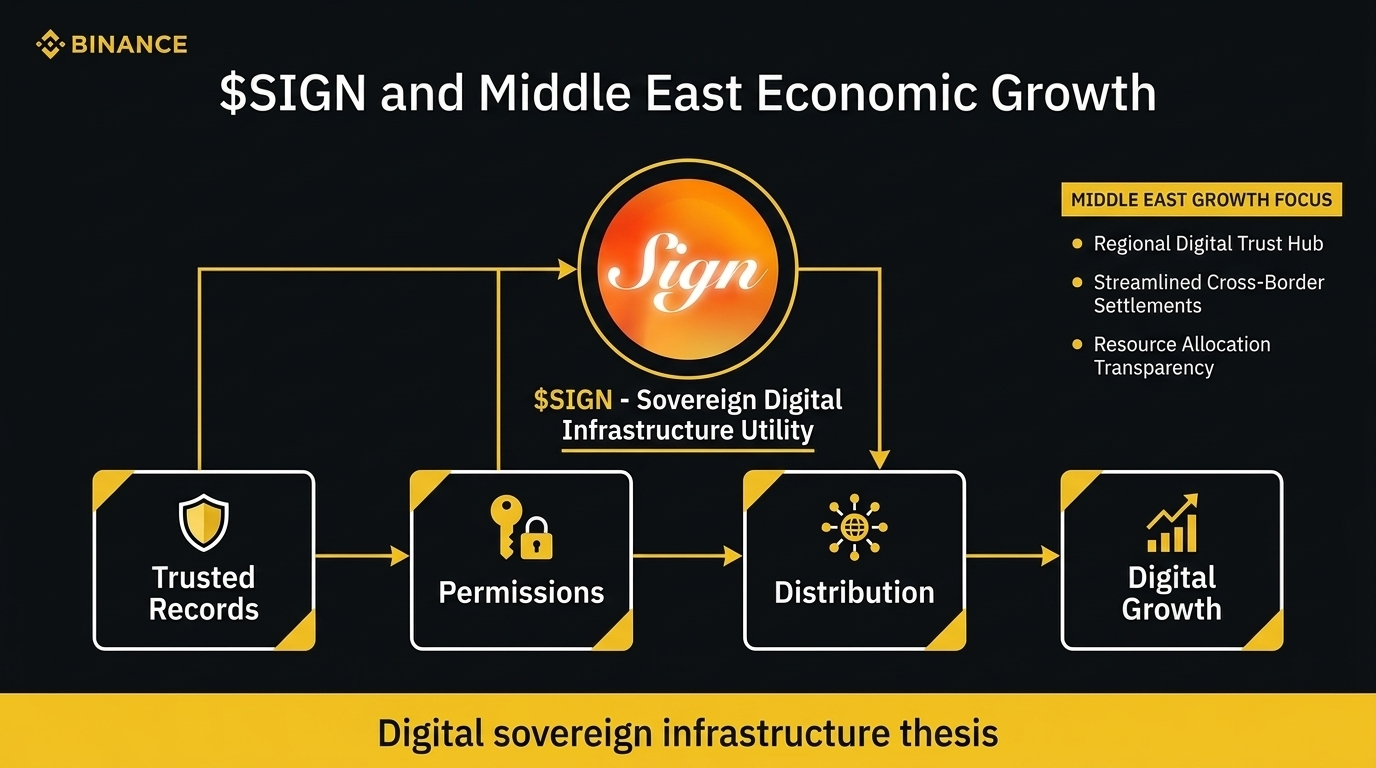
What I keep thinking about is how naturally this maps onto regions that are aggressively building digital economic infrastructure. The Middle East is one of the clearest examples. Governments and institutions across the region are investing in digital identity, financial modernization, tokenization, regulatory clarity, and long-horizon technology planning. In that environment, a protocol that can anchor verifiable claims, structured records, and distribution logic is not just another crypto tool. It starts looking like connective tissue.
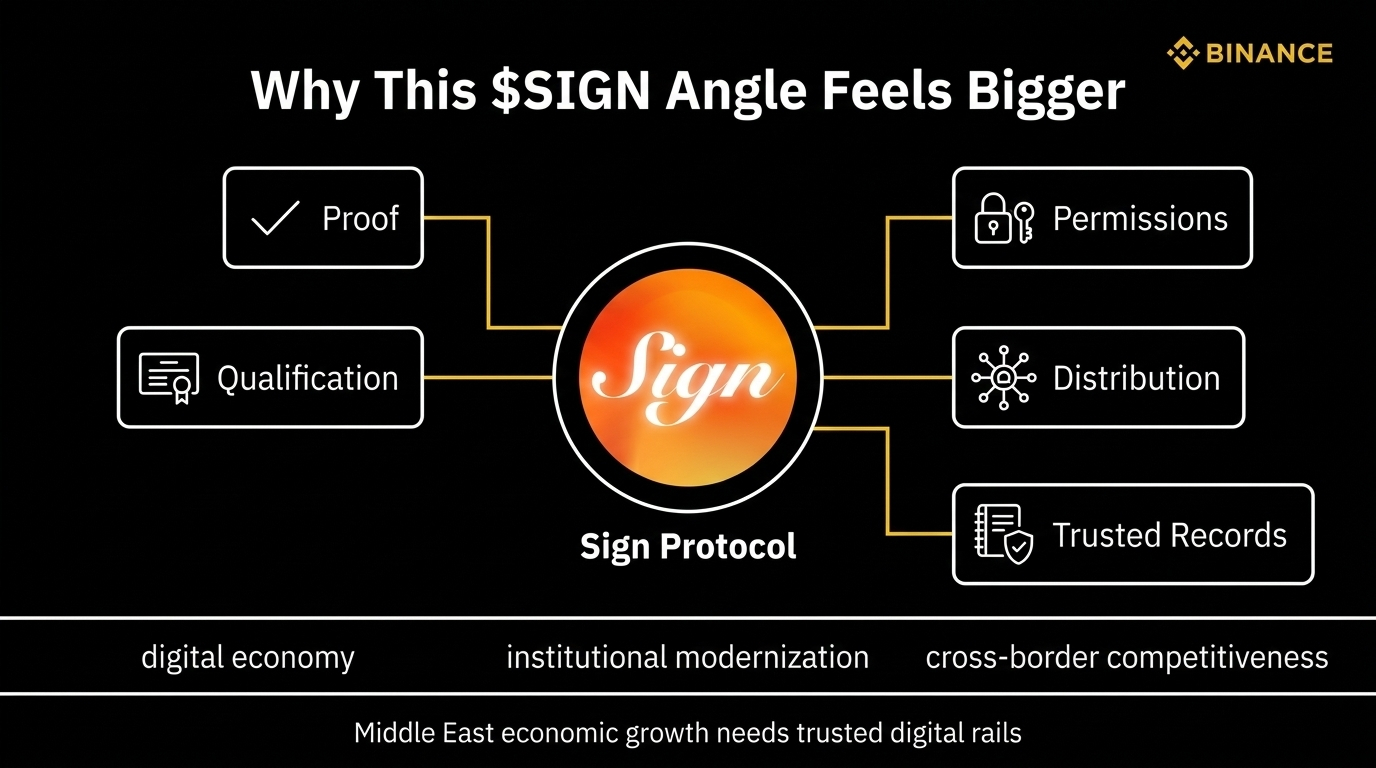
That’s where Sign Protocol gets interesting to me in a very non-generic way.
Binance Research specifically notes live usage and expansion across countries including the UAE, and Sign’s own positioning now extends into sovereign-grade infrastructure language around money, identity, and capital. I’m not saying that means instant dominance. I’m saying it gives the project a frame that is much bigger than “one more alt with an identity narrative.” If the Middle East continues building serious digital rails for growth, then protocols that can support proof, qualification, and trusted coordination could end up sitting much closer to real economic plumbing than most people expect.
And this is where I think the market tends to get lazy.
People are comfortable valuing things they can see. Consumer apps. Trading volume. Pure hype. Fast narratives. But infrastructure that helps systems decide who qualifies, what counts as valid, and how value should be routed is harder to summarize in one sentence. That’s exactly why it can be underappreciated. I’ve seen this pattern too many times. The “boring” layer keeps compounding while everyone crowds into louder stories.
The more I think about it, the stronger the Middle East angle becomes. Economic growth in the region is increasingly tied to digital execution, institutional modernization, and cross-border competitiveness. That means trusted records, verifiable permissions, smoother qualification, and auditable digital workflows are not side issues. They become part of the core stack. If Sign can participate in that stack, then the project is not merely useful. It becomes strategically placed.
That’s a better thesis than generic token cheerleading.
I also like this angle because it gives $SIGN a narrative that is both grounded and differentiated. A lot of campaign content ends up sounding interchangeable because it floats at the same altitude. “Project has strong fundamentals.” “Team is building.” “This could be big.” That language is dead. It could describe almost anything. But saying Sign may represent digital sovereign infrastructure for Middle East economic growth is a sharper claim because it links the protocol to a real regional direction and a real systems need.
It also forces better analysis.
You can’t hide behind hype when you frame it that way. You have to think about infrastructure. You have to think about qualification rails. You have to think about evidence, permissions, public-sector logic, and trusted digital coordination. That’s exactly the kind of mental shift I want from a project before I take it more seriously.
Now, I’m not blind to the risks. Ambitious infrastructure stories can take a long time to unfold. Regional relevance does not automatically create token demand on the timeline traders want. And a strong narrative still has to meet execution, integrations, and durable usage. So no, I’m not turning this into some lazy “send it” post. That would ruin the whole point.
My point is simpler and stronger than that.
The more I research Sign Protocol, the more I think it belongs in a much bigger conversation than most people are having. Not just around Web3 identity. Not just around attestations. But around the infrastructure layer digital economies need when they want growth with trust, speed with records, and scale with proof.
That is why the Middle East framing clicks for me.
And that is why $SIGN eels bigger the more I research it.
@SignOfficial #SignDigitalSovereignInfra $SIGN
