
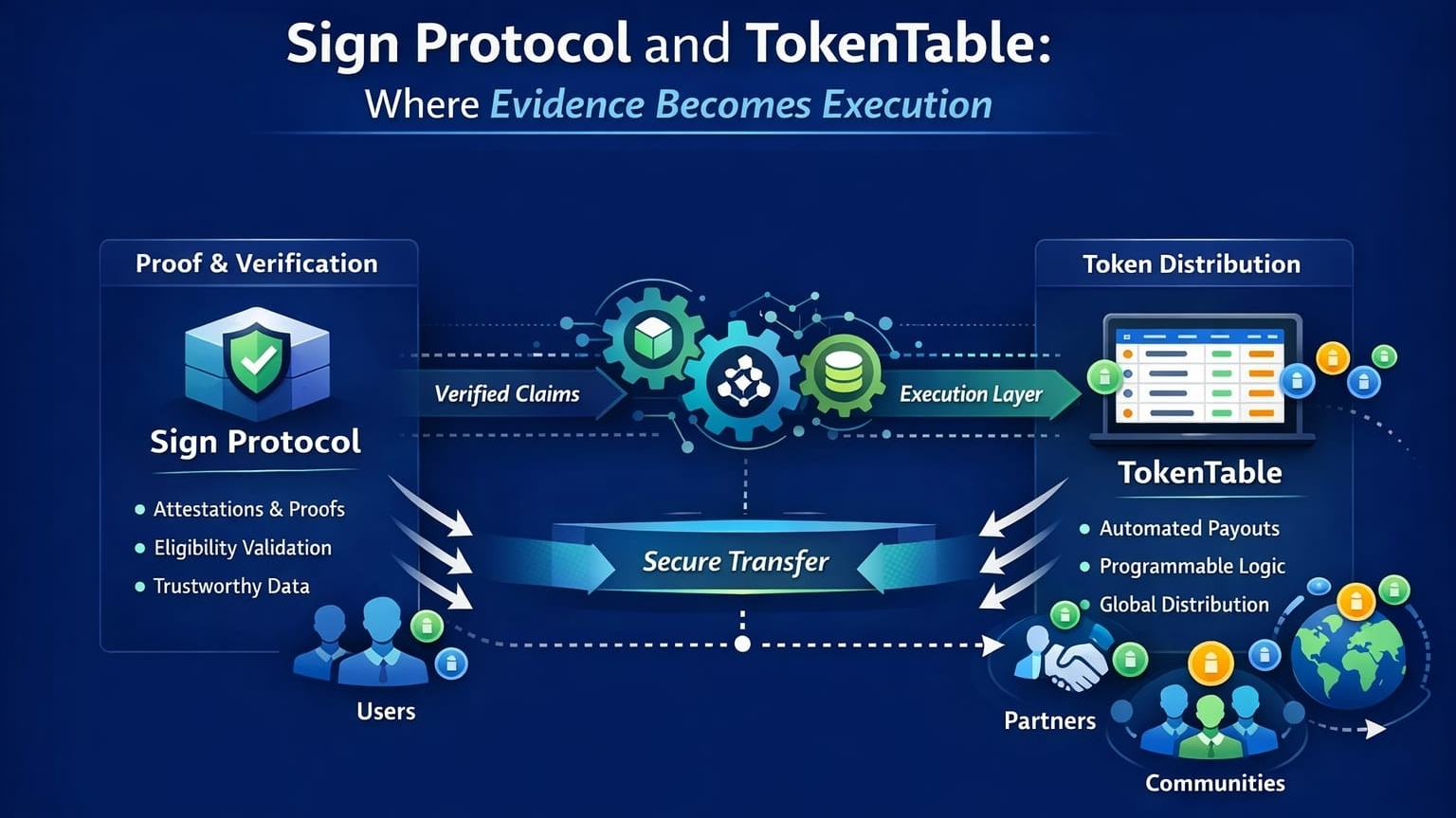

I did not find this interesting because it sounds ambitious. I found it interesting because the structure feels unusually deliberate. The more I looked at Sign Protocol as the evidence layer and TokenTable as the execution layer, the more I felt that this was trying to solve a deeper coordination problem instead of decorating the surface of it.
What keeps pulling me back is how clean the separation feels. I notice that a lot of systems become confusing because proof, trust, and execution get mixed together too early. Everything starts to blur. The logic behind who qualifies or what is valid becomes tangled with the action itself, and once that happens, the system may still function, but it loses clarity. Here, I see an attempt to avoid that. I see one layer trying to hold evidence in a structured way, and another trying to act on that evidence without collapsing the distinction between the two. That may sound simple on paper, but in practice I think it matters a lot.
I keep coming back to Sign Protocol because I think the idea of an evidence layer is stronger than many people first assume. I do not look at it as a technical add-on. I look at it as an effort to make claims more legible. In most digital environments, the real weakness appears when a system has to answer a basic but difficult question: what is true here, and how do we know. That is where things start to break down. Standards become loose, interpretation becomes inconsistent, and trust starts depending too much on the authority of whoever is closest to the decision. What stands out to me is that Sign seems to push in the other direction. It tries to give form to evidence before that evidence gets used.
Then when I think about TokenTable in that context, it becomes more interesting to me than it would on its own. I am not drawn to it because it executes. A lot of products can execute something. What matters to me is whether execution is grounded in something that feels structured, portable, and durable. That is the part I keep paying attention to. If execution is disconnected from evidence, then the whole process starts relying on exceptions, manual handling, hidden assumptions, and quiet inconsistencies. It might still work for a while, but I do not think those systems age well. They become harder to trust when conditions become less forgiving.
What feels structurally strong to me is the discipline of the design. I think this pairing is interesting because it suggests that proof should exist before action, and that action should remain accountable to proof. That sounds obvious, but I do not think the market treats it as obvious. I think the market often rewards visible outputs and ignores the architecture underneath them. It notices the front-end event, not the hidden logic that makes the event reliable. That is one reason I feel this topic is easy to underestimate. It does not scream for attention. It asks for a closer read.
At the same time, I do not think the model is free of tension. In fact, I think the tension is where the real judgment begins. Evidence systems only become valuable if the people using them trust the shape of the evidence, the way it is created, and the boundaries around what it means. I keep asking myself where subjectivity can still slip in. Who decides what counts. Who defines the schema. Who has the power to shape the standards that others are expected to accept. These questions matter because a system can look neutral while still embedding bias at the design layer. That is one of the first risks I notice when I study something like this.
I also think adoption is not guaranteed just because the structure makes sense. Builders do not stay for elegant theory alone. They stay when the workflow reduces confusion, when integration feels worth the effort, and when the system keeps helping even as complexity increases. That is where I think the pressure test really is. Not in the clean version of the idea, but in the messy version, where people interpret things differently, edge cases appear, and the product has to prove that its structure can survive real behavior.
That is why I am still watching this closely. I do not see it as a finished answer. I see it as a serious attempt to make digital coordination more credible by separating evidence from execution in a more disciplined way. To me, that is not a small design choice. That is the whole reason the idea has weight. Whether it can hold that weight over time is still something I am watching, but the structure is strong enough that I cannot dismiss it.
@SignOfficial #SignDigitalSovereignInfra $SIGN
